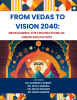
From Vedas to Vision 2040: Reimagining the Foundations of Indian Education
Synopsis
This volume, From Vedas to Vision 2040: Reimagining the Foundations of Indian Education, offers a panoramic journey through India’s educational heritage and its unfolding future. At once historical survey, policy analysis, and forward-looking roadmap, it is organized into five thematic parts:
-
Defining “Indian Education”
– Establishes the book’s lens: an education system shaped by philosophy, community values, and evolving institutions rather than by geography alone.
– Sets out key questions about purpose, identity, and the interplay between tradition and innovation.
-
Ancient Ethos & Pedagogy
– Vedic Vision (Ch. 2): Explores aims and ethos in the Ṛg‐ and Sāma-Vedic texts cultivating wisdom, discipline, and societal harmony.
– Guru–Śiṣya Paramparā (Ch. 3): Examines the one-to-one mentorship model, its methods (recitation, debate, ritual), and role in character formation.
– Early Institutions (Ch. 4): Surveys financial support (royal patronage, community endowments) and governance structures of āśrama and śāla.
– Epic Pedagogy (Ch. 5): Distills lessons in ethics, leadership, and duty from narrative episodes in the Rāmāyaṇa and Mahābhārata.
-
Heterodox & Classical Centres
– Buddhist & Jain Learning (Ch. 6): Details philosophical frameworks and monastic curricula that emphasized logic, healing arts, and liberal discourse.
– Nalanda to Vallabhi (Ch. 7): Charts the rise, organization, and decline of pan-Asian universities, including administrative innovations and intellectual networks.
– Inter-Empire Continuities (Ch. 8): Traces how centres of learning adapted under successors to the Guptas and the socio-religious ferment on the eve of colonial contact.
-
Colonial Encounter & Nationalist Responses
– Macaulay to Wood (Ch. 9): Analyses British blueprints English-medium schools, grant-in-aid system, curricular shifts and their long-term impacts.
– Swadeshi Classrooms (Ch. 10): Profiles Indigenous schools, vernacular experiments, and early nationalist academies that sought to reclaim cultural agency.
-
Modern Policy & the Road to 2040
– Constitutional Promises (Ch. 11): Revisits Article 21A, the right to education, and the interplay of rights and duties in shaping public schooling.
– Commissions & Committees (Ch. 12): Chronicles landmark commissions (Kothari, Mudaliar, etc.), their recommendations, and resulting policy frameworks of the twentieth century.
– Universalization & Inclusion (Ch. 13): Evaluates flagship schemes UEE, RMSA, RTE 2009 and their outcomes in access, equity, and quality.
– NEP 2020 (Ch. 14): Unpacks the National Education Policy’s vision, structural reforms (multidisciplinary, autonomy), and implementation roadmaps.
– Toward 2040 (Ch. 15): Projects future needs in financing, governance, technology integration, and civic engagement to build a resilient, inclusive system by mid-century.
Key Themes
-
Continuity & Adaptation: How core values (holism, inquiry, community) persist even as structures transform.
-
Pluralism & Equity: The tension between centralized policy and localized needs, and efforts to widen access.
-
Tradition & Innovation: Dialogues between ancient pedagogies and modern methodologies, from oral recitation to digital classrooms.
-
Governance & Finance: Evolving models of support from gurukula patronage to public-private partnerships.
Who Should Read This Book?
-
Scholars of education history and policy
-
Policymakers and administrators charting future reforms
-
Teachers and teacher-educators seeking contextual grounding
-
Civil society actors and citizens interested in the evolving social contract of learning
By weaving narrative history with critical policy analysis and future-oriented recommendations, this book aims to inform and inspire the next generation of practitioners, thinkers, and citizens to co-create an Indian education system that honours its roots while embracing the challenges and opportunities of 2040.
Chapters
-
Framing the Foundations: What Do We Mean by “Indian Education”?
-
Light of the Vedas: Vision, Aims and Ethos of Vedic Education
-
Guru–Shishya Parampara and Pedagogy in the Vedic Era
-
Institutions, Finance and Governance in Early India
-
Education in the Epics: Pedagogic Lessons from the Ramayana & Mahabharata
-
Paths of Renunciation and Reason: Buddhist & Jain Educational Philosophies
-
Nalanda to Vallabhi: Iconic Centres of Learning and their Administration
-
Between Empires: Education from Post-Gupta to Pre-Colonial Times
-
Macaulay to Wood: Colonial Blueprints and the Westernization of Indian Schooling
-
Swadeshi Classrooms: Indigenous Interventions and Nationalist Experiments
-
Constitutional Promises: Values, Rights and Duties in Independent India
-
Commissions, Committees and Policies of the 20th Century
-
Universalization & Inclusion: UEE, RMSA, RTE 2009 in Practice
-
NEP 2020: Vision, Architecture and Roadmaps for Implementation
-
Toward 2040: Financing, Government and Citizenry for a Vibrant India
Downloads
References
Chapter 1. Framing the Foundations: What Do We Mean by “Indian Education”?
Altbach, P. G., & Kelly, G. P. (Eds.). (1978). Education and colonialism. Longman.
Mukherjee, R. (1997). The idea of Indian education: Cultural roots and colonial genesis. Sage Publications.
Srinivas, M. N. (1962). Social change in modern India. University of California Press.
Chapter 2. Light of the Vedas: Vision, Aims and Ethos of Vedic Education
Jamison, S. W., & Brereton, J. P. (Eds.). (2014). The Rig Veda: The earliest religious poetry of India (Vol. 1). Oxford University Press.
Mallory, J. P. (1989). In search of the Indo-Europeans: Language, archaeology and myth. Thames & Hudson.
Witzel, M. (1997). The development of the Vedic canon and its schools: The social and political milieu. In W. McCormack (Ed.), The Indo-Aryans of ancient South Asia (pp. 257–345). Walter de Gruyter.
Chapter 3. Guru–Śiṣya Paramparā and Pedagogy in the Vedic Era
Olivelle, P. (1996). The Āśrama system: The history and hermeneutics of a religious in stitution. Oxford University Press.
Sharma, R. S. (2005). India’s ancient past (2nd ed.). Oxford University Press.
Varadachari, T. S. (1986). Teachings of the Vedas and Vedānta. Bharatiya Vidya Bhavan.
Chapter 4. Institutions, Finance and Governance in Early India
Kangle, R. P. (1965). The Kautilya Arthashastra (Vol. 1–2, B. S. Pagdi, Trans.). University of Bombay.
Mookerji, R. K. (1957). Studies in Indian economic and social history. Asia Publishing House.
Raychaudhuri, T. (1953). Political history of ancient India: From the accession of Parikshit to the extinction of the Gupta dynasty. University of Calcutta.
Chapter 5. Education in the Epics: Pedagogic Lessons from the Rāmāyaṇa & Mahābhārata
Goldman, R. P. (1984). The Rāmāyaṇa of Vālmīki: An epic of ancient India (Vol. 1). Princeton University Press.
Lerner, G., & Oberlies, T. (Eds.). (2002). Encyclopedia of Hinduism. Routledge.
van Buitenen, J. A. B. (1973). The Mahābhārata (Vol. 1). University of Chicago Press.
Chapter 6. Paths of Renunciation and Reason: Buddhist & Jain Educational Philosophies
Carrithers, M., Collins, S., & Lukes, S. (1983). The category of the person: Anthropology, philosophy, history. Cambridge University Press.
Fohr, H. (2006). Jaina studies. Pali Text Society.
Gethin, R. (1998). The foundations of Buddhism. Oxford University Press.
Chapter 7. Nalanda to Vallabhi: Iconic Centres of Learning and their Administration
Dhaky, M. A., Meister, M. W., & Wheeler, B. (Eds.). (1983). The traditions of Indian architecture: Continuity, change, and regionalism since 1985. University of Florida Press.
Hazra, R. C. (1935). Studies in the Tantras and scriptures of the Pāñcarātra. University of Calcutta.
Sen, T. (2003). Buddhist monasteries in South Asia: A survey. Oxford University Press.
Chapter 8. Between Empires: Education from Post-Gupta to Pre-Colonial Times
Chattopadhyaya, B. D. (1994). Studying early India: Archaeology, texts and historical issues. Orient Blackswan.
Kulke, H., & Rothermund, D. (1998). A history of India (3rd ed.). Routledge.
Sastri, K. A. N. (1952). A history of South India. Oxford University Press.
Chapter 9. Macaulay to Wood: Colonial Blueprints and the Westernization of Indian Schooling
Cole, J. R. I. (1965). Colonialism and its forms of knowledge: The British in India. Princeton University Press.
Macaulay, T. B. (1835). Minute on Indian education. (Reprinted in A. Duff, Historical views of Indian education, 1977). Sahitya Akademi.
Wood, J. (1854). Education despatch (Wood’s Despatch). Government of India.
Chapter 10. Swadeshi Classrooms: Indigenous Interventions and Nationalist Experiments
Chatterjee, P. (1993). The nation and its fragments: Colonial and postcolonial histories. Princeton University Press.
Gandhi, M. K. (1937). Hind Swaraj. Navajivan Publishing House.
Tagore, R. (1917). The problem of education. Macmillan.
Chapter 11. Constitutional Promises: Values, Rights and Duties in Independent India
Government of India. (1950). Constitution of India. Ministry of Law and Justice.
Jain, M. P. (2014). Indian constitutional law (7th ed.). LexisNexis Butterworths.
Ministry of Law and Justice. (2002). Right of Children to Free and Compulsory Education Act, 2009. Government of India.
Chapter 12. Commissions, Committees and Policies of the 20th Century
Ministry of Education. (1966). Report of the Education Commission (1964–66) (Kothari Commission). Government of India.
Ministry of Education. (1952–53). Report of the Secondary Education Commission (Mudaliar Commission). Government of India.
National Council of Educational Research and Training. (2005). National Curriculum Framework. NCERT.
Chapter 13. Universalization & Inclusion: UEE, RMSA, RTE 2009 in Practice
Ministry of Human Resource Development. (2009). Right to Education Act, 2009. Government of India.
Planning Commission. (2012). Draft approach to the Twelfth Five Year Plan (2012–17): Inclusive and sustainable growth. Government of India.
World Bank. (2018). World development report 2018: Learning to realize education’s promise. World Bank Publications.
Chapter 14. NEP 2020: Vision, Architecture and Roadmaps for Implementation
Ministry of Education. (2020). National Education Policy 2020. Government of India.
Tilak, J. B. G. (2021). Implementation challenges of NEP 2020 in India. Economic and Political Weekly, 56(36), 23–28.
UNESCO. (2021). Education for sustainable development goals: Learning objectives. UNESCO Publishing.
Chapter 15. Toward 2040: Financing, Governance, and Citizenry for a Vibrant India
Lahiri, S., & Sharma, R. (2022). Financing higher education in India: Models and strategies. Journal of Educational Finance, 47(2), 145–164.
National Institute of Educational Planning and Administration. (2023). Governance frameworks for public universities in India. NIEPA.
Tilak, J. B. G. (2023). Higher education in India: Retrospect and prospects. Higher Education for the Future, 10(1), 5–30.
Published
Data Availability Statement
This edited volume is conceptual and scholarly in nature. It does not involve the generation of new empirical datasets. All analyses, discussions, and case examples presented in the chapters are derived from previously published research, publicly available resources, and the contributing authors’ theoretical perspectives. Any data referenced within individual chapters are available through the original cited sources. No new datasets were created or analyzed for this publication; therefore, no additional data are available.
License

This work is licensed under a Creative Commons Attribution 4.0 International License.
Creative Commons Attribution 4.0 International (CC BY 4.0) — License Terms
The Creative Commons Attribution 4.0 International License (CC BY 4.0) is one of the most permissive open licenses. It allows others to use, share, and build upon a work for any purpose—including commercial use—provided that proper credit is given to the original creator.
1. Permissions Granted
Under CC BY 4.0, anyone may:
a) Share
Copy and redistribute the material in any medium or format (print, digital, audio, video, etc.).
b) Adapt
Remix, transform, translate, or build upon the material.
c) Commercial Use Allowed
The work may be used for commercial purposes, including resale, inclusion in paid products, or monetized distribution.
d) No Additional Permission Required
Users do not need to contact the author for permission, as long as they follow the license conditions.
2. Attribution Requirements (Core Condition)
Users must give appropriate credit to the original creator. Attribution should include:
- Name of the author/creator
- Title of the work (if available)
- Source (publisher, website, or platform)
- Link to the original work (if online)
- Link to the CC BY 4.0 license
- Indication of any changes made
Example Attribution:
“Title of Work” by Author Name is licensed under CC BY 4.0.
Adapted from the original available at [URL].
3. Indicating Changes
If the material is modified, translated, shortened, or otherwise altered, users must clearly state that changes were made.
Examples:
- “Translated from the original”
- “Adapted from…”
- “Modified version of…”
4. No Additional Restrictions
Users may not:
- Apply legal terms or technological measures (such as DRM) that restrict others from exercising the license rights
- Impose new licensing conditions that contradict CC BY 4.0
5. Rights Not Covered by the License
CC BY 4.0 does not automatically grant:
- Patent rights
- Trademark rights
- Privacy or publicity rights
- Moral rights where they cannot be waived by law
Users must ensure compliance with these separately.
6. Disclaimer of Warranties
The material is provided “as-is.”
The licensor (author/publisher) gives no guarantees regarding accuracy, suitability, or fitness for any purpose.
7. Termination and Reinstatement
- The license remains valid as long as the terms are followed.
- If a user violates the terms (e.g., fails to attribute), the rights terminate automatically.
- Rights may be reinstated if the violation is corrected within 30 days of discovery.
8. International Scope
CC BY 4.0 is designed to work worldwide and is not limited to any specific country’s copyright law.
Suggested Copyright Notice Using CC BY 4.0
© [Year] [Author Name].
This work is licensed under the Creative Commons Attribution 4.0 International License (CC BY 4.0).
To view a copy of this license, visit: https://creativecommons.org/licenses/by/4.0/
You are free to share and adapt this work for any purpose, even commercially, provided that appropriate credit is given.