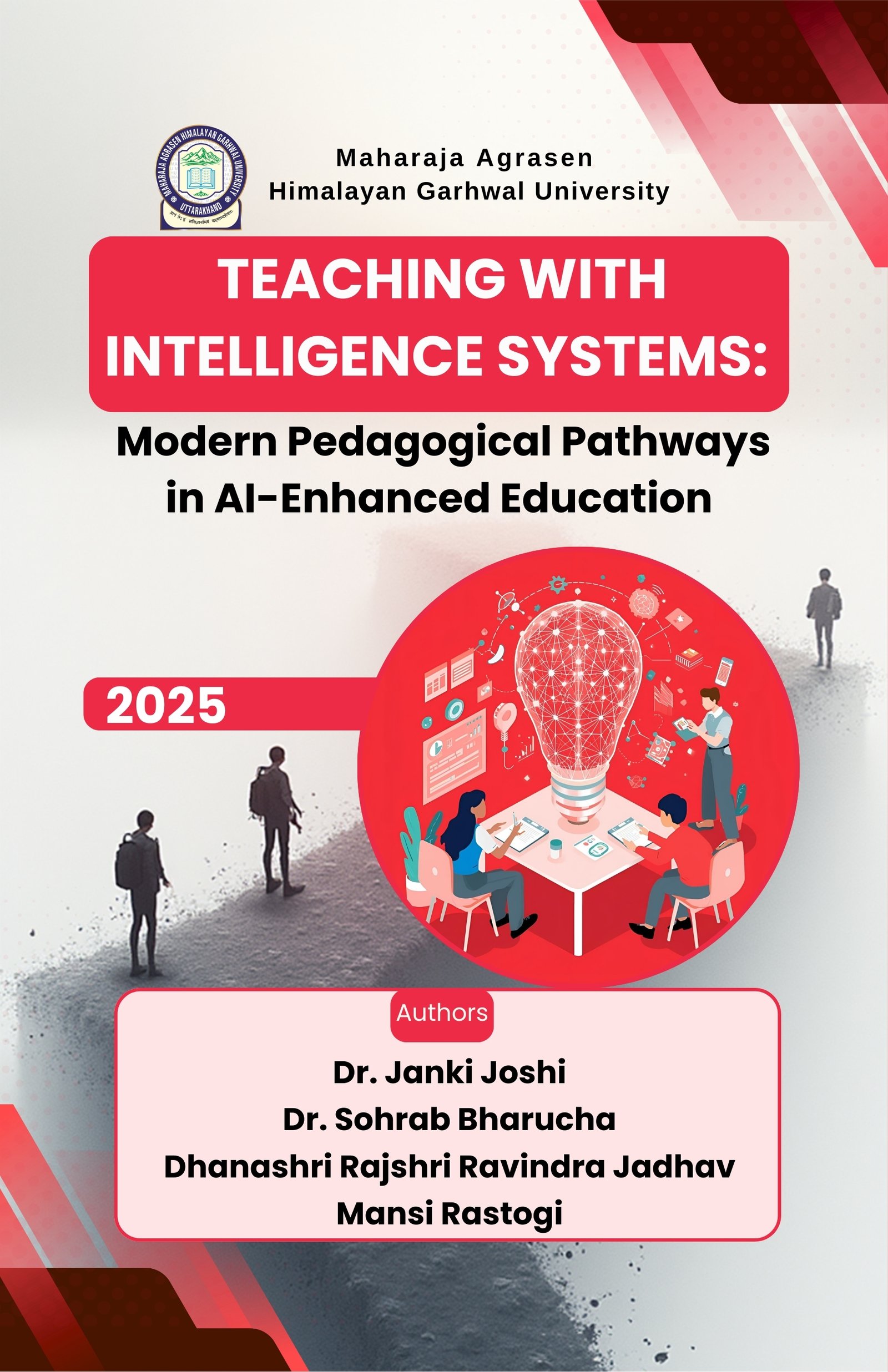
Teaching with Intelligent Systems: Modern Pedagogical Pathways in AI-Enhanced Education
Keywords:
Teaching, Intelligence, Artificial Intelligence, educationSynopsis
In an era where technology is evolving at an unprecedented rate, the integration of Artificial Intelligence (AI) into education is no longer a distant possibility but a present-day reality. " Teaching with Intelligent Systems: Modern Pedagogical Pathways in AI-Enhanced Education " explores the transformative potential of AI in shaping the future of education. This book delves into the ways in which AI can revolutionize the teaching and learning experience, offering new pathways for personalized education, assessment, and teacher efficiency.
The goal of this book is not just to explore the technological aspects of AI, but to understand its pedagogical implications. As AI systems become more embedded in educational practices, educators, students, and policymakers must consider not only how these technologies can improve educational outcomes but also the ethical, social, and cultural considerations that arise with their use.
The chapters within this book are designed to offer a comprehensive view of AI in education. Beginning with an introduction to AI technologies and their role in education, we move through the evolution of pedagogy in the age of AI, highlighting how teaching practices are being reshaped by AI's ability to personalize learning. We also explore the challenges AI presents, particularly in terms of bias, privacy, and accessibility, as well as the evolving role of educators in an AI-enhanced classroom.
As we look toward the future, we envision a world where AI helps to democratize education, providing personalized, accessible learning experiences for students across the globe. However, this vision is contingent upon our ability to ethically and responsibly implement AI systems in educational settings. It is crucial to consider how AI can serve as a tool for equity, rather than exacerbating existing educational inequalities. This book is intended for educators, researchers, technology developers, and anyone interested in the intersection of AI and education. Whether you are a teacher seeking to understand how AI can enhance your classroom or a researcher exploring the broader implications of AI in education, this book offers valuable insights into the pedagogical pathways that AI is paving for the future.
Chapters
-
Introduction to AI in Education
-
The Evolution of Pedagogy in the Age of AI
-
Personalized Learning with AI
-
AI in Assessments and Evaluations
-
Enhancing Teacher Efficiency with AI Tools
-
AI for Collaborative Learning and Communication
-
Ethical and Social Considerations in AI-Driven Education
-
AI and the Future of Teaching Careers
-
Pedagogical Pathways and Innovations in AI-Driven Education
Downloads
References
Chapter 1: Introduction to AI in Education
1. Baker, R. S. J. d., & Siemens, G. (2014). Educational data mining and learning analytics. Learning Analytics, 61–71. https://doi.org/10.1007/978-1-4614-6435-8_6
2. Albrecht, A., & Rautenbach, C. (2020). Artificial Intelligence in Education: A Review of Applications and Challenges. Journal of Educational Technology Systems, 49(4), 441–455. https://doi.org/10.1177/0047239519899360
3. Luckin, R. (2017). Enhancing Learning and Teaching with Technology: What the Research Says. UCL Institute of Education.
Chapter 2: The Evolution of Pedagogy in the Age of AI
1. Christensen, C. M., Horn, M. B., & Johnson, C. W. (2008). Disrupting Class: How Disruptive Innovation Will Change the Way the World Learns. McGraw-Hill.
2. Siemens, G. (2005). Connectivism: A learning theory for the digital age. International Journal of Instructional Technology and Distance Learning, 2(1). https://www.itdl.org/Journal/Jan_05/article01.htm
3. Dede, C. (2016). The Role of Digital Technologies in Deeper Learning. SRI International.
Chapter 3: Personalized Learning with AI
1. Heffernan, N. T., & Heffernan, C. L. (2014). Cognitive Tutor: A Case Study in Personalized Learning. Educational Testing Service.
2. Ng, S., & Yau, M. (2017). AI-driven Personalized Learning in K–12 Education. Computers & Education, 113, 101–111. https://doi.org/10.1016/j.compedu.2017.06.003
3. Popenici, S. A. D., & Kerr, S. (2017). Exploring the Impact of Artificial Intelligence on Teaching and Learning in Higher Education. Higher Education Research & Development, 36(1), 38–52. https://doi.org/10.1080/07294360.2017.1360236
Chapter 4: AI in Assessments and Evaluations
1. Beetham, H., & Sharpe, R. (Eds.). (2013). Rethinking Pedagogy for a Digital Age: Designing for 21st Century Learning. Routledge.
2. Holmes, W., Bialik, M., & Fadel, C. (2019). Artificial Intelligence in Education: Promises and Implications for Teaching and Learning. Centre for Curriculum Redesign.
3. Gikandi, J. W., Morrow, D., & Davis, N. E. (2011). Online Assessment: Methods, Challenges, and Opportunities. Journal of Distance Education, 26(1), 9-25.
Chapter 5: Enhancing Teacher Efficiency with AI Tools
1. Dede, C. (2014). The Role of Digital Technologies in Education. UNESCO.
2. Cope, B., & Kalantzis, M. (2015). Big Data and Education: An Overview of Digital Tools for Learning. Routledge.
3. Luckin, R., Holmes, W., Griffiths, M., & Forcier, L. B. (2016). Intelligence Unleashed: An Argument for AI in Education. Pearson Education.
Chapter 6: AI for Collaborative Learning and Communication
1. Woolf, B. P., & Lane, H. C. (2013). The Role of AI in Educational Technology. Handbook of Research on Educational Communications and Technology, 125-138. https://doi.org/10.1007/978-1-4614-6435-8_9
2. Slavin, R. E. (2015). Cooperative Learning in Education: Theoretical and Practical Insights. Educational Psychologist, 50(4), 232-246.
3. Czerkawski, B. C., & Lyman, E. (2016). AI in Collaborative Learning Systems: The Future of Peer-to-Peer Education. Educational Technology Research and Development, 64(4), 687-704.
Chapter 7: Ethical and Social Considerations in AI-Driven Education
1. O'Neil, C. (2016). Weapons of Math Destruction: How Big Data Increases Inequality and Threatens Democracy. Crown Publishing Group.
2. Coeckelbergh, M. (2020). AI Ethics: Ethical Perspectives on Artificial Intelligence. Springer.
3. Fraga, L., & Franklin, L. (2019). Bias and Fairness in AI: Exploring the Ethical and Social Challenges. AI & Society, 34(4), 723-735. https://doi.org/10.1007/s00146-019-00900-6
Chapter 8: AI and the Future of Teaching Careers
1. Brynjolfsson, E., & McAfee, A. (2014). The Second Machine Age: Work, Progress, and Prosperity in a Time of Brilliant Technologies. W.W. Norton & Company.
2. Chou, P. N., & Wang, S. K. (2021). AI and the Future of Teaching: Changing Roles for Educators in a Tech-Driven World. Springer.
3. Zhang, K., & Xiang, Y. (2019). The Role of AI in Teacher Professional Development and Lifelong Learning. Educational Technology and Society, 22(4), 102–113.
Chapter 9: Pedagogical Pathways and Innovations in AI-Driven Education
1. Koller, D., & Adams, R. (2016). The Future of Education in the Age of AI: Revolutionizing Pedagogy with Technology. Harvard University Press.
2. Christensen, C. M., & Horn, M. B. (2010). Disrupting Class: How Disruptive Innovation Will Change the Way the World Learns. McGraw-Hill.
3. Weller, M. (2018). The Digital University: A Dialogue and Manifesto. Routledge.
Published
License

This work is licensed under a Creative Commons Attribution 4.0 International License.
Creative Commons Attribution 4.0 International (CC BY 4.0) — License Terms
The Creative Commons Attribution 4.0 International License (CC BY 4.0) is one of the most permissive open licenses. It allows others to use, share, and build upon a work for any purpose—including commercial use—provided that proper credit is given to the original creator.
1. Permissions Granted
Under CC BY 4.0, anyone may:
a) Share
Copy and redistribute the material in any medium or format (print, digital, audio, video, etc.).
b) Adapt
Remix, transform, translate, or build upon the material.
c) Commercial Use Allowed
The work may be used for commercial purposes, including resale, inclusion in paid products, or monetized distribution.
d) No Additional Permission Required
Users do not need to contact the author for permission, as long as they follow the license conditions.
2. Attribution Requirements (Core Condition)
Users must give appropriate credit to the original creator. Attribution should include:
- Name of the author/creator
- Title of the work (if available)
- Source (publisher, website, or platform)
- Link to the original work (if online)
- Link to the CC BY 4.0 license
- Indication of any changes made
Example Attribution:
“Title of Work” by Author Name is licensed under CC BY 4.0.
Adapted from the original available at [URL].
3. Indicating Changes
If the material is modified, translated, shortened, or otherwise altered, users must clearly state that changes were made.
Examples:
- “Translated from the original”
- “Adapted from…”
- “Modified version of…”
4. No Additional Restrictions
Users may not:
- Apply legal terms or technological measures (such as DRM) that restrict others from exercising the license rights
- Impose new licensing conditions that contradict CC BY 4.0
5. Rights Not Covered by the License
CC BY 4.0 does not automatically grant:
- Patent rights
- Trademark rights
- Privacy or publicity rights
- Moral rights where they cannot be waived by law
Users must ensure compliance with these separately.
6. Disclaimer of Warranties
The material is provided “as-is.”
The licensor (author/publisher) gives no guarantees regarding accuracy, suitability, or fitness for any purpose.
7. Termination and Reinstatement
- The license remains valid as long as the terms are followed.
- If a user violates the terms (e.g., fails to attribute), the rights terminate automatically.
- Rights may be reinstated if the violation is corrected within 30 days of discovery.
8. International Scope
CC BY 4.0 is designed to work worldwide and is not limited to any specific country’s copyright law.
Suggested Copyright Notice Using CC BY 4.0
© [Year] [Author Name].
This work is licensed under the Creative Commons Attribution 4.0 International License (CC BY 4.0).
To view a copy of this license, visit: https://creativecommons.org/licenses/by/4.0/
You are free to share and adapt this work for any purpose, even commercially, provided that appropriate credit is given.









