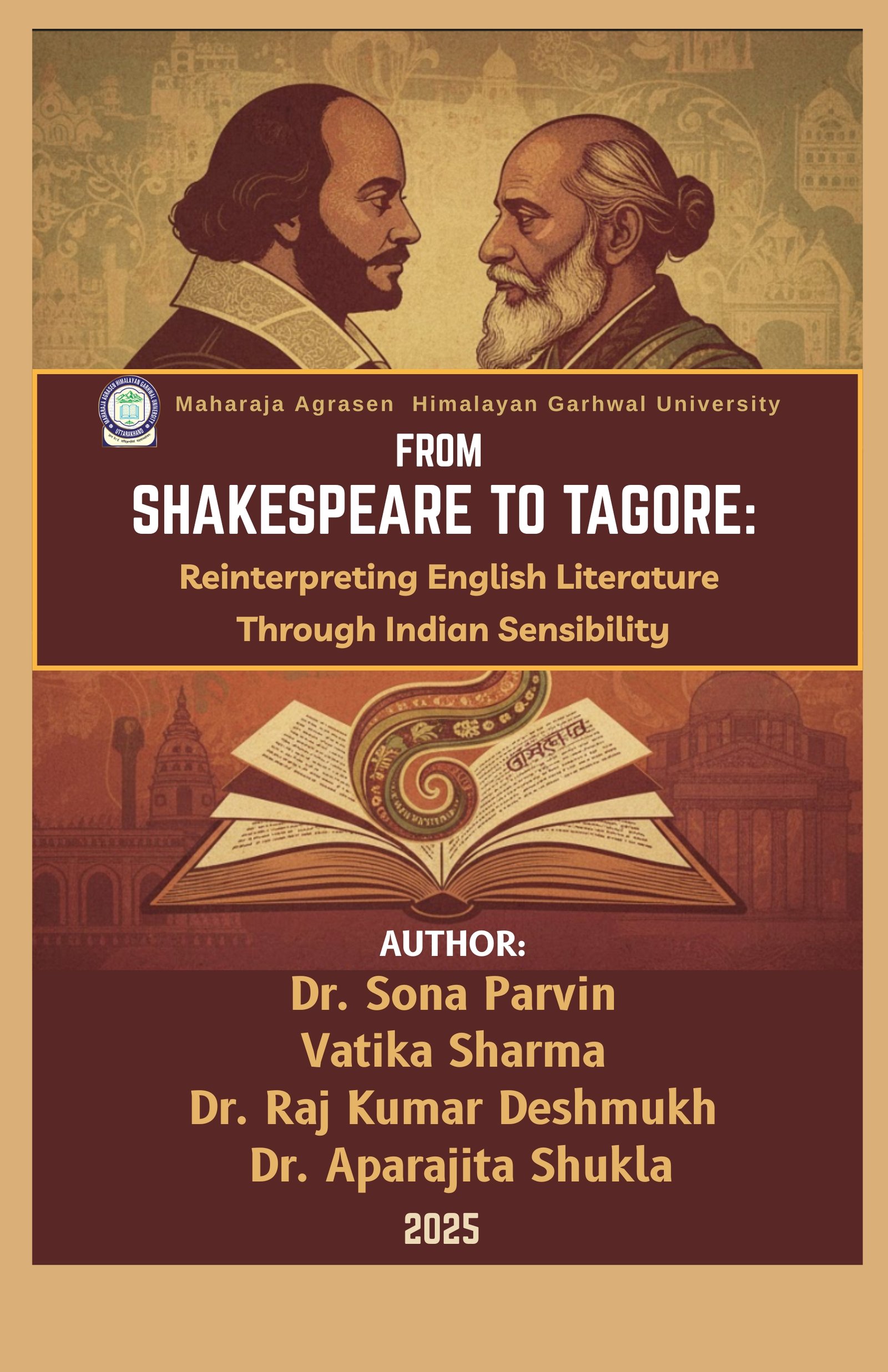
From Shakespeare to Tagore: Reinterpreting English Literature Through Indian Sensibility
Synopsis
English literature has traveled far beyond the borders of its origin, finding new meanings and emotional textures in diverse cultures across the world. Nowhere has this journey been as transformative and creatively fertile as in India-a land where storytelling traditions are ancient, aesthetics is deeply philosophical, and cultural exchange is woven into everyday life. This book, From Shakespeare to Tagore: Reinterpreting English Literature Through Indian Sensibility, emerges from a desire to explore that remarkable encounter.
The chapters that follow examine how Indian readers, writers, translators, performers, and thinkers have engaged with English literary texts-not as passive recipients but as active interpreters. From Shakespeare being staged through Kathakali gestures to Tagore reshaping Western Romanticism with Upanishadic depth, from the colonial classroom to modern global literature, India has consistently infused English texts with its own individuality and worldview.
This book does not seek to trace a linear history. Instead, it offers a tapestry of cultural interactions-adaptations, translations, reinterpretations, and hybrid forms of creativity. It highlights how rasa theory enriches the reading of Shakespeare, how Indian English novelists blend global narrative techniques with local realities, and how new digital platforms are globalizing Indian voices in unprecedented ways.
Above all, the book celebrates a simple truth: literature thrives when it is shared, exchanged, and reimagined. English literature in India is not a derivative tradition; it is a dialogue-sometimes harmonious, sometimes critical, always evolving. Through this exploration, I hope readers will discover how Indian sensibilities have not only reshaped English texts but also expanded the very horizons of world literature.
This work is intended for students, teachers, researchers, and all lovers of literature who believe that cultural intersections create new forms of beauty. May it inspire fresh interpretations and new pathways of understanding in the ever-growing landscape of global literary exchange.
Chapters
-
The Meeting of Two Worlds: English Canon Through an Indian Lens
-
Shakespeare in India: Adaptation, Translation, and Cultural Transformation
-
Colonial Encounters: Rise of English Literary Education in India
-
Tagore’s Dialogue with the West: A Poet Between Two Civilizations
-
Comparative Aesthetics: Rasa Theory Meets Western Poetics
-
Indian Translators as Cultural Interpreters
-
Reinventing Characters: Indian Reimagining’s of English Literary Icons
-
The Indian English Novel: A Literary Bridge Across Continents
-
Towards a New Global Literature: Fusion, Hybridity, and Future Pathways
Downloads
References
Chapter 1- The Meeting of Two Worlds: English Canon Through an Indian Lens
1. Viswanathan, Gauri. Masks of Conquest: Literary Study and British Rule in India. Oxford University Press, 1989.
2. Said, Edward W. Culture and Imperialism. Knopf, 1993.
3. Mukherjee, Meenakshi. The Perishable Empire: Essays on Indian Writing in English. Oxford University Press, 2000.
4. Paranjape, Makarand. In Diaspora: Representations of India in Contemporary Fiction. India log Publications, 2001.
Chapter 2 -Shakespeare in India: Adaptation, Translation, and Cultural Transformation
1. Dharwadker, Aparna Bhargava (Ed.). Shakespeare in India. Pearson Longman, 2005.
2. Trivedi, Poonam. “Shakespeare in India: The Performing Arts.” Shakespeare Survey, vol. 52, 1999.
3. Orsini, Francesca. The Hindi Public Sphere. Oxford University Press, 2002.
4. Desai, Rakesh H. Shakespeare on the Indian Stage. DK Publishers, 1980.
Chapter 3 - Colonial Encounters: Rise of English Literary Education in India
1. Sharp, Henry. Selections from Educational Records, 1781–1839. Government of India Press, 1920.
2. Macaulay, Thomas B. Minute on Indian Education. Government of India, 1835.
3. Kopf, David. British Orientalism and the Bengal Renaissance. University of California Press, 1969.
4. King, Christopher R. One Language, Two Scripts: The Hindi Movement in Nineteenth Century North India. Oxford University Press, 1994.
Chapter 4 - Tagore’s Dialogue with the West: A Poet Between Two Civilizations
1. Sen, Amartya. Tagore and His India. Nobel Lecture Series, 1997.
2. Dutta, Krishna & Robinson, Andrew. Rabindranath Tagore: The Myriad-Minded Man. St. Martin’s Press, 1996.
3. Radice, William. Songs of Tagore. Penguin, 2011.
4. Hogan, Patrick Colm. “Tagore and the West.” Comparative Literature Studies, 2004.
Chapter 5 -Comparative Aesthetics: Rasa Theory Meets Western Poetics
1. Bharata Muni. Nāṭyaśāstra. Translated by Manomohan Ghosh. Asiatic Society, 1950.
2. Abhinavagupta. The Abhinavabhāratī (Commentary on Nāṭyaśāstra).
3. De, S.K. Sanskrit Poetics as a Study of Aesthetic. University of Calcutta, 1921.
4. Wimsatt, W. K., & Brooks, Cleanth. Literary Criticism: A Short History. Knopf, 1957.
Chapter 6 - Indian Translators as Cultural Interpreters
1. Bassnett, Susan. Translation Studies. Routledge, 2002.
2. Trivedi, Harish. “Translating Culture vs. Cultural Translation.” Asia Pacific Translation Studies, 2005.
3. Tagore, Rabindranath. Gitanjali (Self-translated English version). Macmillan, 1913.
4. Aurobindo, Sri. Translations of Classical Sanskrit Texts. Sri Aurobindo Ashram Press.
Chapter 7 - Reinventing Characters: Indian Reimagining’s of English Literary Icons
1. Lal, Ananda. The Oxford Companion to Indian Theatre. Oxford University Press, 2004.
2. Bharucha, Rustom. Theatre and the World: Performance and the Politics of Culture. Routledge, 1993.
3. Bhardwaj, Vishal. Macbeth → Maqbool; Othello → Omkara; Hamlet → Haider (Film Adaptations).
4. Paul, Rajinder. “Indianizing Shakespeare: Cultural Appropriation in Indian Theatre.” Indian Literature, Sahitya Akademi, 2009
Chapter 8 - The Indian English Novel: A Literary Bridge Across Continents
1. Naik, M.K. A History of Indian English Literature. Sahitya Akademi, 1982.
2. Anand, Mulk Raj. Untouchable. Penguin, 1935.
3. Narayan, R.K. Malgudi Days. Indian Thought Publications, 1943.
4. Rushdie, Salman. Midnight’s Children. Jonathan Cape, 1981.
Chapter 9 - Towards a New Global Literature: Fusion, Hybridity, and Future Pathways
1. Appadurai, Arjun. Modernity at Large: Cultural Dimensions of Globalization. University of Minnesota Press, 1996.
2. Ghosh, Amitav. The Great Derangement: Climate Change and the Unthinkable. University of Chicago Press, 2016.
3. Desai, Anita. Clear Light of Day. Harper & Row, 1980.
4. Adichie, Chimamanda Ngozi. Half of a Yellow Sun. Knopf, 2006.
Downloads
Published
License

This work is licensed under a Creative Commons Attribution 4.0 International License.
Creative Commons Attribution 4.0 International (CC BY 4.0) — License Terms
The Creative Commons Attribution 4.0 International License (CC BY 4.0) is one of the most permissive open licenses. It allows others to use, share, and build upon a work for any purpose—including commercial use—provided that proper credit is given to the original creator.
1. Permissions Granted
Under CC BY 4.0, anyone may:
a) Share
Copy and redistribute the material in any medium or format (print, digital, audio, video, etc.).
b) Adapt
Remix, transform, translate, or build upon the material.
c) Commercial Use Allowed
The work may be used for commercial purposes, including resale, inclusion in paid products, or monetized distribution.
d) No Additional Permission Required
Users do not need to contact the author for permission, as long as they follow the license conditions.
2. Attribution Requirements (Core Condition)
Users must give appropriate credit to the original creator. Attribution should include:
- Name of the author/creator
- Title of the work (if available)
- Source (publisher, website, or platform)
- Link to the original work (if online)
- Link to the CC BY 4.0 license
- Indication of any changes made
Example Attribution:
“Title of Work” by Author Name is licensed under CC BY 4.0.
Adapted from the original available at [URL].
3. Indicating Changes
If the material is modified, translated, shortened, or otherwise altered, users must clearly state that changes were made.
Examples:
- “Translated from the original”
- “Adapted from…”
- “Modified version of…”
4. No Additional Restrictions
Users may not:
- Apply legal terms or technological measures (such as DRM) that restrict others from exercising the license rights
- Impose new licensing conditions that contradict CC BY 4.0
5. Rights Not Covered by the License
CC BY 4.0 does not automatically grant:
- Patent rights
- Trademark rights
- Privacy or publicity rights
- Moral rights where they cannot be waived by law
Users must ensure compliance with these separately.
6. Disclaimer of Warranties
The material is provided “as-is.”
The licensor (author/publisher) gives no guarantees regarding accuracy, suitability, or fitness for any purpose.
7. Termination and Reinstatement
- The license remains valid as long as the terms are followed.
- If a user violates the terms (e.g., fails to attribute), the rights terminate automatically.
- Rights may be reinstated if the violation is corrected within 30 days of discovery.
8. International Scope
CC BY 4.0 is designed to work worldwide and is not limited to any specific country’s copyright law.
Suggested Copyright Notice Using CC BY 4.0
© [Year] [Author Name].
This work is licensed under the Creative Commons Attribution 4.0 International License (CC BY 4.0).
To view a copy of this license, visit: https://creativecommons.org/licenses/by/4.0/
You are free to share and adapt this work for any purpose, even commercially, provided that appropriate credit is given.









