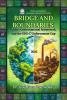
Bridge & Boundaries: India’s Environmental Framework and the SDG-17 Enforcement Gap
Synopsis
Environmental protection in India stands at a critical crossroads. Over the past few decades, the country has developed an extensive legal and institutional framework aimed at safeguarding its forests, water bodies, biodiversity, and climate systems. At the same time, India has emerged as a committed participant in global sustainability efforts, aligning itself with international agreements and the United Nations Sustainable Development Goals. Yet, despite these formal commitments and policy ambitions, environmental degradation continues to intensify across regions. This book is written at this moment of tension-between intent and impact, commitment and compliance.
Bridge & Boundaries: India’s Environmental Framework and the SDG-17 Enforcement Gap seek to explore this paradox. Rather than questioning the absence of environmental laws or partnerships, the book examines why strong frameworks often fail to deliver consistent results on the ground. It argues that the central challenge is not policy scarcity but enforcement weakness-shaped by institutional fragmentation, capacity constraints, uneven accountability, and the complex political economy of development.
The book places SDG-17, Partnerships for the Goals, at the centre of this analysis. SDG-17 is frequently celebrated as the connective tissue of the 2030 Agenda, emphasizing collaboration across governments, private sector actors, civil society, and international institutions. However, partnerships alone do not guarantee outcomes. This work critically examines how SDG-17 functions in the Indian environmental context-both as a bridge that enables cooperation and as a boundary that reveals the limits of voluntary, non-binding mechanisms when enforcement systems are weak.
This book adopts an interdisciplinary approach, drawing from environmental law, public policy, governance studies, climate science, and development economics. It combines legal analysis with policy evaluation, institutional critique, and real-world case studies to present a holistic understanding of India’s environmental governance landscape. Special attention is given to climate change, environmental justice, technological innovation, and the role of communities-areas where enforcement gaps have profound social and ecological consequences.
Chapters
-
Introduction to India’s Environmental Framework
-
The Evolution of India’s Environmental Policies
-
Understanding SDG-17 – Partnerships for Sustainable Development
-
The Enforcement Gap - Institutional and Legal Barriers
-
Bridging the Gap - Strengthening India’s Environmental Partnerships
-
The Role of Technology and Innovation in Environmental Governance
-
Climate Change and India - A Call for Urgent Action
-
Environmental Justice - Ensuring Equity in Environmental Policies
-
The Future of India’s Environmental Governance - Policy Reforms and Innovations
Downloads
References
Chapter 1: Introduction to India’s Environmental Framework
1. Ministry of Environment, Forest and Climate Change (MoEFCC).
India: State of Forest Report. Government of India.
https://fsi.nic.in/forest-report
2. Government of India.
The Constitution of India (Articles 48A and 51A).
https://legislative.gov.in/constitution-of-india
Chapter 2: The Evolution of India’s Environmental Policies
1. Government of India.
The Environment (Protection) Act, 1986.
https://legislative.gov.in/actsofparliamentfromtheyear/environment-protection-act-1986
2. Ministry of Environment, Forest and Climate Change.
National Action Plan on Climate Change (NAPCC).
https://moef.gov.in/en/national-action-plan-on-climate-change/
Chapter 3: Understanding SDG-17 - Partnerships for Sustainable Development
1. United Nations.
SDG 17: Partnerships for the Goals.
https://sdgs.un.org/goals/goal17
2. Sachs, J. D., Schmidt-Traub, G., Kroll, C. (2019).
Sustainable Development Report. Bertelsmann Stiftung. https://www.sdgindex.org/
Chapter 4: The Enforcement Gap - Institutional and Legal Barriers
1. National Green Tribunal (NGT). Judgments and Orders. https://greentribunal.gov.in
2. Comptroller and Auditor General of India (CAG).
Performance Audit on Environmental Regulation.
Chapter 5: Bridging the Gap - Strengthening India’s Environmental Partnerships
1. UNDP India. Partnerships for Sustainable Development in India. https://www.undp.org/india
2. Ministry of Statistics and Programme Implementation (MoSPI). SDG India Index Reports.
https://www.niti.gov.in/sdg-india-index
Chapter 6: The Role of Technology and Innovation in Environmental Governance
1. Central Pollution Control Board (CPCB).
Continuous mission Monitoring Systems (CEMS).
2. World Economic Forum.
Harnessing Technology for Environmental Governance. https://www.weforum.org
Chapter 7: Climate Change and India - A Call for Urgent Action
1. Intergovernmental Panel on Climate Change (IPCC).
Sixth Assessment Report (AR6). https://www.ipcc.ch
2. Government of India.
India’s Updated Nationally Determined Contributions (NDC). https://unfccc.int/NDCREG
Chapter 8: Environmental Justice - Ensuring Equity in Environmental Policies
1. United Nations Environment Programme (UNEP).
Environmental Justice and Human Rights.
2. National Commission for Scheduled Tribes (NCST).
Reports on Tribal Displacement and Mining.
Chapter 9: The Future of India’s Environmental Governance
1. World Bank.
India: Enhancing Environmental Sustainability.
https://www.worldbank.org/en/country/india
2. OECD.
Environmental Governance in Federal Systems.
Published
License

This work is licensed under a Creative Commons Attribution 4.0 International License.
Creative Commons Attribution 4.0 International (CC BY 4.0) — License Terms
The Creative Commons Attribution 4.0 International License (CC BY 4.0) is one of the most permissive open licenses. It allows others to use, share, and build upon a work for any purpose—including commercial use—provided that proper credit is given to the original creator.
1. Permissions Granted
Under CC BY 4.0, anyone may:
a) Share
Copy and redistribute the material in any medium or format (print, digital, audio, video, etc.).
b) Adapt
Remix, transform, translate, or build upon the material.
c) Commercial Use Allowed
The work may be used for commercial purposes, including resale, inclusion in paid products, or monetized distribution.
d) No Additional Permission Required
Users do not need to contact the author for permission, as long as they follow the license conditions.
2. Attribution Requirements (Core Condition)
Users must give appropriate credit to the original creator. Attribution should include:
- Name of the author/creator
- Title of the work (if available)
- Source (publisher, website, or platform)
- Link to the original work (if online)
- Link to the CC BY 4.0 license
- Indication of any changes made
Example Attribution:
“Title of Work” by Author Name is licensed under CC BY 4.0.
Adapted from the original available at [URL].
3. Indicating Changes
If the material is modified, translated, shortened, or otherwise altered, users must clearly state that changes were made.
Examples:
- “Translated from the original”
- “Adapted from…”
- “Modified version of…”
4. No Additional Restrictions
Users may not:
- Apply legal terms or technological measures (such as DRM) that restrict others from exercising the license rights
- Impose new licensing conditions that contradict CC BY 4.0
5. Rights Not Covered by the License
CC BY 4.0 does not automatically grant:
- Patent rights
- Trademark rights
- Privacy or publicity rights
- Moral rights where they cannot be waived by law
Users must ensure compliance with these separately.
6. Disclaimer of Warranties
The material is provided “as-is.”
The licensor (author/publisher) gives no guarantees regarding accuracy, suitability, or fitness for any purpose.
7. Termination and Reinstatement
- The license remains valid as long as the terms are followed.
- If a user violates the terms (e.g., fails to attribute), the rights terminate automatically.
- Rights may be reinstated if the violation is corrected within 30 days of discovery.
8. International Scope
CC BY 4.0 is designed to work worldwide and is not limited to any specific country’s copyright law.
Suggested Copyright Notice Using CC BY 4.0
© [Year] [Author Name].
This work is licensed under the Creative Commons Attribution 4.0 International License (CC BY 4.0).
To view a copy of this license, visit: https://creativecommons.org/licenses/by/4.0/
You are free to share and adapt this work for any purpose, even commercially, provided that appropriate credit is given.









