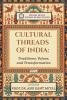
Cultural Threads of India: Traditions, Values, and Transformation
Synopsis
India is often described through fragments-religion, language, region, or history-yet its cultural reality cannot be fully understood through isolated categories. It is a civilization that has evolved through dialogue rather than dominance, continuity rather than rigidity, and adaptation rather than erasure. Cultural Threads of India: Traditions, Values, and Transformation is an attempt to present Indian culture as a living, breathing process shaped by time, people, and ideas.
This book does not treat culture as a static inheritance frozen in the past. Instead, it approaches Indian culture as an evolving framework of meanings, practices, and values that respond to historical disruptions, social change, and global influences while retaining a distinctive civilizational core. From ancient traditions and philosophical foundations to colonial encounters, modernization, and contemporary debates, the book traces how cultural continuity and transformation coexist rather than contradict one another.
The central motivation behind this work is to move beyond romanticized nostalgia and simplistic binaries such as “traditional versus modern.” Indian culture has never existed in isolation; it has grown through exchange, negotiation, and reinterpretation. Traditions survive not because they resist change, but because they possess the capacity to absorb new realities while preserving ethical and symbolic significance. This book highlights that resilience as a defining cultural strength.
Written in an accessible yet academically grounded manner, the book is intended for students, educators, researchers, and general readers interested in understanding India beyond surface-level representations. It integrates insights from history, sociology, philosophy, and cultural studies without privileging any single disciplinary lens. Case illustrations and examples are used to ground theory in lived experience, making culture visible in everyday life rather than abstract discourse alone.
At a time when cultural identities are often politicized or reduced to rigid narratives, this book seeks to restore nuance. It emphasizes pluralism, coexistence, and ethical reflection as essential elements of India’s cultural fabric. The hope is that readers will not only gain knowledge but also develop a deeper sensitivity toward the complexity and responsibility that come with engaging a civilization as diverse as India.
Ultimately, Cultural Threads of India is an invitation-to observe, to question, and to reflect on how traditions endure, how values guide social life, and how transformation shapes the future without severing ties with the past.
Chapters
-
India as a Living Civilization
-
Roots of Indian Traditions
-
Philosophy, Spirituality, and Value Systems
-
Language, Literature, and Artistic Expression
-
Social Structures and Community Life
-
Faiths, Pluralism, and Coexistence
-
Colonialism and Cultural Re-Negotiation
-
Modernization, Globalization, and Cultural Change
-
Continuity and Transformation in Contemporary India
Downloads
References
Chapter 1: India as a Living Civilization
1. Basham, A. L. (2004). The Wonder That Was India. Rupa Publications.
2. Thapar, R. (2004). Early India: From the Origins to AD 1300. University of California Press.
3. Huntington, S. P. (1996). The Clash of Civilizations and the Remaking of World Order. Simon & Schuster.
Chapter 2: Roots of Indian Traditions
1. Altekar, A. S. (1958). The Position of Women in Hindu Civilization. Motilal Banasiaks.
2. Srinivas, M. N. (1962). Caste in Modern India and Other Essays. Asia Publishing House.
3. Fuller, C. J. (2004). The Camphor Flame: Popular Hinduism and Society in India. Princeton University Press.
Chapter 3: Philosophy, Spirituality, and Value Systems
1. Radhakrishnan, S. (1951). Indian Philosophy (Vols. 1–2). George Allen & Unwin.
2. Deutsch, E., & Bontekoe, R. (Eds.). (1997). A Companion to World Philosophies. Blackwell.
3. Sharma, A. (2000). Classical Indian Philosophy. Oxford University Press.
Chapter 4: Language, Literature, and Artistic Expression
1. Pollock, S. (2006). The Language of the Gods in the World of Men. University of California Press.
2. Das, S. K. (2005). A History of Indian Literature. Sahitya Akademi.
3. Coomaraswamy, A. K. (1956). The Transformation of Nature in Art. Dover Publications.
Chapter 5: Social Structures and Community Life
1. Dumont, L. (1980). Homo Hierarchicus: The Caste System and Its Implications. University of Chicago Press.
2. Béteille, A. (1992). Society and Politics in India. Oxford University Press.
3. Uberoi, P. (2006). Freedom and Destiny: Gender, Family, and Popular Culture in India. Oxford University Press.
Chapter 6: Faiths, Pluralism, and Coexistence
1. Panikkar, K. N. (1997). Culture, Ideology, Hegemony: Intellectuals and Social Consciousness in Colonial India. Tulika Books.
2. Nandy, A. (1998). The Politics of Secularism and the Recovery of Religious Tolerance. Oxford University Press.
3. Eaton, R. M. (2000). Essays on Islam and Indian History. Oxford University Press.
Chapter 7: Colonialism and Cultural Re-Negotiation
1. Chatterjee, P. (1993). The Nation and Its Fragments. Princeton University Press.
2. Guha, R. (1997). Dominance Without Hegemony. Harvard University Press.
3. Bayly, C. A. (1998). Origins of Nationality in South Asia. Oxford University Press.
Chapter 8: Modernization, Globalization, and Cultural Change
1. Appadurai, A. (1996). Modernity at Large: Cultural Dimensions of Globalization. University of Minnesota Press.
2. Giddens, A. (1991). Modernity and Self-Identity. Stanford University Press.
3. Fernandes, L. (2006). India’s New Middle Class. University of Minnesota Press.
Chapter 9: Continuity and Transformation in Contemporary India
1. Sen, A. (2017). Collective Choice and Social Welfare. Harvard University Press.
2. Jeffery, R., & Jeffery, P. (2012). Population, Gender and Politics. Cambridge University Press.
3. Deshpande, S. (2003). Contemporary India: A Sociological View. Penguin India.
Downloads
Published
License

This work is licensed under a Creative Commons Attribution 4.0 International License.
Creative Commons Attribution 4.0 International (CC BY 4.0) — License Terms
The Creative Commons Attribution 4.0 International License (CC BY 4.0) is one of the most permissive open licenses. It allows others to use, share, and build upon a work for any purpose—including commercial use—provided that proper credit is given to the original creator.
1. Permissions Granted
Under CC BY 4.0, anyone may:
a) Share
Copy and redistribute the material in any medium or format (print, digital, audio, video, etc.).
b) Adapt
Remix, transform, translate, or build upon the material.
c) Commercial Use Allowed
The work may be used for commercial purposes, including resale, inclusion in paid products, or monetized distribution.
d) No Additional Permission Required
Users do not need to contact the author for permission, as long as they follow the license conditions.
2. Attribution Requirements (Core Condition)
Users must give appropriate credit to the original creator. Attribution should include:
- Name of the author/creator
- Title of the work (if available)
- Source (publisher, website, or platform)
- Link to the original work (if online)
- Link to the CC BY 4.0 license
- Indication of any changes made
Example Attribution:
“Title of Work” by Author Name is licensed under CC BY 4.0.
Adapted from the original available at [URL].
3. Indicating Changes
If the material is modified, translated, shortened, or otherwise altered, users must clearly state that changes were made.
Examples:
- “Translated from the original”
- “Adapted from…”
- “Modified version of…”
4. No Additional Restrictions
Users may not:
- Apply legal terms or technological measures (such as DRM) that restrict others from exercising the license rights
- Impose new licensing conditions that contradict CC BY 4.0
5. Rights Not Covered by the License
CC BY 4.0 does not automatically grant:
- Patent rights
- Trademark rights
- Privacy or publicity rights
- Moral rights where they cannot be waived by law
Users must ensure compliance with these separately.
6. Disclaimer of Warranties
The material is provided “as-is.”
The licensor (author/publisher) gives no guarantees regarding accuracy, suitability, or fitness for any purpose.
7. Termination and Reinstatement
- The license remains valid as long as the terms are followed.
- If a user violates the terms (e.g., fails to attribute), the rights terminate automatically.
- Rights may be reinstated if the violation is corrected within 30 days of discovery.
8. International Scope
CC BY 4.0 is designed to work worldwide and is not limited to any specific country’s copyright law.
Suggested Copyright Notice Using CC BY 4.0
© [Year] [Author Name].
This work is licensed under the Creative Commons Attribution 4.0 International License (CC BY 4.0).
To view a copy of this license, visit: https://creativecommons.org/licenses/by/4.0/
You are free to share and adapt this work for any purpose, even commercially, provided that appropriate credit is given.