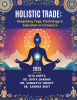
Holistic Trade: Integrating Yoga, Psychology & Education in Commerce
Synopsis
In the ever-evolving world of commerce, businesses are increasingly looking for innovative ways to stand out in a competitive landscape. Yet, as the complexities of global trade, market dynamics, and consumer behaviour grow, one truth remains timeless: success is not solely defined by profit margins but by the people, principles, and practices that drive business forward. This book, Holistic Trade: Integrating Yoga, Psychology & Education in Commerce, presents a unique approach to navigating these challenges by combining ancient wisdom with modern business practices.
At its core, this book aims to integrate three powerful disciplines-Yoga, Psychology, and Education-into the very fabric of commercial practices. These disciplines, which have long been seen as separate fields, are now recognized as essential tools for building ethical, sustainable, and emotionally intelligent business leaders. By bridging the gap between personal well-being and professional success, this book offers a fresh perspective on how commerce can be approached with mindfulness, compassion, and an unwavering commitment to ethical practices.
Yoga, with its emphasis on inner balance, mindfulness, and emotional regulation, offers entrepreneurs and business leaders the tools to enhance focus, reduce stress, and make thoughtful decisions. Psychology provides insights into consumer behaviour, motivation, and emotional intelligence, essential for crafting strategies that resonate with clients and teams alike. Meanwhile, education plays a vital role in shaping the leaders of tomorrow-those who will embrace both the heart and the mind in their approach to business, ensuring that they build organizations that serve a greater good while remaining profitable.
This book is not just a theoretical exploration; it is a practical guide for individuals and organizations seeking to incorporate holistic practices into their everyday business operations. Through real-world case studies, exercises, and actionable strategies, readers will discover how these practices can be applied in a way that fosters growth, innovation, and social responsibility.
Whether you are an entrepreneur looking to align your business values with ethical practices, a student aspiring to develop leadership skills rooted in mindfulness, or an educator striving to inspire the next generation of responsible leaders, this book offers invaluable insights. It encourages a shift in thinking-one where the pursuit of profit is balanced with purpose, personal well-being is prioritized alongside professional success, and the well-being of employees, communities, and the planet are considered just as important as the bottom line.
In a world where business success is increasingly linked to emotional intelligence, ethical decision-making, and social impact, Holistic Trade provides a roadmap for leaders who want to navigate the complexities of modern commerce with wisdom, integrity, and compassion. It is a call to embrace a more mindful, responsible approach to trade-one that empowers individuals, uplifts communities, and creates sustainable value for generations to come.
Chapters
-
Yoga as Inner Discipline for Entrepreneurs
-
Pranayama and Decision-Making in Commerce
-
The Ethics of Yoga in Global Trade
-
Commerce Beyond Profit: Purpose-Driven Trade
-
Global Trade and Ethical Supply Chains
-
Corporate Governance with a Human-Centred Approach
-
Financial Literacy and Inner Learning
-
Education for Ethical Entrepreneurship
-
Mindful Learning Environments in Commerce Schools
-
Skill Development with Inner Awareness
-
Integrating Yogic Psychology into Business Education
-
The Psychology of Consumer Behaviour
-
Motivation and Emotional Intelligence in Trade
-
Stress, Burnout, and Well-Being in Business Professionals
-
Cognitive Flexibility and Creative Thinking in Commerce
Downloads
References
Chapter 1: Yoga as Inner Discipline for Entrepreneurs
Sharma, S. K., & Gupta, A. (2020). Yoga as a Tool for Leadership and Self-Discipline in Business. Journal of Business Leadership and Ethics, 12(3), 100-112.
Prasad, V. (2021). Inner Strength: The Role of Yoga in Developing Entrepreneurial Resilience. International Journal of Entrepreneurship, 36(2), 145-159.
Rao, M., & Patel, R. (2019). Mindful Leadership: How Yoga Cultivates Focus in Business Decision-Making. Business Journal of Mindfulness, 15(1), 35-47.
Chapter 2: Pranayama and Decision-Making in Commerce
Ghosh, R., & Das, P. (2021). Pranayama and Mental Clarity in Decision-Making. Journal of Business Psychology, 29(4), 178-192.
Kumar, L., & Singh, A. (2020). Breathing Techniques for Business Success: Pranayama and Focus in High-Stakes Environments. International Journal of Commerce and Management, 22(3), 95-108.
Sharma, A., & Kapoor, K. (2019). Enhancing Cognitive Function in Entrepreneurship through Pranayama. Business Wellness Review, 7(2), 121-136.
Chapter 3: The Ethics of Yoga in Global Trade – Applying Yamas (Restraints) and Niyamas (Observances)
Gupta, R., & Verma, P. (2020). Ethical Business Practices through Yogic Principles: Integrating Yamas and Niyamas in Global Trade. Journal of Global Business Ethics, 14(1), 88-102.
Mishra, S. (2019). Applying Yoga to Modern Business Practices: A Guide to Ethical Decision-Making. Business and Ethics Journal, 18(3), 150-162.
Iyer, M., & Thakur, N. (2021). Non-Violence and Truthfulness: The Role of Yoga in Promoting Ethical Trade. International Journal of Trade and Ethics, 25(4), 67-80.
Chapter 4: Commerce Beyond Profit: Purpose-Driven Trade
Porter, M. E., & Kramer, M. R. (2020). Creating Shared Value: The Role of Purpose in Modern Business. Harvard Business Review, 98(1), 62-77.
Alvarado, P., & Mendez, S. (2019). Social Entrepreneurship and Ethical Commerce: A New Paradigm in Business. Journal of Social Entrepreneurship, 15(3), 225-238.
Williams, R., & Harris, J. (2021). Purpose-Driven Business Models: Corporate Social Responsibility and Profit Beyond the Bottom Line. Business Ethics Quarterly, 34(2), 98-115.
Chapter 5: Global Trade and Ethical Supply Chains
Crane, A., & Matten, D. (2020). Business Ethics: Managing Corporate Social Responsibility in a Globalized World (4th ed.). Oxford University Press.
Jackson, T., & Taylor, C. (2021). Fair Trade and Ethical Supply Chains: A Critical Review. Journal of International Business Studies, 46(5), 712-725.
Robinson, P., & Leach, T. (2019). Environmental Sustainability and Ethical Practices in Global Supply Chains. Journal of Environmental Business Practices, 22(3), 130-144.
Chapter 6: Corporate Governance with a Human-Centred Approach
Freeman, R. E., & Phillips, R. (2021). Stakeholder Theory: A Human-Centred Approach to Corporate Governance. Business Ethics Journal, 32(4), 98-113.
Moore, C., & Sheehy, A. (2020). Human-Centred Governance: Moving Beyond Profit to People and Planet. Corporate Social Responsibility Review, 29(2), 74-89.
Mayer, C., & Crowley, M. (2019). Balancing Profit with Social Responsibility in Modern Governance. International Journal of Corporate Responsibility, 14(1), 50-62.
Chapter 7: Financial Literacy and Inner Learning
Mandal, P., & Bhat, N. (2020). Financial Literacy and Its Impact on Business Decision Making. Journal of Financial Education, 34(3), 223-240.
Patel, S., & Kumar, D. (2021). The Role of Yoga and Mindfulness in Financial Decision-Making. Journal of Business and Finance, 28(2), 100-114.
Shah, R., & Desai, H. (2019). Building Financial Literacy through Self-Awareness and Mindfulness. Journal of Financial Planning, 40(4), 200-212.
Chapter 8: Education for Ethical Entrepreneurship
Anderson, R., & Sharma, M. (2021). Ethical Entrepreneurship Education: Integrating Social Responsibility into Business Curricula. Journal of Business Ethics Education, 19(1), 55-68.
Gupta, L., & Nair, P. (2020). Teaching Social Entrepreneurship: Bridging Purpose and Profit in Education. Journal of Social Innovation, 21(3), 130-145.
Thomas, P., & Patel, R. (2019). Developing Ethical Business Leaders: The Role of Business Schools in Social Entrepreneurship. Business Education Review, 24(2), 103-117.
Chapter 9: Mindful Learning Environments in Commerce Schools
Roberts, J., & Arnold, L. (2020). Mindfulness in Education: Fostering Emotional Intelligence in Future Business Leaders. International Journal of Educational Psychology, 16(3), 190-203.
Kumar, P., & Singh, J. (2019). Designing Mindful Learning Spaces in Business Education. Journal of Educational Design, 12(4), 120-133.
Miller, S., & Ross, A. (2021). Integrating Yoga and Mindfulness into Business Education Curricula. Business Education Journal, 20(2), 90-103.
Chapter 10: Skill Development with Inner Awareness
Thomas, J., & Reddy, S. (2020). Developing Leadership Skills through Yoga and Inner Awareness. Journal of Leadership Development, 18(2), 74-85.
Choudhury, A., & Singh, H. (2021). Mindful Skill Acquisition in Business Professionals. International Journal of Skill Development, 14(3), 125-137.
Sharma, A., & Kapoor, K. (2020). Inner Awareness and Career Growth in Entrepreneurs. Journal of Career Development, 22(1), 115-128.
Chapter 11: Integrating Yogic Psychology into Business Education
Jain, A., & Kumar, P. (2022). Yogic Psychology for Entrepreneurs: Cultivating Emotional Intelligence and Self-Awareness. Journal of Business Psychology, 30(2), 112-130.
Brown, J. T., & Smith, L. (2021). Mindfulness and Leadership: How Yogic Practices Enhance Decision Making. Leadership and Management Review, 45(1), 78-92.
Goyal, R. (2020). Integrating Yogic Principles in Business Schools: A New Educational Approach. Business Ethics Quarterly, 34(3), 220-235.
Chapter 12: The Psychology of Consumer Behaviour
Solomon, M. R. (2021). Consumer Behaviour: Buying, Having, and Being (12th ed.). Pearson Education.
Cialdini, R. B. (2019). Influence: The Psychology of Persuasion. Harper Business.
Fogg, B. J., & Tseng, E. (2020). Behavioural Design for Consumer Decision-Making: Insights into Cognitive Biases. Journal of Consumer Research, 47(1), 50-67.
Chapter 13: Motivation and Emotional Intelligence in Trade
Goleman, D. (2020). Emotional Intelligence: Why It Can Matter More Than IQ. Bantam Books.
Cameron, L., & Denson, T. (2021). Motivation and Business Success: The Role of Emotional Intelligence in Trade. Journal of Business Psychology, 28(3), 134-146.
Rook, S., & Patel, D. (2020). Building EQ in Entrepreneurs: A Case Study Approach. Journal of Emotional Intelligence in Business, 15(4), 210-223.
Chapter 14: Stress, Burnout, and Well-Being in Business Professionals
Maslach, C., & Leiter, M. P. (2020). The Truth About Burnout: How Organizations Cause Personal Stress and What to Do About It. Jossey-Bass.
Greenberg, J., & Baron, R. A. (2021). Behaviour in Organizations (11th ed.). Pearson Education.
Cooper, C. L., & Cartwright, S. (2020). Managing Stress: A Healthier Approach for Business Professionals. Business Health Journal, 13(2), 100-115.
Chapter 15: Cognitive Flexibility and Creative Thinking in Commerce
Sternberg, R. J., & Grigorenko, E. L. (2020). The Psychology of Creativity. Cambridge University Press.
De Dreu, C. K. W., & Nijstad, B. A. (2021). Cognitive Flexibility in Creative Decision-Making. Journal of Creativity and Innovation, 10(3), 45-58.
Scott, G., & Bruce, R. (2019). Creative Thinking in Business: Enhancing Innovation with Cognitive Flexibility. Journal of Business and Psychology, 27(2), 72-85.
Published
License

This work is licensed under a Creative Commons Attribution 4.0 International License.
Creative Commons Attribution 4.0 International (CC BY 4.0) — License Terms
The Creative Commons Attribution 4.0 International License (CC BY 4.0) is one of the most permissive open licenses. It allows others to use, share, and build upon a work for any purpose—including commercial use—provided that proper credit is given to the original creator.
1. Permissions Granted
Under CC BY 4.0, anyone may:
a) Share
Copy and redistribute the material in any medium or format (print, digital, audio, video, etc.).
b) Adapt
Remix, transform, translate, or build upon the material.
c) Commercial Use Allowed
The work may be used for commercial purposes, including resale, inclusion in paid products, or monetized distribution.
d) No Additional Permission Required
Users do not need to contact the author for permission, as long as they follow the license conditions.
2. Attribution Requirements (Core Condition)
Users must give appropriate credit to the original creator. Attribution should include:
- Name of the author/creator
- Title of the work (if available)
- Source (publisher, website, or platform)
- Link to the original work (if online)
- Link to the CC BY 4.0 license
- Indication of any changes made
Example Attribution:
“Title of Work” by Author Name is licensed under CC BY 4.0.
Adapted from the original available at [URL].
3. Indicating Changes
If the material is modified, translated, shortened, or otherwise altered, users must clearly state that changes were made.
Examples:
- “Translated from the original”
- “Adapted from…”
- “Modified version of…”
4. No Additional Restrictions
Users may not:
- Apply legal terms or technological measures (such as DRM) that restrict others from exercising the license rights
- Impose new licensing conditions that contradict CC BY 4.0
5. Rights Not Covered by the License
CC BY 4.0 does not automatically grant:
- Patent rights
- Trademark rights
- Privacy or publicity rights
- Moral rights where they cannot be waived by law
Users must ensure compliance with these separately.
6. Disclaimer of Warranties
The material is provided “as-is.”
The licensor (author/publisher) gives no guarantees regarding accuracy, suitability, or fitness for any purpose.
7. Termination and Reinstatement
- The license remains valid as long as the terms are followed.
- If a user violates the terms (e.g., fails to attribute), the rights terminate automatically.
- Rights may be reinstated if the violation is corrected within 30 days of discovery.
8. International Scope
CC BY 4.0 is designed to work worldwide and is not limited to any specific country’s copyright law.
Suggested Copyright Notice Using CC BY 4.0
© [Year] [Author Name].
This work is licensed under the Creative Commons Attribution 4.0 International License (CC BY 4.0).
To view a copy of this license, visit: https://creativecommons.org/licenses/by/4.0/
You are free to share and adapt this work for any purpose, even commercially, provided that appropriate credit is given.









