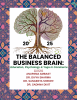
The Balanced Business Brain: Education, Psychology & Yoga in Commerce
Synopsis
The Balanced Business Brain: Education, Psychology & Yoga in Commerce offers a transformative framework that unites modern commerce education with the timeless wisdom of psychology and yogic philosophy. The book redefines business learning as a holistic discipline-one that not only develops analytical and entrepreneurial skills but also nurtures emotional balance, ethical awareness, and mindful decision-making. It moves beyond the traditional boundaries of profit and productivity to emphasize inner harmony, sustainable leadership, and human-centric growth.
Rooted in the philosophy that the human mind is both the engine and compass of commerce, this book explores how emotional intelligence, cognitive balance, and self-awareness can reshape business education and practice. Drawing from both ancient Indian yogic traditions and contemporary psychological research, it presents a model where intellect and intuition, logic and empathy, material success and spiritual fulfilment coexist in dynamic equilibrium.
Each chapter bridges the gap between classroom learning and lived experience-introducing yoga-based stress management for entrepreneurs, mindfulness training for business students, and ethical frameworks for decision-making in trade and finance. By weaving together neuroscience, educational psychology, and yogic self-discipline, the book illustrates how leaders can cultivate clarity, resilience, and ethical consciousness in a volatile business environment.
Designed for educators, students, corporate trainers, and policy thinkers, The Balanced Business Brain serves as both a reflective guide and a practical textbook. It provides research-backed insights, case studies, and experiential exercises that foster self-mastery, collaborative innovation, and social responsibility. In essence, it reimagines commerce not merely as an economic pursuit but as a mindful practice-where balance becomes the new measure of success, and education becomes a path to both prosperity and inner peace.
Chapters
-
Yoga as a Tool for Business Resilience
-
Mindfulness and Decision-Making
-
Yogic Ethics in Trade and Finance
-
Work-Life Harmony Through Yogic Practices
-
The Brain of Business: Rational vs. Emotional Economics
-
Sustainable Commerce and Social Responsibility
-
Leadership, Innovation, and the Balanced Brain
-
Global Markets, Local Values
-
Redesigning Business Education
-
Learning with Balance: Cognitive and Emotional Skills
-
Case Studies in Experiential Commerce Education
-
Educating Ethical Entrepreneurs
-
Consumer Psychology and Inner Awareness
-
The Motivated Mind: Psychology of Work and Productivity
-
Balancing Mental Health in Corporate Structures
Downloads
References
Chapter 1. Yoga as a Tool for Business Resilience
Della Valle, E., Tramontano, M., D’Aiuto, M., et al. (2020). Yoga for work-related musculoskeletal disorders and stress: A systematic review. International Journal of Environmental Research and Public Health, 17(21), 7935. https://doi.org/10.3390/ijerph17217935 Europe PMC
Hartfiel, N., Havenhand, J., Khalsa, S. B. S., Clarke, G., & Krayer, A. (2011). The effectiveness of yoga for the improvement of well-being and resilience to stress in the workplace. Scandinavian Journal of Work, Environment & Health, 37(1), 70–76. https://www.sjweh.fi/show_abstract.php?abstract_id=3118 PubMed+1
Tang, Y.-Y., Hölzel, B. K., & Posner, M. I. (2015). The neuroscience of mindfulness meditation. Nature Reviews Neuroscience, 16(4), 213–225. https://doi.org/10.1038/nrn3916 PubMed
Chapter 2. Mindfulness and Decision-Making
Hafenbrack, A. C., Kinias, Z., & Barsade, S. G. (2014). Debiasing the mind through meditation: Mindfulness and the sunk-cost bias. Psychological Science, 25(2), 369–376. https://doi.org/10.1177/0956797613503853 SAGE Journals+1
Hafenbrack, A. C., & Vohs, K. D. (2018). Mindfulness meditation impairs task motivation but not performance. Organizational Behaviour and Human Decision Processes, 147, 1–15. (Working-paper PDF) https://carlsonschool.umn.edu/sites/carlsonschool.umn.edu/files/2019-04/hafenbrack_vohs_2018_obhdp_mindfulness_impairs_motivation_0.pdf
Carlson School of Management
Kiken, L. G., Garland, E. L., Bluth, K., Palsson, O. S., & Gaylord, S. A. (2015). From a state to a trait: Trajectories of state mindfulness during intervention predict changes in trait mindfulness. Personality and Individual Differences, 81, 41–46. https://pubmed.ncbi.nlm.nih.gov/25914434/ PubMed
Chapter 3. Yogic Ethics in Trade and Finance
Fairtrade International. (2024). Fairtrade Trader Standard. https://www.fairtrade.net/content/dam/fairtrade/fairtrade-international/standards/trader-standards/TS_EN.pdf fairtrade.net
Fairtrade International. (2024). Trader Standard – Interpretation Notes. https://www.fairtrade.net/content/dam/fairtrade/fairtrade-international/standards/trader-standards/TS-INT_EN.pdf fairtrade.net
IIM Bangalore. (2014). Management Paradigms from Bhagavad Gita (Course Outline). https://www.iimb.ac.in/sites/default/files/inline-files/MPBG%20Course%20Outline_0_1.pdf iimb.ac.in
Chapter 4. Work-Life Harmony Through Yogic Practices
Della Valle, E., Tramontano, M., D’Aiuto, M., et al. (2020). Yoga for work-related musculoskeletal disorders and stress: A systematic review. IJERPH, 17(21), 7935. https://doi.org/10.3390/ijerph17217935 Europe PMC
Hartfiel, N., et al. (2011). Yoga in the workplace RCT. Scand J Work Environ Health, 37(1), 70–76. https://www.sjweh.fi/show_abstract.php?abstract_id=3118 PubMed+1
WHO. (2022). Mental health at work: Policy brief. https://www.who.int/publications/i/item/9789240053052 World Health Organization
Chapter 5. The Brain of Business: Rational vs. Emotional Economics
Kahneman, D., & Tversky, A. (1979). Prospect theory. Econometrica, 47(2), 263–291. http://web.mit.edu/curhan/www/docs/Articles/15341_Readings/Behavioral_Decision_Theory/Kahneman_Tversky_1979_Prospect_theory.pdf Massachusetts Institute of Technology
Damasio, A. R. (1996). The somatic marker hypothesis. Philosophical Transactions of the Royal Society B, 351(1346), 1413–1420. https://people.ict.usc.edu/~gratch/CSCI534/Readings/The%20Somatic%20Marker%20Hypothesis%20and%20the%20Possible%20Functions%20of%20the%20Prefrontal%20Cortex%20%5BandDiscussion%5D.pdf Institute for Creative Technologies
Bechara, A., & Damasio, A. R. (2005). The somatic marker hypothesis. Trends in Cognitive Sciences, 9(4), 159–162. https://ahandfulofleaves.files.wordpress.com/2013/07/the-somatic-marker-hypothesis_bechara-damasio_2005.pdf ahandfulofleaves.files.wordpress.com
Chapter 6. Sustainable Commerce and Social Responsibility
Carroll, A. B. (1991). The pyramid of corporate social responsibility. Academy of Management Review, 16(4), 691–718. (Accessible summaries abound) https://scholar.google.com/scholar?cluster=5615829075240903758 ResearchGate
Elkington, J. (1997). Cannibals with Forks: The Triple Bottom Line of 21st-Century Business. Capstone.
Porter, M. E., & Kramer, M. R. (2011). Creating Shared Value. Harvard Business Review. https://hbr.org/2011/01/the-big-idea-creating-shared-value hbr.org
Chapter 7. Leadership, Innovation, and the Balanced Brain
Colzato, L. S., Ozturk, A., & Hommel, B. (2012). Meditate to create: Mindfulness and divergent thinking. Frontiers in Psychology, 3, 116. https://doi.org/10.3389/fpsyg.2012.00116 (overview via Google Scholar) ResearchGate
Hougaard, R., & Carter, J. (2020). Compassionate leadership is necessary-but not sufficient. Harvard Business Review.
Harvard Professional Development. (n.d.). Authentic Leadership (Mindful leadership program). https://professional.dce.harvard.edu/programs/authentic-leadership/ Harvard DCE
Chapter 8. Global Markets, Local Values
Ghemawat, P. (2001). Distance still matters: The hard reality of global expansion. Harvard Business Review, 79(8), 137–147. (PDF) https://faculty.washington.edu/pathaksd/BBUS549/Required%20Readings/Distance%20Still%20Matters.pdf UW Faculty
Fairtrade International. (2024). Fairtrade Trader Standard. https://www.fairtrade.net/content/dam/fairtrade/fairtrade-international/standards/trader-standards/TS_EN.pdf fairtrade.net
Harvard Business Review. (2006). Localization: The revolution in consumer markets. https://hbr.org/2006/04/localization-the-revolution-in-consumer-markets hbr.org
Chapter 9. Redesigning Business Education
Kolb, D. A. (1984). Experiential Learning: Experience as the Source of Learning and Development. Prentice Hall. (Author PDF overview) https://learningfromexperience.com/downloads/research-library/experiential-learning-theory.pdf learningfromexperience.com
AACSB (2025 update to 2020 standards). Business Accreditation Standards (societal impact, learning experiences). https://www.aacsb.edu/educators/accreditation/business-accreditation/aacsb-business-accreditation-standards AACSB
Hyland, T. (2015). The limits of mindfulness: Emerging issues for education. British Journal of Educational Studies, 63(3), 263–279. (Author PDF) https://www.researchgate.net/.../BJES.pdf ResearchGate
Chapter 10. Learning with Balance: Cognitive and Emotional Skills
Hölzel, B. K., Carmody, J., Vangel, M., et al. (2011). Mindfulness practice leads to increases in regional brain gray matter density. Psychiatry Research: Neuroimaging, 191(1), 36–43. (Author PDF) https://www.harvardgazette.com/wp-content/uploads/2011/01/holzel.pdf (via author repositories) Greater Good
Tang, Y.-Y., Hölzel, B. K., & Posner, M. I. (2015). Nature Reviews Neuroscience, 16(4), 213–225. https://doi.org/10.1038/nrn3916 PubMed
Kolb, D. A. (1999/2014). Experiential Learning Theory (selected chapters). Pearson sample: https://ptgmedia.pearsoncmg.com/images/9780133892406/samplepages/9780133892406.pdf Pearson Technology Group
Chapter 11. Case Studies in Experiential Commerce Education
Kolb, D. A. (1984). Experiential Learning. (see above) https://learningfromexperience.com/downloads/research-library/experiential-learning-theory.pdf learningfromexperience.com
AACSB. (2025). Business Accreditation Standards & Interpretive Guidance (on learning experiences & societal impact). https://www.aacsb.edu/-/media/documents/accreditation/2020-aacsb-business-accreditation-standards-feb-28-2025.pdf AACSB
HBR. (2015). Why NYU’s B-School teaches mindfulness. https://hbr.org/2015/12/why-nyus-b-school-teaches-mindfulness hbr.org
Chapter 12. Educating Ethical Entrepreneurs
Porter, M. E., & Kramer, M. R. (2011). Creating Shared Value. HBR. https://hbr.org/2011/01/the-big-idea-creating-shared-value hbr.org
IIM Ahmedabad (News). (2017). Business ethics through meditation. https://www.iima.ac.in/news/business-ethics-through-meditation Indian Institute of Management Ahmedabad
Hyland, T. (2015). The limits of mindfulness (critical lens for ethics curricula). Author PDF. ResearchGate
Chapter 13. Consumer Psychology and Inner Awareness
Bray, J., Johns, N., & Kilburn, D. (2011). Factors impeding ethical consumption. Journal of Business Ethics, 98(4), 597–608. https://link.springer.com/article/10.1007/s10551-010-0640-9 SpringerLink
Garg, R., et al. (2024). Mindful consumption-A systematic review. Journal of Cleaner Production. https://www.sciencedirect.com/science/article/abs/pii/S0959652624018213 ScienceDirect
Jain, V. K., et al. (2023). Goodbye materialism: Minimalism and consumer behaviour. Humanities & Social Sciences Communications, 10, 344. https://www.ncbi.nlm.nih.gov/pmc/articles/PMC10249935/ PMC
Chapter 14. The Motivated Mind: Psychology of Work and Productivity
Csikszentmihalyi, M. (1990). Flow: The Psychology of Optimal Experience. Harper Perennial. (Book page) https://www.goodreads.com/book/show/66354.Flow Goodreads
Maslach Burnout Inventory-General Survey (technical). (2024). Validation paper. https://www.wilmarschaufeli.nl/publications/Schaufeli/603.pdf wilmarschaufeli.nl
Chapter 15. Balancing Mental Health in Corporate Structures
World Health Organization. (2022). Mental health at work: Policy brief. https://www.who.int/publications/i/item/9789240053052 World Health Organization
Bakker, A. B., & Demerouti, E. (2007). The Job Demands–Resources model: State of the art. Journal of Managerial Psychology, 22(3), 309–328. (Author PDFs widely available) https://scholar.google.com/scholar?cluster=17288512290206406460 ResearchGate
Hartfiel, N., et al. (2011). Workplace yoga RCT. Scand J Work Environ Health, 37(1), 70–76. https://www.sjweh.fi/show_abstract.php?abstract_id=3118 PubMed+1
Published
License

This work is licensed under a Creative Commons Attribution 4.0 International License.
Creative Commons Attribution 4.0 International (CC BY 4.0) — License Terms
The Creative Commons Attribution 4.0 International License (CC BY 4.0) is one of the most permissive open licenses. It allows others to use, share, and build upon a work for any purpose—including commercial use—provided that proper credit is given to the original creator.
1. Permissions Granted
Under CC BY 4.0, anyone may:
a) Share
Copy and redistribute the material in any medium or format (print, digital, audio, video, etc.).
b) Adapt
Remix, transform, translate, or build upon the material.
c) Commercial Use Allowed
The work may be used for commercial purposes, including resale, inclusion in paid products, or monetized distribution.
d) No Additional Permission Required
Users do not need to contact the author for permission, as long as they follow the license conditions.
2. Attribution Requirements (Core Condition)
Users must give appropriate credit to the original creator. Attribution should include:
- Name of the author/creator
- Title of the work (if available)
- Source (publisher, website, or platform)
- Link to the original work (if online)
- Link to the CC BY 4.0 license
- Indication of any changes made
Example Attribution:
“Title of Work” by Author Name is licensed under CC BY 4.0.
Adapted from the original available at [URL].
3. Indicating Changes
If the material is modified, translated, shortened, or otherwise altered, users must clearly state that changes were made.
Examples:
- “Translated from the original”
- “Adapted from…”
- “Modified version of…”
4. No Additional Restrictions
Users may not:
- Apply legal terms or technological measures (such as DRM) that restrict others from exercising the license rights
- Impose new licensing conditions that contradict CC BY 4.0
5. Rights Not Covered by the License
CC BY 4.0 does not automatically grant:
- Patent rights
- Trademark rights
- Privacy or publicity rights
- Moral rights where they cannot be waived by law
Users must ensure compliance with these separately.
6. Disclaimer of Warranties
The material is provided “as-is.”
The licensor (author/publisher) gives no guarantees regarding accuracy, suitability, or fitness for any purpose.
7. Termination and Reinstatement
- The license remains valid as long as the terms are followed.
- If a user violates the terms (e.g., fails to attribute), the rights terminate automatically.
- Rights may be reinstated if the violation is corrected within 30 days of discovery.
8. International Scope
CC BY 4.0 is designed to work worldwide and is not limited to any specific country’s copyright law.
Suggested Copyright Notice Using CC BY 4.0
© [Year] [Author Name].
This work is licensed under the Creative Commons Attribution 4.0 International License (CC BY 4.0).
To view a copy of this license, visit: https://creativecommons.org/licenses/by/4.0/
You are free to share and adapt this work for any purpose, even commercially, provided that appropriate credit is given.









