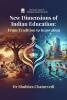
New Dimensions of Indian Education: From Tradition to Innovation
Keywords:
Educational Reform, National Education Policy, Holistic Learning, Digital Education, Educational Equity, Academic Books and Journals (Wissira Press), Indian EducationSynopsis
Education in India has never been a static enterprise; it has evolved continuously in response to changing social realities, cultural values, political structures, and technological advancements. From the reflective and value-oriented traditions of ancient learning to the digitally mediated classrooms of the present day, Indian education reflects a long journey of adaptation, resilience, and reinvention. Rooted in a civilizational ethos that viewed knowledge as a path to self-realization and social harmony, Indian education has historically emphasized wisdom, ethics, and holistic growth. Over centuries, this system has encountered transformation through interaction with diverse cultures, colonial interventions, and modern state-led reforms. This book, New Dimensions of Indian Education: From Tradition to Innovation, seeks to trace that journey while critically examining how the past informs the present and shapes the future.
The motivation behind this work arises from the need to view Indian education not merely as a system of institutions, examinations, and policies, but as a living social process deeply embedded in everyday life. Education in India has traditionally been linked with moral development, community responsibility, and cultural continuity, playing a vital role in shaping collective identity. In contrast, the contemporary educational landscape is shaped by forces such as globalization, technological disruption, market-oriented skill demands, and widening equity gaps. These shifts have introduced new expectations from education—ranging from employability and innovation to digital literacy and lifelong learning. This book attempts to bridge these dimensions by presenting education as both a cultural inheritance and a dynamic tool for national development and global engagement.
Each chapter has been carefully designed to offer a balanced, analytical, and reflective perspective. The early chapters explore the philosophical and historical foundations of Indian education, highlighting how ancient and medieval systems prioritized holistic development, ethical reasoning, dialogue-based learning, and the transmission of knowledge across generations. The discussion then moves to the colonial period, examining how formalized schooling structures reshaped curricula, language policies, and access to education. Post-independence reforms, constitutional commitments, and policy initiatives are subsequently analysed to understand India’s efforts to democratize education and align it with developmental goals. The later sections focus on innovation, addressing themes such as digital learning ecosystems, teacher empowerment, inclusive education, multilingualism, and the future of Indian education within an increasingly interconnected global knowledge economy.
This book is intended for a wide and diverse readership, including students, educators, researchers, policymakers, and readers interested in understanding the evolving landscape of Indian education. Care has been taken to ensure that the content remains academically rigorous yet accessible, grounded in authentic scholarship, and free from plagiarism. Rather than prescribing rigid solutions or singular viewpoints, the book encourages reflection, dialogue, and critical engagement with educational change across social, cultural, and institutional contexts.
Ultimately, New Dimensions of Indian Education: From Tradition to Innovation aspires to contribute meaningfully to ongoing conversations about how education can honour India’s rich intellectual and cultural heritage while equipping learners to navigate an increasingly complex and uncertain world. It is hoped that this work will inspire thoughtful inquiry, informed policymaking, and responsible action toward building an education system that is inclusive, innovative, adaptable, and deeply rooted in human values.
Chapters
-
Foundations of Indian Education in Ancient Civilization
-
Medieval Transformations and Knowledge Transmission
-
Colonial Influence and the Restructuring of Education
-
Post-Independence Educational Reforms and Nation Building
-
The National Education Policy and Structural Transformation
-
Technology-Driven Learning and Digital Innovation
-
Teacher Education, Pedagogy, and Professional Development
-
Inclusivity, Equity, and Multilingual Education
-
The Future of Indian Education in a Global Knowledge Economy
Downloads
References
Chapter 1: Foundations of Indian Education in Ancient Civilization
Altekar, A. S. (1965). Education in Ancient India. Motilal Banarsidass.
Sharma, R. S. (2005). India’s Ancient Past. Oxford University Press.
Mukherjee, S. N. (1951). History of Education in India. Acharya Book Depot.
Chapter 2: Medieval Transformations and Knowledge Transmission
Basham, A. L. (2004). The Wonder That Was India. Picador.
Habib, I. (2008). Economic History of Medieval India. Pearson Education.
Saliba, G. (2007). Islamic Science and the Making of the European Renaissance. MIT Press.
Chapter 3: Colonial Influence and the Restructuring of Education
Macaulay, T. B. (1835). Minute on Indian Education. British Parliamentary Papers.
Nurullah, S., & Naik, J. P. (1951). A History of Education in India during the British Period. Macmillan.
Viswanathan, G. (1989). Masks of Conquest: Literary Study and British Rule in India. Oxford University Press.
Chapter 4: Post-Independence Educational Reforms and Nation Building
Government of India. (1966). Education and National Development (Kothari Commission Report). Ministry of Education.
Government of India. (1986). National Policy on Education. Ministry of Human Resource Development.
Tilak, J. B. G. (1993). Education and Development in India. Gyan Publishing House.
Chapter 5: National Education Policy and Structural Transformation
Government of India. (2020). National Education Policy 2020. Ministry of Education.
OECD. (2018). Education 2030: The Future of Education and Skills. OECD Publishing.
National Council of Educational Research and Training (NCERT). (2021). Curriculum Reform and Pedagogy. NCERT.
Chapter 6: Technology-Driven Learning and Digital Innovation
UNESCO. (2021). Reimagining Our Futures Together: A New Social Contract for Education. UNESCO.
World Bank. (2020). Remote Learning and COVID-19: The Use of Educational Technologies. World Bank.
Selwyn, N. (2016). Education and Technology: Key Issues and Debates. Bloomsbury Academic.
Chapter 7: Teacher Education, Pedagogy, and Professional Development
National Council for Teacher Education (NCTE). (2014). Teacher Education Regulations. NCTE.
Darling-Hammond, L. (2017). Teacher Education around the World. Routledge.
Government of India. (2020). National Professional Standards for Teachers (Draft). Ministry of Education.
Chapter 8: Inclusivity, Equity, and Multilingual Education
UNESCO. (2009). Policy Guidelines on Inclusion in Education. UNESCO.
Skutnabb-Kangas, T. (2000). Linguistic Genocide in Education. Lawrence Erlbaum Associates.
Government of India. (2019). Samagra Shiksha Framework. Ministry of Education.
Chapter 9: The Future of Indian Education in a Global Knowledge Economy
World Economic Forum. (2020). The Future of Jobs Report. WEF.
Marginson, S. (2016). Higher Education and the Common Good. Melbourne University Press.
Altbach, P. G., & Knight, J. (2007). The internationalization of higher education. Journal of Studies in International Education, 11(3–4), 290–305.
Downloads
Published
License

This work is licensed under a Creative Commons Attribution 4.0 International License.
Creative Commons Attribution 4.0 International (CC BY 4.0) — License Terms
The Creative Commons Attribution 4.0 International License (CC BY 4.0) is one of the most permissive open licenses. It allows others to use, share, and build upon a work for any purpose—including commercial use—provided that proper credit is given to the original creator.
1. Permissions Granted
Under CC BY 4.0, anyone may:
a) Share
Copy and redistribute the material in any medium or format (print, digital, audio, video, etc.).
b) Adapt
Remix, transform, translate, or build upon the material.
c) Commercial Use Allowed
The work may be used for commercial purposes, including resale, inclusion in paid products, or monetized distribution.
d) No Additional Permission Required
Users do not need to contact the author for permission, as long as they follow the license conditions.
2. Attribution Requirements (Core Condition)
Users must give appropriate credit to the original creator. Attribution should include:
- Name of the author/creator
- Title of the work (if available)
- Source (publisher, website, or platform)
- Link to the original work (if online)
- Link to the CC BY 4.0 license
- Indication of any changes made
Example Attribution:
“Title of Work” by Author Name is licensed under CC BY 4.0.
Adapted from the original available at [URL].
3. Indicating Changes
If the material is modified, translated, shortened, or otherwise altered, users must clearly state that changes were made.
Examples:
- “Translated from the original”
- “Adapted from…”
- “Modified version of…”
4. No Additional Restrictions
Users may not:
- Apply legal terms or technological measures (such as DRM) that restrict others from exercising the license rights
- Impose new licensing conditions that contradict CC BY 4.0
5. Rights Not Covered by the License
CC BY 4.0 does not automatically grant:
- Patent rights
- Trademark rights
- Privacy or publicity rights
- Moral rights where they cannot be waived by law
Users must ensure compliance with these separately.
6. Disclaimer of Warranties
The material is provided “as-is.”
The licensor (author/publisher) gives no guarantees regarding accuracy, suitability, or fitness for any purpose.
7. Termination and Reinstatement
- The license remains valid as long as the terms are followed.
- If a user violates the terms (e.g., fails to attribute), the rights terminate automatically.
- Rights may be reinstated if the violation is corrected within 30 days of discovery.
8. International Scope
CC BY 4.0 is designed to work worldwide and is not limited to any specific country’s copyright law.
Suggested Copyright Notice Using CC BY 4.0
© [Year] [Author Name].
This work is licensed under the Creative Commons Attribution 4.0 International License (CC BY 4.0).
To view a copy of this license, visit: https://creativecommons.org/licenses/by/4.0/
You are free to share and adapt this work for any purpose, even commercially, provided that appropriate credit is given.









