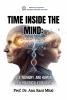
Time Inside the Mind: Age, Memory, and Human Psychological Evolution
Keywords:
Time Perception, Memory and Aging, Lifespan Development, Cognitive Neuroscience, Psychological Evolution, Scopus-Indexed Journals, Wissira Press Academic BooksSynopsis
Time is one of the most familiar yet mysterious elements of human existence. We measure it precisely with clocks and calendars, yet we experience it subjectively-sometimes flowing effortlessly, sometimes stretching unbearably, and at other moments slipping away before we realize it has passed. This book, Time Inside the Mind: Age, Memory, and Human Psychological Evolution, is born from the recognition that time is not merely an external dimension, but a deeply psychological phenomenon shaped by memory, emotion, development, culture, and biology.
The central aim of this book is to explore how human beings experience time across the lifespan. From the earliest moments of childhood, when the present dominates awareness, to later life, where reflection and reminiscence give time its depth and meaning, our relationship with time continually evolves. Memory acts as the thread that binds these stages together, allowing the past to inform the present and the future to be imagined. Understanding this dynamic relationship between time and memory offers valuable insight into human identity, decision-making, emotional regulation, and psychological well-being.
This book takes an interdisciplinary approach, drawing upon cognitive psychology, developmental science, neuroscience, sociology, and evolutionary perspectives. Rather than treating time as a fixed entity, the chapters examine how subjective time is shaped by cognitive growth, emotional intensity, routine, aging, cultural norms, and technological change. Special attention is given to how modern life-characterized by speed, digital memory, and extended longevity-is reshaping our temporal consciousness in unprecedented ways.
The content is structured to move progressively through the human lifespan, while also situating individual experience within broader biological and cultural frameworks. Each chapter is designed to be conceptually clear and empirically grounded, making the book suitable for undergraduate and postgraduate students, researchers, educators, and readers with a general interest in psychology and human behaviour. Real-world examples and contemporary research are used to bridge theory and lived experience.
This book is an invitation to examine the machinery behind that travel. It explores the tension between Kronos (quantitative, linear time) and Kairos (the qualitative, opportune moment). By bridging these concepts, we reveal why a childhood summer felt like an eternity, while a year in middle age vanishes in a blink.
The methodology behind this volume is rooted in the "Tripartite Model of Temporal Experience": the biological clock, the cognitive processor, and the social construct. We delve into the neurochemical messengers, like dopamine, that speed up our internal metronome during moments of excitement, and the inhibitory processes that slow it down during boredom or trauma. Furthermore, we address the "scarcity mindset"—the psychological state of feeling that time is a vanishing resource—and how this impacts our decision-making, from financial investments to romantic commitments.
Ultimately, Time Inside the Mind invites readers to reflect on their own relationship with time. By understanding how the mind constructs and interprets temporal experience, we gain the ability not only to study human psychological evolution but also to live more consciously within the time we have. This book hopes to encourage thoughtful engagement with the rhythms of memory, aging, and change that define the human journey.
Chapters
-
Chapter-1 Time as a Psychological Construct
-
Chapter-2 Memory and the Architecture of the Mind
-
Chapter-3 Childhood and the Formation of Temporal Awareness
-
Chapter-4 Adolescence, Identity, and Accelerated Time Perception
-
Chapter-5 Adulthood, Routine, and the Compression of Time
-
Chapter-6 Aging, Memory Transformation, and Psychological Adaptation
-
Chapter-7 The Neuroscience of Time and Memory Across the Lifespan
-
Chapter-8 Cultural, Social, and Evolutionary Perspectives on Psychological Time
-
Chapter-9 The Future Mind – Technology, Longevity, and Temporal Consciousness
Downloads
References
Block, R. A., Hancock, P. A., & Zakay, D. (2010). How cognitive load affects duration judgments: A meta-analytic review. Psychological Bulletin, 136(3), 430–451. https://doi.org/10.1037/a0019540
Zakay, D., & Block, R. A. (1997). Temporal cognition. Current Directions in Psychological Science, 6(1), 12–16. https://doi.org/10.1111/1467-8721.ep11512604
Eagleman, D. M. (2008). Human time perception and its illusions. Current Opinion in Neurobiology, 18(2), 131–136. https://doi.org/10.1016/j.conb.2008.06.002
Tulving, E. (2002). Episodic memory: From mind to brain. Annual Review of Psychology, 53, 1–25. https://doi.org/10.1146/annurev.psych.53.100901.135114
Baddeley, A. (2003). Working memory: Looking back and looking forward. Nature Reviews Neuroscience, 4(10), 829–839. https://doi.org/10.1038/nrn1201
Suddendorf, T., & Corballis, M. C. (2007). The evolution of foresight: What is mental time travel? Behavioural and Brain Sciences, 30(3), 299–351. https://doi.org/10.1017/S0140525X07001975
Friedman, W. J. (2003). The development of a differentiated sense of the past and future. Advances in Child Development and Behaviour, 31, 229–269. https://doi.org/10.1016/S0065-2407(03)31005-1
Nelson, K., & Fivush, R. (2004). The emergence of autobiographical memory: A social cultural developmental theory. Psychological Review, 111(2), 486–511. https://doi.org/10.1037/0033-295X.111.2.486
McCormack, T., & Hoerl, C. (2008). Temporal concepts and the development of episodic memory. Psychological Bulletin, 134(1), 133–153. https://doi.org/10.1037/0033-2909.134.1.133
Blakemore, S. J., & Mills, K. L. (2014). Is adolescence a sensitive period for sociocultural processing? Annual Review of Psychology, 65, 187–207. https://doi.org/10.1146/annurev-psych-010213-115202
Erikson, E. H. (1968). Identity: Youth and crisis. New York: W. W. Norton & Company.
Steinberg, L. (2008). A social neuroscience perspective on adolescent risk-taking. Developmental Review, 28(1), 78–106. https://doi.org/10.1016/j.dr.2007.08.002
James, W. (1890). The principles of psychology. New York: Henry Holt and Company.
Csikszentmihalyi, M. (1990). Flow: The psychology of optimal experience. New York: Harper & Row.
Wittmann, M., & Lehnhoff, S. (2005). Age effects in perception of time. Psychological Reports, 97(3), 921–935.
Park, D. C., & Reuter-Lorenz, P. (2009). The adaptive brain: Aging and neurocognitive scaffolding. Annual Review of Psychology, 60, 173–196. https://doi.org/10.1146/annurev.psych.59.103006.093656
Rubin, D. C., Wetzler, S. E., & Nebes, R. D. (1986). Autobiographical memory across the lifespan. Human Development, 29(1), 1–12. https://doi.org/10.1159/000273042
Baltes, P. B., & Baltes, M. M. (1990). Successful aging: Perspectives from the behavioural sciences. Cambridge University Press.
Buhusi, C. V., & Meck, W. H. (2005). What makes us tick? Nature Reviews Neuroscience, 6(10), 755–765. https://doi.org/10.1038/nrn1764
Nyberg, L., et al. (2012). Memory aging and brain maintenance. Trends in Cognitive Sciences, 16(5), 292–305. https://doi.org/10.1016/j.tics.2012.04.005
Draganski, B., et al. (2004). Neuroplasticity: Changes in grey matter induced by training. Nature, 427, 311–312. https://doi.org/10.1038/427311a
Hall, E. T. (1983). The dance of life: The other dimension of time. Anchor Press.
Levine, R. (1997). A geography of time. Basic Books.
Tomasello, M. (2014). A natural history of human thinking. Harvard University Press.
Sparrow, B., Liu, J., & Wegner, D. M. (2011). Google effects on memory. Science, 333(6043), 776–778.
Clark, A., & Chalmers, D. (1998). The extended mind. Analysis, 58(1), 7–19. https://doi.org/10.1093/analys/58.1.7
Harari, Y. N. (2017). Homo Deus: A brief history of tomorrow. Harper.
Downloads
Published
License

This work is licensed under a Creative Commons Attribution 4.0 International License.
Creative Commons Attribution 4.0 International (CC BY 4.0) — License Terms
The Creative Commons Attribution 4.0 International License (CC BY 4.0) is one of the most permissive open licenses. It allows others to use, share, and build upon a work for any purpose—including commercial use—provided that proper credit is given to the original creator.
1. Permissions Granted
Under CC BY 4.0, anyone may:
a) Share
Copy and redistribute the material in any medium or format (print, digital, audio, video, etc.).
b) Adapt
Remix, transform, translate, or build upon the material.
c) Commercial Use Allowed
The work may be used for commercial purposes, including resale, inclusion in paid products, or monetized distribution.
d) No Additional Permission Required
Users do not need to contact the author for permission, as long as they follow the license conditions.
2. Attribution Requirements (Core Condition)
Users must give appropriate credit to the original creator. Attribution should include:
- Name of the author/creator
- Title of the work (if available)
- Source (publisher, website, or platform)
- Link to the original work (if online)
- Link to the CC BY 4.0 license
- Indication of any changes made
Example Attribution:
“Title of Work” by Author Name is licensed under CC BY 4.0.
Adapted from the original available at [URL].
3. Indicating Changes
If the material is modified, translated, shortened, or otherwise altered, users must clearly state that changes were made.
Examples:
- “Translated from the original”
- “Adapted from…”
- “Modified version of…”
4. No Additional Restrictions
Users may not:
- Apply legal terms or technological measures (such as DRM) that restrict others from exercising the license rights
- Impose new licensing conditions that contradict CC BY 4.0
5. Rights Not Covered by the License
CC BY 4.0 does not automatically grant:
- Patent rights
- Trademark rights
- Privacy or publicity rights
- Moral rights where they cannot be waived by law
Users must ensure compliance with these separately.
6. Disclaimer of Warranties
The material is provided “as-is.”
The licensor (author/publisher) gives no guarantees regarding accuracy, suitability, or fitness for any purpose.
7. Termination and Reinstatement
- The license remains valid as long as the terms are followed.
- If a user violates the terms (e.g., fails to attribute), the rights terminate automatically.
- Rights may be reinstated if the violation is corrected within 30 days of discovery.
8. International Scope
CC BY 4.0 is designed to work worldwide and is not limited to any specific country’s copyright law.
Suggested Copyright Notice Using CC BY 4.0
© [Year] [Author Name].
This work is licensed under the Creative Commons Attribution 4.0 International License (CC BY 4.0).
To view a copy of this license, visit: https://creativecommons.org/licenses/by/4.0/
You are free to share and adapt this work for any purpose, even commercially, provided that appropriate credit is given.









