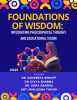
Foundations of Wisdom: Integrating Philosophical Thought and Educational Vision
Keywords:
pedagogical vision, knowledge systems, integral education, moral development, critical thinking, educational philosophySynopsis
Foundations of Wisdom: Integrating Philosophical Thought and Educational Vision offers a profound inquiry into how philosophy serves as the guiding spirit of education. It begins with the recognition that education is not simply about the acquisition of skills or the accumulation of facts, but about shaping individuals into thoughtful, ethical, and responsible members of society. At a time when rapid technological change and global challenges demand more than technical expertise, this book emphasizes the need to root educational practices in philosophical reflection and human values.
The book journeys through the insights of classical thinkers such as Plato, Aristotle, Confucius, and Indian sages, while also engaging with modern philosophers like Dewey, Rousseau, and Tagore. It highlights how their perspectives on knowledge, ethics, and human development can inspire fresh approaches to learning today. By exploring questions such as What is the purpose of education? How should knowledge be structured? What values should guide teaching? the book demonstrates the enduring relevance of philosophical wisdom in addressing contemporary educational challenges.
Each chapter integrates theory with practice, showing how philosophical principles can inform curriculum design, teaching methodologies, student assessment, and educational policy. Topics such as critical thinking, moral education, holistic learning, creativity, and the balance between individuality and community are addressed with clarity and depth. The book also emphasizes the need for an education system that prepares learners not only for careers but for meaningful lives rooted in justice, empathy, and wisdom.
Designed for educators, researchers, policymakers, and students of philosophy and education, this work encourages readers to see education as a transformative journey rather than a transactional process. It seeks to inspire a generation of teachers and learners to view education as a pathway to wisdom, cultural harmony, and societal progress.
Foundations of Wisdom is both a philosophical reflection and a practical guide an invitation to reimagine education as a lifelong endeavour of cultivating the mind, refining the character, and nurturing the spirit.
Chapters
-
Philosophy and Education: Interwoven Concepts and Relationships
-
Why Philosophy Matters in Education: Aims and Relevance
-
Metaphysics in Education: The Quest for Ultimate Reality
-
Epistemology and Learning: Understanding Knowledge in the Classroom
-
Axiology in Education: Nurturing Values and Aesthetic Sensibilities
-
Vedic to Islamic Traditions: Indian Perspectives on Education
-
Indigenous Educational Concepts: Darshana to Swadhyaya
-
Western Philosophical Theories in Education
-
Bharatiya Darshanas: Schools of Thought and Educational Vision
-
Western Philosophical Schools: Idealism to Progressivism
-
Voices from India: Visionary Educators and Their Contributions
-
Global Thinkers in Education: From Rousseau to Dewey
-
Values in Education: Concepts, Classifications, and Relevance
-
Indian Ethos and Value Transmission in Education
-
Contemporary Reflections: Values in NEP 2020 and the 21st Century
Downloads
References
Chapter 1 – Philosophy and Education: Interwoven Concepts and Relationships
Companion to the Philosophy of Education, edited by Randal Curren a comprehensive introduction to core themes in philosophy of education.
The SAGE Handbook of Philosophy of Education covers scope, key thinkers, and intersections between philosophy and educational theory.
Chapter 2 – Why Philosophy Matters in Education: Aims and Relevance
Encyclopaedia of Educational Philosophy and Theory, edited by Peters et al. authoritative entries on educational philosophy concepts.
Curren’s Companion to the Philosophy of Education as above.
Chapter 3 – Metaphysics in Education: The Quest for Ultimate Reality
While there is no direct chapter found online, metaphysical foundations of education are often covered in comprehensive philosophy-of-education handbooks such as SAGE or by addressing questions of reality, purpose, and being in education (see Chapter 1 sources).
Chapter 4 – Epistemology and Learning: Understanding Knowledge in the Classroom
Again, foundational texts like the Companion to the Philosophy of Education and the SAGE Handbook discuss epistemological issues in educational contexts.
Chapter 5 – Axiology in Education: Nurturing Values and Aesthetic Sensibilities
The Elements of Moral Philosophy, James Rachels well-known ethics text covering moral theories relevant for understanding educational values.
Chapters 6 & 7 – Vedic to Islamic Traditions; Indigenous Educational Concepts
A History of Indian Philosophy, Surendranath Dasgupta extensive volumes covering Indian philosophical traditions, including educational thought.
Chapter 8 – Western Philosophical Theories in Education
Philosophy of Education, by Nel Noddings a respected overview of Western philosophical traditions in education.
Chapter 9 – Bharatiya Darshanas: Schools of Thought and Educational Vision
Again, Dasgupta’s A History of Indian Philosophy is useful for covering Indian schools of thought (darshanas).
Chapter 10 – Western Philosophical Schools: Idealism to Progressivism
Nel Noddings’ Philosophy of Education provides accessible overviews, especially around Dewey and other Western theorists.
Chapter 11: Voices from India Visionary Educators and Their Contributions
Chitra Naik Advocate of Non-Formal & Adult Education
Chitra Naik (1918–2010) was a renowned educationist who chaired the Indian Institute of Education. She led non-formal education initiatives, served on the Planning Commission, and contributed significantly to literacy and women's training programs in India.
Chapter 12 – Global Thinkers in Education: From Rousseau to Dewey
Emile, or On Education by JeanJacques Rousseau a foundational 18th-century treatise on educational theory.
Nodding’s’ text on Dewey.
Chapters 13 & 14 – Values in Education; Indian Ethos and Value Transmission
The Elements of Moral Philosophy, James Rachels for foundational understanding of values.
For the Indian context and NEP connections, refer to NEP2020 Philosophy: Indian Philosophical Thoughts… by Dr. Muttu Vemula.
Chapter 15 – Contemporary Reflections: Values in NEP 2020 and the 21st Century
National Education Policy 2020, official government document articulates philosophical underpinnings and value aims.
Scholarly analysis: National Education Policy 2020: Explicating its Philosophy and Pedagogy (ResearchGate article).
Gandhian perspectives aligned with NEP: Gandhian Perspective on India’s National Education Policy 2020.
Published
Data Availability Statement
This book is conceptual and does not involve the collection of primary empirical data. All discussions, models, and analyses are derived from previously published literature, established psychological frameworks, educational theories, and traditional yogic texts. All sources referenced are publicly available through their respective publications. No new datasets were generated or analyzed for this work; therefore, no additional data are available.
License

This work is licensed under a Creative Commons Attribution 4.0 International License.
Creative Commons Attribution 4.0 International (CC BY 4.0) — License Terms
The Creative Commons Attribution 4.0 International License (CC BY 4.0) is one of the most permissive open licenses. It allows others to use, share, and build upon a work for any purpose—including commercial use—provided that proper credit is given to the original creator.
1. Permissions Granted
Under CC BY 4.0, anyone may:
a) Share
Copy and redistribute the material in any medium or format (print, digital, audio, video, etc.).
b) Adapt
Remix, transform, translate, or build upon the material.
c) Commercial Use Allowed
The work may be used for commercial purposes, including resale, inclusion in paid products, or monetized distribution.
d) No Additional Permission Required
Users do not need to contact the author for permission, as long as they follow the license conditions.
2. Attribution Requirements (Core Condition)
Users must give appropriate credit to the original creator. Attribution should include:
- Name of the author/creator
- Title of the work (if available)
- Source (publisher, website, or platform)
- Link to the original work (if online)
- Link to the CC BY 4.0 license
- Indication of any changes made
Example Attribution:
“Title of Work” by Author Name is licensed under CC BY 4.0.
Adapted from the original available at [URL].
3. Indicating Changes
If the material is modified, translated, shortened, or otherwise altered, users must clearly state that changes were made.
Examples:
- “Translated from the original”
- “Adapted from…”
- “Modified version of…”
4. No Additional Restrictions
Users may not:
- Apply legal terms or technological measures (such as DRM) that restrict others from exercising the license rights
- Impose new licensing conditions that contradict CC BY 4.0
5. Rights Not Covered by the License
CC BY 4.0 does not automatically grant:
- Patent rights
- Trademark rights
- Privacy or publicity rights
- Moral rights where they cannot be waived by law
Users must ensure compliance with these separately.
6. Disclaimer of Warranties
The material is provided “as-is.”
The licensor (author/publisher) gives no guarantees regarding accuracy, suitability, or fitness for any purpose.
7. Termination and Reinstatement
- The license remains valid as long as the terms are followed.
- If a user violates the terms (e.g., fails to attribute), the rights terminate automatically.
- Rights may be reinstated if the violation is corrected within 30 days of discovery.
8. International Scope
CC BY 4.0 is designed to work worldwide and is not limited to any specific country’s copyright law.
Suggested Copyright Notice Using CC BY 4.0
© [Year] [Author Name].
This work is licensed under the Creative Commons Attribution 4.0 International License (CC BY 4.0).
To view a copy of this license, visit: https://creativecommons.org/licenses/by/4.0/
You are free to share and adapt this work for any purpose, even commercially, provided that appropriate credit is given.









