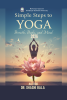
Simple Steps to Yoga: Breath, Body, and Mind
Keywords:
Yoga Practice, Mind–Body Connection, Yogic Lifestyle, Wissira Press, Wissira Press Publications, Wissira Research LabSynopsis
Yoga is more than a practice; it is a journey-a journey that leads us inward to discover the true essence of who we are. As a philosophy, a discipline, and a way of life, yoga offers profound tools to cultivate harmony between the mind, body, and spirit. The simplicity of its movements and breathwork is deceptively powerful, capable of transforming every aspect of our lives if practiced with dedication and intention.
“Simple Steps to Yoga: Breath, Body, and Mind” is a comprehensive guide that seeks to bridge the gap between the ancient wisdom of yoga and modern-day practices. With this book, my goal is not only to introduce readers to the fundamental aspects of yoga but also to inspire a deeper, more personal connection with the practice. It is written for those who are just beginning their yoga journey as well as for those who have already begun to explore its transformative potential.
This book emphasizes the integration of three essential components: Breath, Body, and Mind. Through controlled breathing (pranayama), conscious movement (asanas), and mental stillness (meditation), we find the path to a more balanced and fulfilling life. Each chapter in this book provides not only practical guidance but also insight into the underlying philosophy of yoga. The chapters are structured to help you ease into the practice, no matter your experience level, and explore how each of these elements can elevate your well-being-physically, mentally, and spiritually.
In the chapters that follow, you will learn not only the technical aspects of yoga postures but also how to connect with your breath and your mind in a way that brings clarity and peace. You will discover how small, simple steps can lead to profound changes, whether you are using yoga to improve your physical health, reduce stress, or cultivate a deeper sense of self-awareness.
Yoga is a lifelong practice, and it is my belief that each step we take on this journey brings us closer to a place of greater inner peace, resilience, and self-understanding. This book is an invitation to take that first step, or to continue the journey with renewed purpose and clarity.
May this work inspire you to find stillness amidst the noise of the world, to reconnect with your body as a source of strength and healing, and to experience the deep peace that comes from aligning breath, body, and mind.
Chapters
-
Chapter 1: The Essence of Yoga – Union Beyond the Mat
-
Chapter 2: Preparing the Mind – Cultivating Inner Stillness
-
Chapter 3: The Breath of Life – Mastering Pranayama
-
Chapter 4: Aligning the Body – Foundation Asanas for All Levels
-
Chapter 5: The Flow Within – Coordinating Movement and Breath
-
Chapter 6: The Power of Stillness – Meditation and Mental Clarity
-
Chapter 7: Nourishing the Body and Soul – Yogic Diet and Lifestyle
-
Chapter 8: Integrating Yoga into Daily Life – From Practice to Presence
-
Chapter 9: The Journey Within – Self-Realization and Inner Freedom
Downloads
References
Patanjali, S. (2002). The Yoga Sutras of Patanjali. Translated by Sri Swami Sivananda. Divine Life Society.
Iyengar, B. K. S. (2002). Light on Yoga. HarperCollins Publishers.
Desikachar, T. K. V. (1995). The Heart of Yoga: Developing a Personal Practice. Inner Traditions.
Kabat-Zinn, J. (1990). Full Catastrophe Living: Using the Wisdom of Your Body and Mind to Face Stress, Pain, and Illness. Delta.
Goleman, D. (2013). Focus: The Hidden Driver of Excellence. Harper.
Patel, V., & Gawande, A. (2018). Mindfulness and the Role of Meditation in Stress Management. Harvard Medical School.
Sivananda, S. (2001). Pranayama: The Science of Breathing. The Divine Life Society.
Iyengar, B. K. S. (1995). Light on Pranayama. HarperCollins Publishers.
Taimni, I. K. (2012). The Science of Yoga. The Theosophical Publishing House.
Iyengar, B. K. S. (2002). Light on Yoga. HarperCollins Publishers.
Desikachar, T. K. V. (1995). The Heart of Yoga: Developing a Personal Practice. Inner Traditions.
Satchidananda, S. (1997). The Yoga Sutras of Patanjali: A New Commentary. Integral Yoga Publications.
Shandor, M. (2007). Vinyasa Yoga: A Practice of Connection. Prana Press.
Markandeya, R. (2011). The Art of Vinyasa: A Comprehensive Approach to Yoga Sequences. New World Library.
EkhartYoga (2016). The Philosophy of Vinyasa Flow: Benefits and Techniques. Ekhart Yoga.
Thich Nhat Hanh, T. (1999). The Miracle of Mindfulness: An Introduction to the Practice of Meditation. Beacon Press.
Kabat-Zinn, J. (2005). Wherever You Go, There You Are: Mindfulness Meditation in Everyday Life. Hyperion.
Goleman, D. (2013). The Focused Mind: How Meditation Can Improve Attention and Mental Clarity. Harper Collins.
Sivananda, S. (2002). The Yoga Diet. The Divine Life Society.
Desikachar, T. K. V. (2004). The Healing Power of Yoga: The Yogic Path to Wellness. Bantam.
Miller, J. S. (2012). The Yogic Path: A Guide to Living with Purpose, Awareness, and Consciousness. Hay House.
Satchidananda, S. (1985). The Yoga Sutras of Patanjali: A New Commentary. Integral Yoga Publications.
Kabat-Zinn, J. (2005). Full Catastrophe Living: Using the Wisdom of Your Body and Mind to Face Stress, Pain, and Illness. Delta.
Nhat Hanh, T. (2014). The Art of Power. HarperOne.
Patanjali, S. (2003). The Yoga Sutras of Patanjali. Translated by E. S. Shastri. Yoga Publication Trust.
Brahmananda, S. (2006). Self-Realization and the Path to Inner Peace. The Divine Life Society.
Published
License

This work is licensed under a Creative Commons Attribution 4.0 International License.
Creative Commons Attribution 4.0 International (CC BY 4.0) — License Terms
The Creative Commons Attribution 4.0 International License (CC BY 4.0) is one of the most permissive open licenses. It allows others to use, share, and build upon a work for any purpose—including commercial use—provided that proper credit is given to the original creator.
1. Permissions Granted
Under CC BY 4.0, anyone may:
a) Share
Copy and redistribute the material in any medium or format (print, digital, audio, video, etc.).
b) Adapt
Remix, transform, translate, or build upon the material.
c) Commercial Use Allowed
The work may be used for commercial purposes, including resale, inclusion in paid products, or monetized distribution.
d) No Additional Permission Required
Users do not need to contact the author for permission, as long as they follow the license conditions.
2. Attribution Requirements (Core Condition)
Users must give appropriate credit to the original creator. Attribution should include:
- Name of the author/creator
- Title of the work (if available)
- Source (publisher, website, or platform)
- Link to the original work (if online)
- Link to the CC BY 4.0 license
- Indication of any changes made
Example Attribution:
“Title of Work” by Author Name is licensed under CC BY 4.0.
Adapted from the original available at [URL].
3. Indicating Changes
If the material is modified, translated, shortened, or otherwise altered, users must clearly state that changes were made.
Examples:
- “Translated from the original”
- “Adapted from…”
- “Modified version of…”
4. No Additional Restrictions
Users may not:
- Apply legal terms or technological measures (such as DRM) that restrict others from exercising the license rights
- Impose new licensing conditions that contradict CC BY 4.0
5. Rights Not Covered by the License
CC BY 4.0 does not automatically grant:
- Patent rights
- Trademark rights
- Privacy or publicity rights
- Moral rights where they cannot be waived by law
Users must ensure compliance with these separately.
6. Disclaimer of Warranties
The material is provided “as-is.”
The licensor (author/publisher) gives no guarantees regarding accuracy, suitability, or fitness for any purpose.
7. Termination and Reinstatement
- The license remains valid as long as the terms are followed.
- If a user violates the terms (e.g., fails to attribute), the rights terminate automatically.
- Rights may be reinstated if the violation is corrected within 30 days of discovery.
8. International Scope
CC BY 4.0 is designed to work worldwide and is not limited to any specific country’s copyright law.
Suggested Copyright Notice Using CC BY 4.0
© [Year] [Author Name].
This work is licensed under the Creative Commons Attribution 4.0 International License (CC BY 4.0).
To view a copy of this license, visit: https://creativecommons.org/licenses/by/4.0/
You are free to share and adapt this work for any purpose, even commercially, provided that appropriate credit is given.









