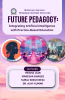
Future Pedagogy: Integrating Artificial Intelligence with Practice-Based Education
Keywords:
Future pedagogy, Practice-based learning, AI-enabled teaching, Wissira Research Lab, Wissira Press, Books by WissiraSynopsis
The landscape of education is undergoing an unprecedented transformation, driven by the rapid integration of Artificial Intelligence (AI) into teaching and learning processes. Traditional pedagogy, long rooted in memorization and standardized testing, is increasingly being challenged by approaches that emphasize creativity, adaptability, and experiential learning. As industries evolve toward automation and knowledge-driven economies, education systems must also adapt to prepare learners not only with subject knowledge but with the skills and resilience required for uncertain futures.
This book, Future Pedagogy: Integrating Artificial Intelligence with Practice-Based Education, emerges from the recognition that AI is not merely a technological tool but a catalyst for rethinking how learning is designed, delivered, and experienced. By bridging theory with practice, AI-enabled pedagogy ensures that learners engage deeply with concepts, acquire job-ready skills, and cultivate critical thinking abilities. The chapters in this volume explore diverse dimensions of this integration—from intelligent learning environments and virtual classrooms to ethical considerations, equity in access, and the role of educators in AI-driven ecosystems.
Our collective effort as authors has been guided by the conviction that education must remain human-Centered even as it becomes technologically advanced. We believe that AI should complement, rather than replace, the creativity, empathy, and ethical reasoning of teachers and learners. The insights, case studies, and frameworks presented here are intended not only for researchers and educators but also for policymakers and industry leaders seeking to align educational innovation with societal needs.
We extend our gratitude to Maharaja Agrasen Himalayan Garhwal University, whose academic environment and encouragement have been invaluable in shaping this work. We are also deeply thankful to colleagues, students, and practitioners whose experiences and reflections enriched the perspectives shared in these chapters.
It is our hope that this book will serve as both a guide and an inspiration for those committed to building a future-ready education system—one where AI and practice-based pedagogy converge to empower learners for lifelong growth, meaningful careers, and responsible citizenship.
Chapters
-
Chapter 1: Rethinking Pedagogy in the Age of Artificial Intelligence
-
Chapter 2: Foundations of Practice-Based Education
-
Chapter 3: AI as a Catalyst for Experiential Learning
-
Chapter 4: Intelligent Learning Environments and Virtual Classrooms
-
Chapter 5: Human–AI Collaboration in Skill Development
-
Chapter 6: AI for Continuous Assessment and Feedback Loops
-
Chapter 7: Ethics, Equity, and Inclusivity in AI-Driven Pedagogy
-
Chapter 8: Preparing Educators for AI-Enhanced Practice-Based Teaching
-
Chapter 9: Case Studies and Global Practices in AI-Integrated Pedagogy
-
Chapter 10: The Future Roadmap of AI-Driven Practice-Based Education
Downloads
References
Selwyn, N. (2019). Should Robots Replace Teachers? AI and the Future of Education. Polity Press.
Luckin, R., Holmes, W., Griffiths, M., & Forcier, L. B. (2016). Intelligence Unleashed: An Argument for AI in Education. Pearson.
Holmes, W., Bialik, M., & Fadel, C. (2019). Artificial Intelligence in Education: Promises and Implications for Teaching and Learning. Centre for Curriculum Redesign.
OECD (2021). Artificial Intelligence in Society: Education and Skills. OECD Publishing.
Siemens, G. (2013). Learning Analytics: The Emergence of a Discipline. American Behavioural Scientist, 57(10), 1380–1400.
Dewey, J. (1938). Experience and Education. Macmillan.
Kolb, D. A. (1984). Experiential Learning: Experience as the Source of Learning and Development. Prentice Hall.
Lave, J., & Wenger, E. (1991). Situated Learning: Legitimate Peripheral Participation. Cambridge University Press.
Biggs, J., & Tang, C. (2011). Teaching for Quality Learning at University. McGraw-Hill Education.
Boud, D., & Solomon, N. (Eds.). (2001). Work-Based Learning: A New Higher Education? McGraw-Hill.
Heffernan, N. T., & Heffernan, C. L. (2014). The ASSISTments Ecosystem. International Journal of Artificial Intelligence in Education, 24(4), 470–497.
Mhlanga, D. (2023). Artificial Intelligence in Higher Education: Applications, Impacts, and Future Trends. International Journal of Education and Development Using ICT, 19(1), 1–15.
Johnson, L., Becker, S., & Cummins, M. (2014). Technology Outlook for STEM+ Education 2013–2018: An NMC Horizon Project Sector Analysis. The New Media Consortium.
Siemens, G., & Long, P. (2011). Penetrating the Fog: Analytics in Learning and Education. EDUCAUSE Review, 46(5), 30–40.
Laurillard, D. (2012). Teaching as a Design Science: Building Pedagogical Patterns for Learning and Technology. Routledge.
UNESCO (2021). AI and Education: Guidance for Policymakers. UNESCO Publishing.
Singh, A., & Awasthi, R. (2020). Updated Comparative Analysis on Video Conferencing Platforms. EasyChair Preprint.
Zawacki-Richter, O., et al. (2019). Systematic Review of Research on Artificial Intelligence Applications in Higher Education. International Journal of Educational Technology in Higher Education, 16(39).
Holmes, W., et al. (2019). Artificial Intelligence in Education: Promises and Implications for Teaching and Learning. Centre for Curriculum Redesign.
Anderson, T., & Dron, J. (2011). Three Generations of Distance Education Pedagogy. International Review of Research in Open and Distributed Learning, 12(3), 80–97.
Brynjolfsson, E., & McAfee, A. (2014). The Second Machine Age. W. W. Norton.
Davenport, T., & Kirby, J. (2016). Just How Smart Are Smart Machines? MIT Sloan Management Review, 57(3), 21–25.
PwC. (2018). Will Robots Really Steal Our Jobs? PricewaterhouseCoopers Report.
Rolstad, K., & MacSwan, J. (2014). Beyond Cognition: Language, Culture, and Human–AI Collaboration. Language Learning, 64(4), 943–959.
IBM (2020). AI Skills Academy: Training for the Future Workforce. IBM White Paper.
Shute, V. J. (2008). Focus on Formative Feedback. Review of Educational Research, 78(1), 153–189.
Black, P., & Wiliam, D. (1998). Inside the Black Box: Raising Standards Through Classroom Assessment. Phi Delta Kappan, 80(2), 139–148.
Baker, R. S., & Siemens, G. (2014). Educational Data Mining and Learning Analytics. Cambridge Handbook of the Learning Sciences. Cambridge University Press.
Heffernan, N. T. (2016). Real-Time Feedback and AI in Assessments. Journal of Learning Analytics, 3(2), 1–15.
Holmes, W., et al. (2021). AI-Assisted Feedback Systems in Higher Education. British Journal of Educational Technology, 52(4), 1–17.
European Commission (2019). Ethics Guidelines for Trustworthy AI. Brussels: EC.
UNESCO (2021). AI and Education: Guidance for Policymakers. Paris: UNESCO.
Floridi, L., & Cowls, J. (2019). A Unified Framework of Five Principles for AI in Society. Harvard Data Science Review, 1(1).
Crawford, K. (2021). Atlas of AI: Power, Politics, and the Planetary Costs of Artificial Intelligence. Yale University Press.
Microsoft (2019). AI for Accessibility. Microsoft Inclusive Technology Report.
Darling-Hammond, L. (2006). Powerful Teacher Education: Lessons from Exemplary Programs. Jossey-Bass.
IBM (2020). AI Education Program for Teachers. IBM Research White Paper.
Holmes, W., & Tuomi, I. (2021). Educators in the Age of AI. European Journal of Education, 56(4), 543–559.
Ng, A. (2018). AI for Everyone [MOOC]. Coursera.
Finnish Ministry of Education (2019). Elements of AI: A National Curriculum Case Study.
Stanford University (2019). AI-Powered Teaching Assistants in Computer Science. Stanford AI Lab.
Ministry of Education, Singapore (2020). National AI Strategy: Education Sector Implementation. Government of Singapore.
Germany Federal Ministry of Education and Research (2021). Industry 4.0 and AI in Vocational Education. Berlin: BMBF.
NITI Aayog (2020). AI for All: India’s National Strategy on Artificial Intelligence. Government of India.
PwC (2020). AI-Driven Upskilling for the Workforce of the Future. PwC Global Report.
OECD (2021). The Future of Education and Skills: Education 2030. OECD Publishing.
UNESCO (2022). Reimagining Our Futures Together: A New Social Contract for Education. Paris: UNESCO.
World Economic Forum (2020). The Future of Jobs Report. Geneva: WEF.
Gartner (2021). Emerging Technologies and the Future of Education. Gartner Research.
Google (2020). AI and Workforce Training: Industry–Academia Partnerships. Google Education Report.
Published
License

This work is licensed under a Creative Commons Attribution 4.0 International License.
Creative Commons Attribution 4.0 International (CC BY 4.0) — License Terms
The Creative Commons Attribution 4.0 International License (CC BY 4.0) is one of the most permissive open licenses. It allows others to use, share, and build upon a work for any purpose—including commercial use—provided that proper credit is given to the original creator.
1. Permissions Granted
Under CC BY 4.0, anyone may:
a) Share
Copy and redistribute the material in any medium or format (print, digital, audio, video, etc.).
b) Adapt
Remix, transform, translate, or build upon the material.
c) Commercial Use Allowed
The work may be used for commercial purposes, including resale, inclusion in paid products, or monetized distribution.
d) No Additional Permission Required
Users do not need to contact the author for permission, as long as they follow the license conditions.
2. Attribution Requirements (Core Condition)
Users must give appropriate credit to the original creator. Attribution should include:
- Name of the author/creator
- Title of the work (if available)
- Source (publisher, website, or platform)
- Link to the original work (if online)
- Link to the CC BY 4.0 license
- Indication of any changes made
Example Attribution:
“Title of Work” by Author Name is licensed under CC BY 4.0.
Adapted from the original available at [URL].
3. Indicating Changes
If the material is modified, translated, shortened, or otherwise altered, users must clearly state that changes were made.
Examples:
- “Translated from the original”
- “Adapted from…”
- “Modified version of…”
4. No Additional Restrictions
Users may not:
- Apply legal terms or technological measures (such as DRM) that restrict others from exercising the license rights
- Impose new licensing conditions that contradict CC BY 4.0
5. Rights Not Covered by the License
CC BY 4.0 does not automatically grant:
- Patent rights
- Trademark rights
- Privacy or publicity rights
- Moral rights where they cannot be waived by law
Users must ensure compliance with these separately.
6. Disclaimer of Warranties
The material is provided “as-is.”
The licensor (author/publisher) gives no guarantees regarding accuracy, suitability, or fitness for any purpose.
7. Termination and Reinstatement
- The license remains valid as long as the terms are followed.
- If a user violates the terms (e.g., fails to attribute), the rights terminate automatically.
- Rights may be reinstated if the violation is corrected within 30 days of discovery.
8. International Scope
CC BY 4.0 is designed to work worldwide and is not limited to any specific country’s copyright law.
Suggested Copyright Notice Using CC BY 4.0
© [Year] [Author Name].
This work is licensed under the Creative Commons Attribution 4.0 International License (CC BY 4.0).
To view a copy of this license, visit: https://creativecommons.org/licenses/by/4.0/
You are free to share and adapt this work for any purpose, even commercially, provided that appropriate credit is given.









