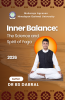
Inner Balance: The Science and Spirit of Yoga
Keywords:
Yoga philosophy, Holistic wellness, Inner peace, Wissira Research Lab, Wissira Press Publications, Books by WissiraSynopsis
In a world that constantly demands more speed, productivity, and external achievement, the quiet art of inner balance has never been more essential. Yoga, in its truest essence, offers that balance-a union between effort and ease, body and mind, science and spirit. It reminds us that well-being is not found in escape from life’s challenges but in our ability to meet them with awareness, composure, and compassion.
This book, Inner Balance: The Science and Spirit of Yoga, is an attempt to bridge the ancient and the modern-to explore yoga not only as a sacred spiritual tradition but also as a living science supported by contemporary research in physiology, psychology, and neuroscience. While modern society often views yoga as a form of physical exercise or stress relief, its true purpose extends far deeper: to harmonize the layers of human existence-physical, mental, emotional, and spiritual.
The chapters unfold as a journey. The early sections explore yoga’s origins and philosophical foundations, revealing how concepts of balance and self-realization emerged from ancient wisdom. Subsequent chapters connect this heritage to the sciences of the body, breath, and mind, illustrating how yoga fosters resilience, emotional stability, and mental clarity. Later chapters address yoga’s role in mental health, nutrition, and lifestyle, before culminating in discussions of spirituality, community well-being, and the pursuit of liberation.
Throughout, this work emphasizes that yoga is not a religion or a rigid discipline-it is a universal method of self-understanding. It welcomes inquiry, encourages scientific validation, and invites personal experience. The aim is not to convince but to awaken-to help readers rediscover that calm, Centered awareness already presents within themselves.
I owe deep gratitude to the teachers, scientists, practitioners, and seekers who have preserved and evolved this wisdom through generations. Their efforts have made yoga accessible to people across cultures and disciplines. I also extend heartfelt appreciation to readers who approach this text with open hearts and curious minds.
May this book serve as both a map and a mirror-a guide to understanding the inner landscape and a reflection of the balance that yoga cultivates. May it inspire you not only to practice but to live yoga-in thought, word, and deed-bringing harmony to yourself and to the world around you.
Chapters
-
Chapter 1: Origins of Yoga – From Ancient Wisdom to Modern Relevance
-
Chapter 2: The Philosophy of Inner Balance
-
Chapter 3: Anatomy of Stillness – The Body in Yoga
-
Chapter 4: Breath as Life Force – The Science of Pranayama
-
Chapter 5: Yoga and the Mind – Neuroscience of Meditation
-
Chapter 6: Energy Pathways – Chakras and Subtle Anatomy
-
Chapter 7: Yoga and Mental Health – A Therapeutic Lens
-
Chapter 8: Nutrition, Lifestyle, and Yogic Living
-
Chapter 9: Spiritual Dimensions of Practice – Beyond the Mat
Downloads
References
Bryant, E. (2009). The Yoga Sutras of Patanjali: A New Edition, Translation, and Commentary. North Point Press.
Feuerstein, G. (2008). The Yoga Tradition: Its History, Literature, Philosophy and Practice. Hohm Press.
Singleton, M. (2010). Yoga Body: The Origins of Modern Posture Practice. Oxford University Press.
Rangan, R., Nagendra, H., & Bhat, G. R. (2013). Effect of yogic education system and modern education system on memory. International Journal of Yoga, 6(1), 55–59.
Vivekananda, S. (2007). Raja Yoga. Advaita Ashrama.
Saraswati, S. S. (2008). Four Chapters on Freedom: Commentary on the Yoga Sutras of Patanjali. Yoga Publications Trust.
Tran, M. D., Holly, R. G., Lashbrook, J., & Amsterdam, E. A. (2001). Effects of hatha yoga practice on health-related aspects of physical fitness. Preventive Cardiology, 4(4), 165–170.
Broad, W. J. (2012). The Science of Yoga: The Risks and the Rewards. Simon & Schuster.
Cowen, V. S., & Adams, T. B. (2005). Physical and perceptual benefits of yoga asana practice: Results of a pilot study. Journal of Bodywork and Movement Therapies, 9(3), 211–219.
Brown, R. P., & Gerbarg, P. L. (2005). Sudarshan Kriya yogic breathing in the treatment of stress, anxiety, and depression: Part II-clinical applications and guidelines. Journal of Alternative and Complementary Medicine, 11(4), 711–717.
Jerath, R., Edry, J. W., Barnes, V. A., & Jerath, V. (2006). Physiology of long pranayamic breathing: Neural respiratory elements may provide a mechanism that explains how slow breathing shifts the autonomic nervous system. Medical Hypotheses, 67(3), 566–571.
Saraswati, S. S. (1996). Prana and Pranayama. Yoga Publications Trust.
Davidson, R. J., & Lutz, A. (2008). Buddha’s brain: Neuroplasticity and meditation. IEEE Signal Processing Magazine, 25(1), 171–174.
Lazar, S. W., et al. (2005). Meditation experience is associated with increased cortical thickness. NeuroReport, 16(17), 1893–1897.
Motoyama, H. (1981). Theories of the Chakras: Bridge to Higher Consciousness. Quest Books.
Anodea, J. (2011). Wheels of Life: A User’s Guide to the Chakra System. Llewellyn Publications.
Kaur, C., & Singh, P. (2015). Yogic concept of chakras and its relevance in psychology. Indian Journal of Health and Wellbeing, 6(6), 607–610.
Streeter, C. C., et al. (2010). Effects of yoga on the autonomic nervous system, gamma-aminobutyric-acid, and allostasis in epilepsy, depression, and post-traumatic stress disorder. Medical Hypotheses, 78(5), 571–579.
Uebelacker, L. A., & Broughton, M. K. (2016). Yoga for depression and anxiety: A review of published research and implications for healthcare providers. Rhode Island Medical Journal, 99(3), 20–22.
van der Kolk, B. A. (2014). The Body Keeps the Score: Brain, Mind, and Body in the Healing of Trauma. Viking.
Telles, S., & Sharma, S. K. (2021). Lifestyle, yoga, and health: Mind-body medicine perspective. Indian Journal of Community Medicine, 46(4), 562–567.
Lad, V. (2002). Ayurveda: The Science of Self-Healing. Lotus Press.
Harvard Health Publishing. (2019). The power of mindful eating. Harvard Medical School.
Gandhi, M. K. (1993). The Essential Gandhi: An Anthology of His Writings on His Life, Work, and Ideas. Vintage.
Feuerstein, G. (2001). The Yoga Tradition: Philosophy, Literature, History, Practice. Hohm Press.
Seppälä, E. M., et al. (2014). Loving-kindness meditation: A tool for self-care and well-being. Journal of Clinical Psychology, 70(7), 661–674.
Published
License

This work is licensed under a Creative Commons Attribution 4.0 International License.
Creative Commons Attribution 4.0 International (CC BY 4.0) — License Terms
The Creative Commons Attribution 4.0 International License (CC BY 4.0) is one of the most permissive open licenses. It allows others to use, share, and build upon a work for any purpose—including commercial use—provided that proper credit is given to the original creator.
1. Permissions Granted
Under CC BY 4.0, anyone may:
a) Share
Copy and redistribute the material in any medium or format (print, digital, audio, video, etc.).
b) Adapt
Remix, transform, translate, or build upon the material.
c) Commercial Use Allowed
The work may be used for commercial purposes, including resale, inclusion in paid products, or monetized distribution.
d) No Additional Permission Required
Users do not need to contact the author for permission, as long as they follow the license conditions.
2. Attribution Requirements (Core Condition)
Users must give appropriate credit to the original creator. Attribution should include:
- Name of the author/creator
- Title of the work (if available)
- Source (publisher, website, or platform)
- Link to the original work (if online)
- Link to the CC BY 4.0 license
- Indication of any changes made
Example Attribution:
“Title of Work” by Author Name is licensed under CC BY 4.0.
Adapted from the original available at [URL].
3. Indicating Changes
If the material is modified, translated, shortened, or otherwise altered, users must clearly state that changes were made.
Examples:
- “Translated from the original”
- “Adapted from…”
- “Modified version of…”
4. No Additional Restrictions
Users may not:
- Apply legal terms or technological measures (such as DRM) that restrict others from exercising the license rights
- Impose new licensing conditions that contradict CC BY 4.0
5. Rights Not Covered by the License
CC BY 4.0 does not automatically grant:
- Patent rights
- Trademark rights
- Privacy or publicity rights
- Moral rights where they cannot be waived by law
Users must ensure compliance with these separately.
6. Disclaimer of Warranties
The material is provided “as-is.”
The licensor (author/publisher) gives no guarantees regarding accuracy, suitability, or fitness for any purpose.
7. Termination and Reinstatement
- The license remains valid as long as the terms are followed.
- If a user violates the terms (e.g., fails to attribute), the rights terminate automatically.
- Rights may be reinstated if the violation is corrected within 30 days of discovery.
8. International Scope
CC BY 4.0 is designed to work worldwide and is not limited to any specific country’s copyright law.
Suggested Copyright Notice Using CC BY 4.0
© [Year] [Author Name].
This work is licensed under the Creative Commons Attribution 4.0 International License (CC BY 4.0).
To view a copy of this license, visit: https://creativecommons.org/licenses/by/4.0/
You are free to share and adapt this work for any purpose, even commercially, provided that appropriate credit is given.