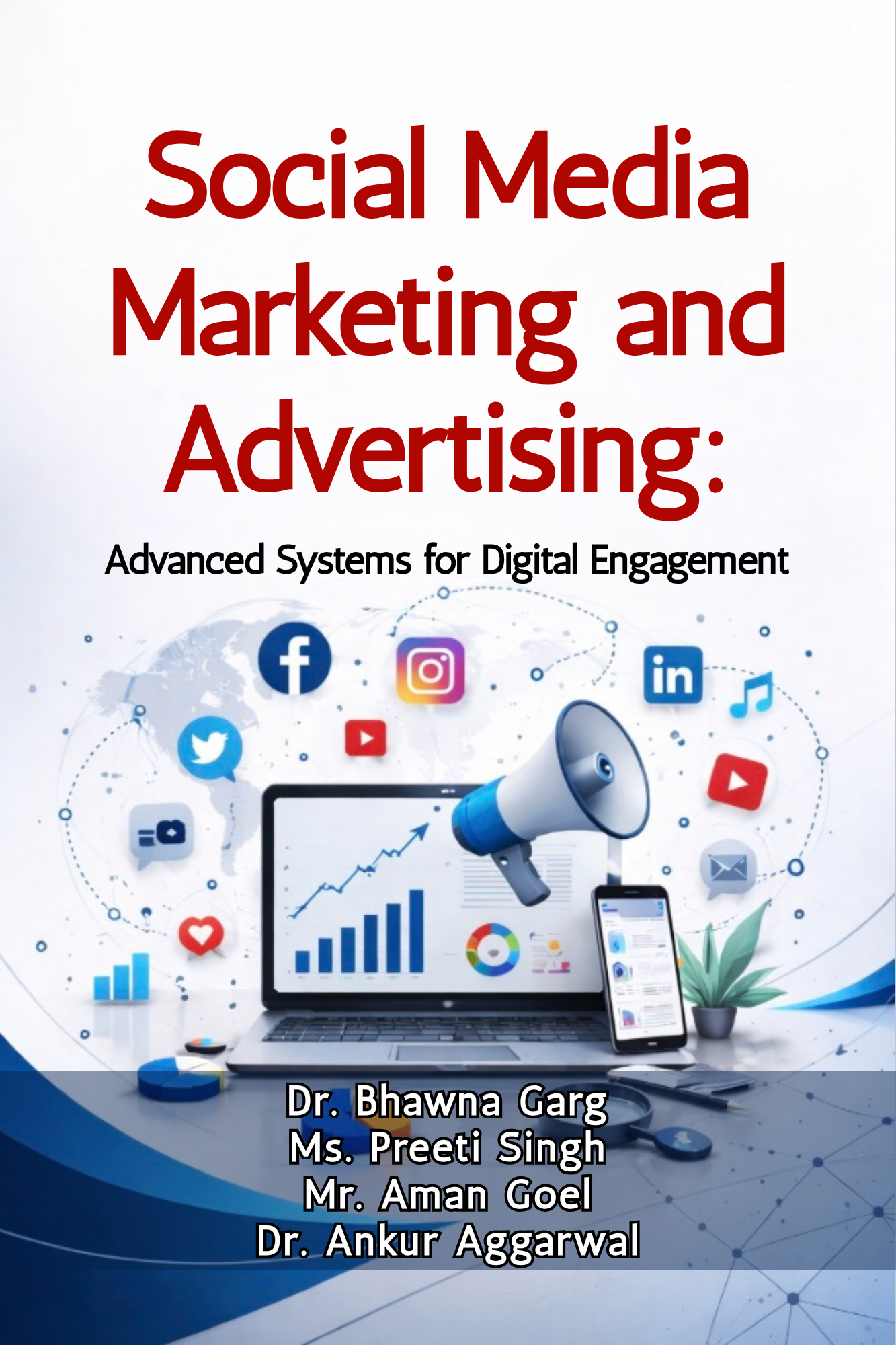
Social Media Marketing and Advertising: Advanced Systems for Digital Engagement
Keywords:
Social Media Marketing, Digital Advertising, Social Media Platforms, Wissira Press Publications, Wissira Research Lab, Books by WissiraSynopsis
The rapid expansion of digital communication technologies has transformed the way organizations connect with audiences, promote products, and build brand value. Social media platforms have evolved from informal networking spaces into sophisticated marketing ecosystems supported by advanced analytics, automation, and advertising systems. In this dynamic environment, marketing is no longer confined to traditional media channels; it is interactive, data-driven, personalized, and measurable. The book Social Media Marketing and Advertising has been developed to provide a comprehensive and structured understanding of this evolving discipline.
Marketing in the digital era demands more than creativity. It requires strategic thinking, technological competence, ethical awareness, and analytical capability. Businesses must understand how to integrate websites, search engines, social networks, email systems, mobile applications, and advertising platforms into a unified strategy. The ability to analyse user behaviour, segment audiences, optimize campaigns, and measure performance outcomes has become essential for both practitioners and scholars.
This book is organized into four major thematic units. The first unit introduces digital marketing foundations, including strategic planning, website development, analytics, search optimization, and email marketing. It establishes the conceptual and technological base necessary for understanding digital ecosystems. The second unit explores content marketing and social media advertising platforms, emphasizing the importance of relevance, engagement, and mobile-first communication. The third unit examines social media strategy, audience segmentation, promotional campaigns, digital vouchers, and performance monitoring. The fourth unit focuses on responsible campaign creation, including policy compliance, customer service management, conflict resolution, and professional online communication.
Throughout the text, emphasis is placed on practical application. Real-world examples and case-based illustrations demonstrate how theoretical principles operate in competitive digital environments. Readers are guided through the processes of planning, executing, monitoring, and refining social media campaigns while maintaining ethical and legal standards. Special attention is given to measurable outcomes, ensuring that marketing decisions are grounded in data rather than assumption.
The intended audience for this book includes undergraduate and postgraduate students of marketing and management, business professionals, entrepreneurs, digital strategists, and anyone seeking structured knowledge of social media marketing practices. The content has been presented in a systematic and accessible manner while maintaining academic rigor suitable for coursework, training programs, and professional development.
As digital platforms continue to evolve, marketing professionals must remain adaptable and forward-thinking. Emerging technologies such as artificial intelligence, automation tools, immersive media, and social commerce are redefining engagement strategies. However, despite technological change, the fundamental objective remains constant: to create meaningful value for customers and build sustainable relationships.
It is hoped that this book will serve as both a foundational guide and a practical resource for understanding and applying the principles of social media marketing and advertising in a responsible, innovative, and results-oriented manner.
Chapters
-
Chapter-1 Foundations of Digital Marketing Strategy, Website Development, and Performance Analytics
-
Chapter-2 Search, Social, and Video Marketing: Strategies for Visibility, Engagement, and Conversion
-
Chapter-3 Email Marketing Fundamentals: Tools, Segmentation, Personalization, and Deliverability
-
Chapter-4 Content Marketing Strategies and Mobile-Driven Engagement Foundations
-
Chapter-5 Social Media Advertising Platforms and Formats
-
Chapter-6 Social Media Marketing Tools, Audience Targeting, and Promotional Campaign Strategies
-
Chapter-7 Digital Voucher Strategies: Implementation, Management, and Performance Evaluation
-
Chapter-8 Strategic Planning, Execution, and Optimization of Social Networking Advertising Campaigns
-
Chapter-9 Target Audience Identification, Ethical Compliance, and Reputation Management in Social Media Marketing
Downloads
References
Chaffey, D., & Ellis-Chadwick, F. (2022). Digital marketing: Strategy, implementation and practice (8th ed.). Pearson.
Kingsnorth, S. (2022). Digital marketing strategy: An integrated approach to online marketing (3rd ed.). Kogan Page.
Ryan, D. (2016). Understanding digital marketing: Marketing strategies for engaging the digital generation (4th ed.). Kogan Page.
Kotler, P., Kartajaya, H., & Setiawan, I. (2017). Marketing 4.0: Moving from traditional to digital. Wiley.
Kaushik, A. (2010). Web analytics 2.0: The art of online accountability and science of customer centricity. Wiley.
Clifton, B. (2012). Advanced web metrics with Google Analytics (3rd ed.). Wiley.
Krug, S. (2014). Don’t make me think: A common-sense approach to web usability (3rd ed.). New Riders.
Tuten, T. L., & Solomon, M. R. (2023). Social media marketing (4th ed.). Sage Publications.
Fishkin, R., & Høgenhaven, T. (2013). Inbound marketing and SEO: Insights from the Moz blog. Wiley.
Ledford, J. L. (2015). SEO: Search engine optimization bible (3rd ed.). Wiley.
Evans, D. (2012). Social media marketing: An hour a day. Wiley.
Järvinen, J., & Karjaluoto, H. (2015). The use of web analytics for digital marketing performance measurement. Industrial Marketing Management, 50, 117–127.
Kaplan, A. M., & Haenlein, M. (2010). Users of the world, unite! The challenges and opportunities of social media. Business Horizons, 53(1), 59–68.
Kietzmann, J. H., Hermkens, K., McCarthy, I. P., & Silvestre, B. S. (2011). Social media? Get serious! Understanding the functional building blocks of social media. Business Horizons, 54(3), 241–251.
Tuten, T. L., & Solomon, M. R. (2023). Social media marketing (4th ed.). Sage Publications.
Hollensen, S. (2020). Marketing management: A relationship approach (4th ed.). Pearson.
Chaffey, D., & Smith, P. R. (2022). Digital marketing excellence (6th ed.). Routledge.
Ellis-Chadwick, F., & Doherty, N. (2012). Web advertising: The role of e-mail marketing. Journal of Business Research, 65(6), 843–848.
Ryan, D. (2016). Understanding digital marketing (4th ed.). Kogan Page.
Strauss, J., & Frost, R. (2014). E-marketing (7th ed.). Pearson.
Pulizzi, J. (2014). Epic content marketing. McGraw-Hill Education.
Holliman, G., & Rowley, J. (2014). Business to business digital content marketing: Marketers’ perceptions of best practice. Journal of Research in Interactive Marketing, 8(4), 269–293.
Rowley, J. (2008). Understanding digital content marketing. Journal of Marketing Management, 24(5–6), 517–540.
Kingsnorth, S. (2022). Digital marketing strategy (3rd ed.). Kogan Page.
Facebook (Meta) Business. (2023). Meta Ads Manager guide. Meta Platforms Inc.
Tuten, T. L., & Solomon, M. R. (2023). Social media marketing (4th ed.). Sage Publications.
Lipsman, A., Mudd, G., Rich, M., & Bruich, S. (2012). The power of “Like.” Journal of Advertising Research, 52(1), 40–52.
Lee, D., Hosanagar, K., & Nair, H. S. (2018). Advertising content and consumer engagement on social media. Management Science, 64(11), 5105–5131.
Smith, P. R., & Zook, Z. (2016). Marketing communications: Integrating offline and online with social media (6th ed.). Kogan Page.
Kotler, P., & Keller, K. L. (2016). Marketing management (15th ed.). Pearson.
Wedel, M., & Kannan, P. K. (2016). Marketing analytics for data-rich environments. Journal of Marketing, 80(6), 97–121.
Chaffey, D., & Ellis-Chadwick, F. (2022). Digital marketing (8th ed.). Pearson.
Blattberg, R. C., & Neslin, S. A. (1990). Sales promotion: Concepts, methods, and strategies. Prentice Hall.
Kotler, P., & Armstrong, G. (2021). Principles of marketing (18th ed.). Pearson.
Grewal, D., Roggeveen, A. L., & Nordfält, J. (2017). The future of retailing. Journal of Retailing, 93(1), 1–6.
Shankar, V., & Balasubramanian, S. (2009). Mobile marketing: A synthesis and prognosis. Journal of Interactive Marketing, 23(2), 118–129.
Downloads
Published
License

This work is licensed under a Creative Commons Attribution 4.0 International License.
Creative Commons Attribution 4.0 International (CC BY 4.0) — License Terms
The Creative Commons Attribution 4.0 International License (CC BY 4.0) is one of the most permissive open licenses. It allows others to use, share, and build upon a work for any purpose—including commercial use—provided that proper credit is given to the original creator.
1. Permissions Granted
Under CC BY 4.0, anyone may:
a) Share
Copy and redistribute the material in any medium or format (print, digital, audio, video, etc.).
b) Adapt
Remix, transform, translate, or build upon the material.
c) Commercial Use Allowed
The work may be used for commercial purposes, including resale, inclusion in paid products, or monetized distribution.
d) No Additional Permission Required
Users do not need to contact the author for permission, as long as they follow the license conditions.
2. Attribution Requirements (Core Condition)
Users must give appropriate credit to the original creator. Attribution should include:
- Name of the author/creator
- Title of the work (if available)
- Source (publisher, website, or platform)
- Link to the original work (if online)
- Link to the CC BY 4.0 license
- Indication of any changes made
Example Attribution:
“Title of Work” by Author Name is licensed under CC BY 4.0.
Adapted from the original available at [URL].
3. Indicating Changes
If the material is modified, translated, shortened, or otherwise altered, users must clearly state that changes were made.
Examples:
- “Translated from the original”
- “Adapted from…”
- “Modified version of…”
4. No Additional Restrictions
Users may not:
- Apply legal terms or technological measures (such as DRM) that restrict others from exercising the license rights
- Impose new licensing conditions that contradict CC BY 4.0
5. Rights Not Covered by the License
CC BY 4.0 does not automatically grant:
- Patent rights
- Trademark rights
- Privacy or publicity rights
- Moral rights where they cannot be waived by law
Users must ensure compliance with these separately.
6. Disclaimer of Warranties
The material is provided “as-is.”
The licensor (author/publisher) gives no guarantees regarding accuracy, suitability, or fitness for any purpose.
7. Termination and Reinstatement
- The license remains valid as long as the terms are followed.
- If a user violates the terms (e.g., fails to attribute), the rights terminate automatically.
- Rights may be reinstated if the violation is corrected within 30 days of discovery.
8. International Scope
CC BY 4.0 is designed to work worldwide and is not limited to any specific country’s copyright law.
Suggested Copyright Notice Using CC BY 4.0
© [Year] [Author Name].
This work is licensed under the Creative Commons Attribution 4.0 International License (CC BY 4.0).
To view a copy of this license, visit: https://creativecommons.org/licenses/by/4.0/
You are free to share and adapt this work for any purpose, even commercially, provided that appropriate credit is given.









