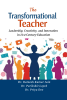
The Transformational Teacher Leadership, Creativity, and Innovation in 21st Century Education
Keywords:
21st Century Education, Educational Innovation, Literacy in Education, Wissira Press Publications, Wissira Research Lab, Books by WissiraSynopsis
Education in the twenty-first century stands at a defining crossroads. Rapid technological advancement, shifting societal expectations, global interconnectivity, and evolving learner needs have fundamentally reshaped what it means to teach and to learn. Classrooms are no longer confined by walls, textbooks are no longer the sole repositories of knowledge, and teachers are no longer mere transmitters of information. They are leaders, designers, innovators, mentors, and change-makers.
The Transformational Teacher: Leadership, Creativity, and Innovation in 21st Century Education emerges from the recognition that modern education demands far more than subject expertise. It requires vision. It requires adaptability. Above all, it requires educators who are willing to transform themselves in order to transform the lives of their students.
This book is built upon a central belief: that teaching is both a science and an art, and that transformational educators consciously integrate leadership, creativity, emotional intelligence, and innovation into their daily practice. The chapters that follow provide a comprehensive framework for understanding and embodying this new professional identity.
Chapter 1 explores the evolution of the teacher’s role in the 21st century, tracing the shift from traditional instruction to dynamic facilitation, mentorship, and global preparation. It lays the foundation for understanding why transformation is no longer optional-it is essential.
Chapter 2 introduces the foundations of transformational teacher leadership. It examines purpose-driven teaching, ethical influence, emotional intelligence, and shared leadership as pillars of impactful classroom practice.
Chapter 3 moves into culture-building, highlighting how visionary classrooms are intentionally designed environments that cultivate growth mindset, inclusion, collaboration, and meaningful traditions.
Chapter 4 positions creativity as a core teaching competency rather than an optional enhancement. It demonstrates how curiosity, divergent thinking, and design thinking methodologies can energize learning and deepen understanding.
Chapter 5 focuses on innovation in pedagogy and curriculum design. It explores differentiation, personalized learning pathways, blended models, and sustainable innovation strategies that respond to diverse learner needs.
Chapter 6 addresses technology integration-not as a tool-driven trend, but as a transformational force. It examines digital literacy, artificial intelligence, ethical responsibility, and collaborative digital ecosystems that expand the boundaries of learning.
Chapter 7 centres on emotional intelligence and student empowerment. It underscores the importance of empathy, resilience-building, and cultivating student agency in an era marked by complexity and change.
Chapter 8 highlights collaborative leadership and professional learning communities. It reinforces the idea that sustainable transformation is collective, not individual, and that educators thrive through shared vision and mutual growth.
Finally, Chapter 9 reframes assessment as a tool for growth and innovation rather than judgment. It explores feedback systems, reflective practices, and alternative evaluation models that nurture continuous improvement.
This book is intended for educators, teacher leaders, school administrators, curriculum designers, and education scholars who believe that teaching is a profession of profound influence. It speaks to those who see classrooms not merely as instructional spaces, but as incubators of possibility.
The future of education will not be shaped by technology alone. It will be shaped by teachers who lead with integrity, teach with creativity, innovate with courage, and empower learners with compassion.
May this book serve as both a guide and an inspiration on that journey.
Chapters
-
Chapter-1 The Evolution of the Teacher’s Role in the 21st Century
-
Chapter-2 Foundations of Transformational Teacher Leadership
-
Chapter-3 Developing a Visionary Classroom Culture
-
Chapter-4 Creativity as a Core Teaching Competency
-
Chapter-5 Innovation in Pedagogy and Curriculum Design
-
Chapter-6 Technology Integration for Transformational Impact
-
Chapter-7 Emotional Intelligence and Student Empowerment
-
Chapter-8 Collaborative Leadership and Professional Learning Communities
-
Chapter-9 Assessment for Growth and Innovation
Downloads
References
Darling-Hammond, L., & Bransford, J. (Eds.). (2005). Preparing teachers for a changing world: What teachers should learn and be able to do. Jossey-Bass.
OECD. (2019). A flying start: Improving initial teacher preparation systems. OECD Publishing. https://doi.org/10.1787/cf74e549-en
UNESCO. (2021). Reimagining our futures together: A new social contract for education. UNESCO Publishing. https://unesdoc.unesco.org/ark:/48223/pf0000379707
Leithwood, K., & Jantzi, D. (2005). A review of transformational school leadership research 1996–2005. Leadership and Policy in Schools, 4(3), 177–199. https://doi.org/10.1080/15700760500244769
Leithwood, K., Harris, A., & Hopkins, D. (2020). Seven strong claims about successful school leadership revisited. School Leadership & Management, 40(1), 5–22. https://doi.org/10.1080/13632434.2019.1596077
Hallinger, P. (2003). Leading educational change: Reflections on the practice of instructional and transformational leadership. Cambridge Journal of Education, 33(3), 329–352. https://doi.org/10.1080/0305764032000122005
Fullan, M. (2014). The principal: Three keys to maximizing impact. Jossey-Bass.
Senge, P. M., Cambron-McCabe, N., Lucas, T., Smith, B., Dutton, J., & Kleiner, A. (2012). Schools that learn (Updated ed.). Crown Business.
OECD. (2018). The future of education and skills: Education 2030. OECD Publishing. https://www.oecd.org/education/2030-project/
Beghetto, R. A., & Kaufman, J. C. (2014). Classroom contexts for creativity. In J. C. Kaufman & R. J. Sternberg (Eds.), The Cambridge handbook of creativity (pp. 395–412). Cambridge University Press.
Kaufman, J. C., & Beghetto, R. A. (2009). Beyond big and little: The four C model of creativity. Review of General Psychology, 13(1), 1–12. https://doi.org/10.1037/a0013688
Robinson, K. (2011). Out of our minds: Learning to be creative (Rev. ed.). Capstone.
Bruner, J. S. (1960). The process of education. Harvard University Press.
Tyler, R. W. (1949). Basic principles of curriculum and instruction. University of Chicago Press.
Wiggins, G., & McTighe, J. (2005). Understanding by design (Expanded 2nd ed.). ASCD.
Mishra, P., & Koehler, M. J. (2006). Technological pedagogical content knowledge: A framework for teacher knowledge. Teachers College Record, 108(6), 1017–1054.
Puentedura, R. R. (2014). SAMR: A contextualized introduction. Retrieved from http://www.hippasus.com/rrpweblog/
Voogt, J., Erstad, O., Dede, C., & Mishra, P. (2013). Challenges to learning and schooling in the digital networked world. Journal of Computer Assisted Learning, 29(5), 403–413. https://doi.org/10.1111/jcal.12029
Brackett, M. A., Rivers, S. E., & Salovey, P. (2011). Emotional intelligence: Implications for personal, social, academic, and workplace success. Social and Personality Psychology Compass, 5(1), 88–103. https://doi.org/10.1111/j.1751-9004.2010.00334.x
Goleman, D. (1995). Emotional intelligence. Bantam Books.
Zins, J. E., Weissberg, R. P., Wang, M. C., & Walberg, H. J. (Eds.). (2004). Building academic success on social and emotional learning. Teachers College Press.
DuFour, R., DuFour, R., Eaker, R., & Many, T. (2010). Learning by doing: A handbook for professional learning communities at work (2nd ed.). Solution Tree Press.
Hord, S. M. (1997). Professional learning communities: Communities of continuous inquiry and improvement. Southwest Educational Development Laboratory.
Vescio, V., Ross, D., & Adams, A. (2008). A review of research on the impact of professional learning communities on teaching practice and student learning. Teaching and Teacher Education, 24(1), 80–91. https://doi.org/10.1016/j.tate.2007.01.004
Black, P., & Wiliam, D. (1998). Assessment and classroom learning. Assessment in Education, 5(1), 7–74. https://doi.org/10.1080/0969595980050102
Darling-Hammond, L., & Adamson, F. (2014). Beyond the bubble test: How performance assessments support 21st century learning. Jossey-Bass.
McTighe, J., & Wiggins, G. (2012). The understanding by design guide to creating high-quality units. ASCD.
Published
License

This work is licensed under a Creative Commons Attribution 4.0 International License.
Creative Commons Attribution 4.0 International (CC BY 4.0) — License Terms
The Creative Commons Attribution 4.0 International License (CC BY 4.0) is one of the most permissive open licenses. It allows others to use, share, and build upon a work for any purpose—including commercial use—provided that proper credit is given to the original creator.
1. Permissions Granted
Under CC BY 4.0, anyone may:
a) Share
Copy and redistribute the material in any medium or format (print, digital, audio, video, etc.).
b) Adapt
Remix, transform, translate, or build upon the material.
c) Commercial Use Allowed
The work may be used for commercial purposes, including resale, inclusion in paid products, or monetized distribution.
d) No Additional Permission Required
Users do not need to contact the author for permission, as long as they follow the license conditions.
2. Attribution Requirements (Core Condition)
Users must give appropriate credit to the original creator. Attribution should include:
- Name of the author/creator
- Title of the work (if available)
- Source (publisher, website, or platform)
- Link to the original work (if online)
- Link to the CC BY 4.0 license
- Indication of any changes made
Example Attribution:
“Title of Work” by Author Name is licensed under CC BY 4.0.
Adapted from the original available at [URL].
3. Indicating Changes
If the material is modified, translated, shortened, or otherwise altered, users must clearly state that changes were made.
Examples:
- “Translated from the original”
- “Adapted from…”
- “Modified version of…”
4. No Additional Restrictions
Users may not:
- Apply legal terms or technological measures (such as DRM) that restrict others from exercising the license rights
- Impose new licensing conditions that contradict CC BY 4.0
5. Rights Not Covered by the License
CC BY 4.0 does not automatically grant:
- Patent rights
- Trademark rights
- Privacy or publicity rights
- Moral rights where they cannot be waived by law
Users must ensure compliance with these separately.
6. Disclaimer of Warranties
The material is provided “as-is.”
The licensor (author/publisher) gives no guarantees regarding accuracy, suitability, or fitness for any purpose.
7. Termination and Reinstatement
- The license remains valid as long as the terms are followed.
- If a user violates the terms (e.g., fails to attribute), the rights terminate automatically.
- Rights may be reinstated if the violation is corrected within 30 days of discovery.
8. International Scope
CC BY 4.0 is designed to work worldwide and is not limited to any specific country’s copyright law.
Suggested Copyright Notice Using CC BY 4.0
© [Year] [Author Name].
This work is licensed under the Creative Commons Attribution 4.0 International License (CC BY 4.0).
To view a copy of this license, visit: https://creativecommons.org/licenses/by/4.0/
You are free to share and adapt this work for any purpose, even commercially, provided that appropriate credit is given.









