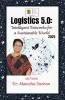
Logistics 5.0: Intelligent Networks for a Sustainable World
Synopsis
The logistics industry stands at a defining moment in history. For decades, global supply chains have evolved to become faster, interconnected, and technologically enabled. Yet the disruptions of the past few years-from pandemics and geopolitical tensions to climate emergencies and digital threats-have revealed a deeper truth: efficiency alone is no longer enough. The future requires intelligence, resilience, sustainability, and above all, human-centered innovation.
This book, Logistics 5.0: Intelligent Networks for a Sustainable World, emerges from this global shift. It explores how the next generation of logistics integrates artificial intelligence, automation, and data-driven insight with ethical principles, environmental responsibility, and compassionate design. Logistics 5.0 is not simply an upgrade in technology-it is a new philosophy for how goods, information, and value move across the world.
The chapters that follow bring together ideas from leading research, emerging industry practices, and real-world case studies to illustrate how logistics is transforming across warehouses, transportation networks, supply chain ecosystems, and last-mile operations. From digital twins and autonomous mobility to circular supply chains, blockchain-enabled trust, and climate-positive logistics, the book highlights the innovations shaping a more balanced and equitable future.
This work is intended for students, professionals, educators, policymakers, and innovators who share a common goal: building supply chains that are intelligent yet inclusive, high-performing yet sustainable, automated yet human-centric. Whether you are exploring the fundamentals of Logistics 5.0 or seeking advanced insights to redesign modern operations, this book offers a comprehensive foundation.
As you read, I invite you to imagine the possibilities of a world where technology strengthens-not replaces-human capability; where environmental stewardship is embedded in every logistical decision; and where global networks adapt with the speed and sensitivity needed for a rapidly changing world.
Logistics 5.0 is not a distant vision. It is an unfolding reality-and together, we are shaping it.
Chapters
-
Foundations of Logistics 5.0
-
Intelligent Automation and Cognitive Supply Chains
-
Sustainable Logistics Infrastructure and Green Operations
-
Human–AI Collaboration and Skills for Logistics 5.0
-
Blockchain, Transparency, and Ethical Traceability
-
Adaptive Transportation Networks and Autonomous Mobility
-
The Circular Supply Chain and Reverse Logistics Intelligence
-
Risk Intelligence, Resilience Engineering, and Cyber-Secure Logistics
-
The Future of Logistics 5.0: Socio-Economic, Technological, and Environmental Horizons
Downloads
References
Chapter 1 – Foundations of Logistics 5.0
1. European Commission. (2020). A European Green Deal. Brussels: European Union.
2. Kagermann, H., Wahlster, W., & Helbig, J. (2013). Recommendations for Implementing the Strategic Initiative INDUSTRIE 4.0. acatech.
3. World Economic Forum. (2020). The Resiliency Compass: Navigating Global Value Chain Disruption.
Chapter 2 – Intelligent Automation and Cognitive Supply Chains
1. Ben-Daya, M., Hassini, E., & Bahroun, Z. (2019). “Internet of Things and supply chain management.” International Journal of Production Research, 57(15–16), 4719–4742.
2. Wamba, S. F., et al. (2017). “Big data analytics and firm performance.” International Journal of Production Economics, 200, 104–118.
3. Zhong, R. Y., et al. (2017). “Intelligent manufacturing in the context of industry 4.0.” Engineering, 3(5), 616–630.
Chapter 3 – Sustainable Logistics Infrastructure and Green Operations
1. McKinnon, A. (2018). Decarbonizing Logistics: Distributing Goods in a Low Carbon World. Kogan Page.
2. IPCC. (2021). Climate Change 2021: Mitigation of Climate Change. Intergovernmental Panel on Climate Change.
3. Evangelista, P., & Huge-Brodin, M. (2019). “Environmental sustainability in third-party logistics service providers.” Transport Reviews, 39(4), 553–573.
Chapter 4 – Human–AI Collaboration and Skills for Logistics 5.0
1. OECD. (2019). Artificial Intelligence in Society. OECD Publishing.
2. Deloitte. (2021). The Augmented Workforce: Human + Machine Collaboration in Logistics.
3. Romero, D., & Stahre, J. (2017). “Towards the resilient operator 4.0.” Procedia Manufacturing, 3, 167–174.
Chapter 5 – Blockchain, Transparency, and Ethical Traceability
1. Kshetri, N. (2018). “Blockchain’s roles in meeting key supply chain management objectives.” International Journal of Information Management, 39, 80–89.
2. Saberi, S., et al. (2019). “Blockchain technology and its relationships to sustainable supply chain management.” International Journal of Production Research, 57(7), 2117–2135.
3. Casino, F., et al. (2019). “Blockchain-based food supply chain traceability.” Food Control, 96, 18–29.
Chapter 6 – Adaptive Transportation Networks and Autonomous Mobility
1. Goodall, N. (2019). Autonomous Vehicles and Transportation Systems. RAND Corporation.
2. Litman, T. (2020). Autonomous Vehicle Implementation Predictions. Victoria Transport Policy Institute.
3. Google/Waymo. (2020). Safety Performance Report.
Chapter 7 – Circular Supply Chains and Reverse Logistics Intelligence
1. Kirchherr, J., et al. (2018). “Barriers to the circular economy.” Journal of Cleaner Production, 222, 403–414.
2. Guide, V. D. R., & Van Wassenhove, L. N. (2009). “The evolution of closed-loop supply chain research.” Operations Research, 57(1), 10–18.
3. Ellen MacArthur Foundation. (2020). The Circular Economy in Detail.
Chapter 8 – Risk Intelligence, Resilience Engineering, and Cyber-Secure Logistics
1. Ivanov, D. (2021). “Supply chain viability and the COVID-19 pandemic.” International Journal of Production Research, 59(12), 3535–3545.
2. Jüttner, U., Peck, H., & Christopher, M. (2003). “Supply chain risk management.” International Journal of Logistics Management, 14(2), 197–210.
3. National Institute of Standards and Technology. (2018). NIST Cybersecurity Framework 1.1.
Chapter 9 – The Future of Logistics 5.0
1. World Economic Forum. (2022). Future of Supply Chain 2030.
2. Accenture. (2021). Technology Vision for Supply Chain Reinvention.
Downloads
Published
License

This work is licensed under a Creative Commons Attribution 4.0 International License.
Creative Commons Attribution 4.0 International (CC BY 4.0) — License Terms
The Creative Commons Attribution 4.0 International License (CC BY 4.0) is one of the most permissive open licenses. It allows others to use, share, and build upon a work for any purpose—including commercial use—provided that proper credit is given to the original creator.
1. Permissions Granted
Under CC BY 4.0, anyone may:
a) Share
Copy and redistribute the material in any medium or format (print, digital, audio, video, etc.).
b) Adapt
Remix, transform, translate, or build upon the material.
c) Commercial Use Allowed
The work may be used for commercial purposes, including resale, inclusion in paid products, or monetized distribution.
d) No Additional Permission Required
Users do not need to contact the author for permission, as long as they follow the license conditions.
2. Attribution Requirements (Core Condition)
Users must give appropriate credit to the original creator. Attribution should include:
- Name of the author/creator
- Title of the work (if available)
- Source (publisher, website, or platform)
- Link to the original work (if online)
- Link to the CC BY 4.0 license
- Indication of any changes made
Example Attribution:
“Title of Work” by Author Name is licensed under CC BY 4.0.
Adapted from the original available at [URL].
3. Indicating Changes
If the material is modified, translated, shortened, or otherwise altered, users must clearly state that changes were made.
Examples:
- “Translated from the original”
- “Adapted from…”
- “Modified version of…”
4. No Additional Restrictions
Users may not:
- Apply legal terms or technological measures (such as DRM) that restrict others from exercising the license rights
- Impose new licensing conditions that contradict CC BY 4.0
5. Rights Not Covered by the License
CC BY 4.0 does not automatically grant:
- Patent rights
- Trademark rights
- Privacy or publicity rights
- Moral rights where they cannot be waived by law
Users must ensure compliance with these separately.
6. Disclaimer of Warranties
The material is provided “as-is.”
The licensor (author/publisher) gives no guarantees regarding accuracy, suitability, or fitness for any purpose.
7. Termination and Reinstatement
- The license remains valid as long as the terms are followed.
- If a user violates the terms (e.g., fails to attribute), the rights terminate automatically.
- Rights may be reinstated if the violation is corrected within 30 days of discovery.
8. International Scope
CC BY 4.0 is designed to work worldwide and is not limited to any specific country’s copyright law.
Suggested Copyright Notice Using CC BY 4.0
© [Year] [Author Name].
This work is licensed under the Creative Commons Attribution 4.0 International License (CC BY 4.0).
To view a copy of this license, visit: https://creativecommons.org/licenses/by/4.0/
You are free to share and adapt this work for any purpose, even commercially, provided that appropriate credit is given.