

Chapter-1 The Foundations of Human Cognition
Synopsis
Understanding Cognitive Psychology
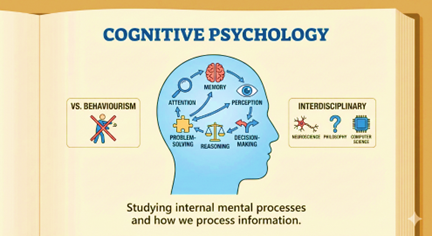
Cognitive psychology is the study of mental processes such as attention, memory, perception, and problem-solving. It focuses on how individuals acquire, process, and store information, ultimately affecting their behaviours and decisions.
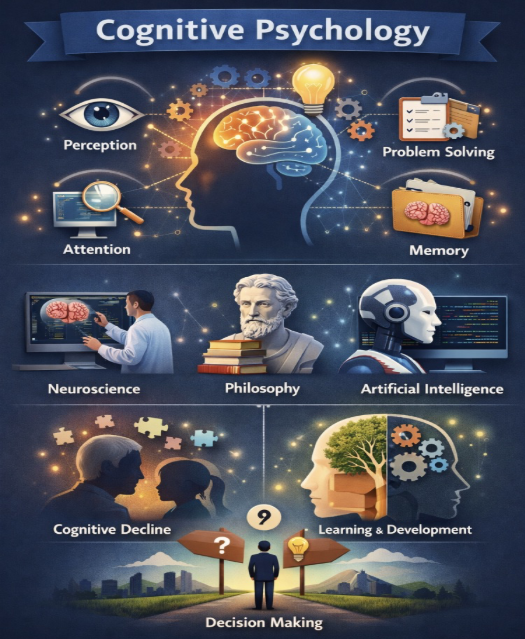
Cognitive psychology is the branch of psychology that focuses on understanding the mental processes that influence human behaviour. These processes include attention, memory, perception, problem-solving, reasoning, and decision-making. Unlike behaviourism, which primarily concentrates on observable actions, cognitive psychology delves into the internal mental mechanisms that guide those actions.
Cognitive psychology emerged in the mid-20th century as a response to behaviourism, which neglected the complexities of the mind in Favor of studying outward behaviours. Researchers in cognitive psychology aim to uncover how individuals acquire, process, and store information, as well as how these processes influence their interactions with the world around them.
The field draws from various disciplines, including neuroscience, which examines the brain's physical structures and functions; philosophy, which explores the nature of knowledge and perception; and computer science, which provides insights into the functioning of artificial intelligence systems that can mimic human cognition. Cognitive psychology uses models and frameworks to study mental processes, such as how individuals interpret sensory input and how they make decisions based on the information they process.
Moreover, cognitive psychology not only examines normal cognitive functions but also explores cognitive decline in conditions like Alzheimer's disease, as well as the developmental changes in cognition throughout a person's life. By understanding how cognitive processes operate and evolve, cognitive psychology offers valuable insights into human learning, memory retention, and the challenges associated with cognitive impairments.
Published
January 7, 2026
Copyright (c) 2026 Wissira Press
How to Cite
Chapter-1 The Foundations of Human Cognition . (2026). In Cognitive Footprints: Tracing Human Nature Through Psychology. Wissira Press. https://books.wissira.us/index.php/WIL/catalog/book/54/chapter/413








