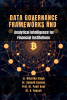
Data Governance Frameworks and Analytical Intelligence for Financial Institutions
Keywords:
Data Governance Frameworks, Financial Data Management, Risk and Fraud Analytics, Books by Wissira, Wissira Press Academic Books, Wissira Academic PublicationsSynopsis
In an era defined by digital acceleration and global financial interconnectedness, data has emerged as the cornerstone of institutional performance, regulatory trust, and competitive advantage. Financial institutions today operate within a complex ecosystem where vast volumes of transactional, customer, and market data must be governed with rigor while simultaneously being transformed into actionable intelligence. The ability to establish robust data governance frameworks and harness analytical intelligence is no longer optional—it is a strategic imperative for institutional resilience, transparency, and sustainable growth.
Data Governance Frameworks and Analytical Intelligence for Financial Institutions are conceived in response to this evolving reality. As financial organizations increasingly adopt data-driven operating models, traditional approaches to data management fall short in addressing the dual demands of regulatory compliance and advanced analytics. Global regulatory mandates such as GDPR, Basel III, BCBS 239, and strengthened KYC/AML regimes require institutions to demonstrate accuracy, traceability, accountability, and security across their data ecosystems. At the same time, innovations in artificial intelligence, machine learning, big data platforms, and real-time processing are redefining how insights are generated and decisions are made. This book explores how financial institutions can navigate these converging forces through structured, scalable, and future-ready governance frameworks.
This book is written for a broad and interdisciplinary audience. Financial executives and practitioners will find actionable frameworks to align governance initiatives with analytical value creation. Regulators and policymakers will gain insight into data-centric oversight models that support financial stability and transparency. Data scientists, architects, and technologists will benefit from understanding how advanced analytical solutions must operate within governance and compliance constraints. Academics and students will find a comprehensive foundation for studying the evolving relationship between data governance, analytics, and financial systems.
It is the author’s hope that this work will serve both as a practical guide and a conceptual framework, empowering readers to design, implement, and evolve data governance frameworks that fully support analytical intelligence in modern financial institutions.
Chapters
-
Chapter 1: Foundations of Data Governance in Financial Enterprises
-
Chapter 2: Data Architecture and Infrastructure
-
Chapter 3: Regulatory Compliance and Risk Management
-
Chapter 4: Data Security, Privacy, and Protection
-
Chapter 5: Master Data Management and Data Quality
-
Chapter 6: Advanced Analytics for Financial Enterprises
-
Chapter 7: Big Data and Real-Time Processing in Finance
-
Chapter 8: Business Intelligence and Visualization
-
Chapter 9: AI, Machine Learning, and NLP in Financial Governance
-
Chapter 10: Future Trends and Strategic Roadmap
Downloads
Published
License

This work is licensed under a Creative Commons Attribution 4.0 International License.
Creative Commons Attribution 4.0 International (CC BY 4.0) — License Terms
The Creative Commons Attribution 4.0 International License (CC BY 4.0) is one of the most permissive open licenses. It allows others to use, share, and build upon a work for any purpose—including commercial use—provided that proper credit is given to the original creator.
1. Permissions Granted
Under CC BY 4.0, anyone may:
a) Share
Copy and redistribute the material in any medium or format (print, digital, audio, video, etc.).
b) Adapt
Remix, transform, translate, or build upon the material.
c) Commercial Use Allowed
The work may be used for commercial purposes, including resale, inclusion in paid products, or monetized distribution.
d) No Additional Permission Required
Users do not need to contact the author for permission, as long as they follow the license conditions.
2. Attribution Requirements (Core Condition)
Users must give appropriate credit to the original creator. Attribution should include:
- Name of the author/creator
- Title of the work (if available)
- Source (publisher, website, or platform)
- Link to the original work (if online)
- Link to the CC BY 4.0 license
- Indication of any changes made
Example Attribution:
“Title of Work” by Author Name is licensed under CC BY 4.0.
Adapted from the original available at [URL].
3. Indicating Changes
If the material is modified, translated, shortened, or otherwise altered, users must clearly state that changes were made.
Examples:
- “Translated from the original”
- “Adapted from…”
- “Modified version of…”
4. No Additional Restrictions
Users may not:
- Apply legal terms or technological measures (such as DRM) that restrict others from exercising the license rights
- Impose new licensing conditions that contradict CC BY 4.0
5. Rights Not Covered by the License
CC BY 4.0 does not automatically grant:
- Patent rights
- Trademark rights
- Privacy or publicity rights
- Moral rights where they cannot be waived by law
Users must ensure compliance with these separately.
6. Disclaimer of Warranties
The material is provided “as-is.”
The licensor (author/publisher) gives no guarantees regarding accuracy, suitability, or fitness for any purpose.
7. Termination and Reinstatement
- The license remains valid as long as the terms are followed.
- If a user violates the terms (e.g., fails to attribute), the rights terminate automatically.
- Rights may be reinstated if the violation is corrected within 30 days of discovery.
8. International Scope
CC BY 4.0 is designed to work worldwide and is not limited to any specific country’s copyright law.
Suggested Copyright Notice Using CC BY 4.0
© [Year] [Author Name].
This work is licensed under the Creative Commons Attribution 4.0 International License (CC BY 4.0).
To view a copy of this license, visit: https://creativecommons.org/licenses/by/4.0/
You are free to share and adapt this work for any purpose, even commercially, provided that appropriate credit is given.









