English at the Crossroads of Time: Whispers from Chaucer’s Road to the Fractured Voices of the Modern Age
Keywords:
English Literature, English, Time, CrossroadsSynopsis
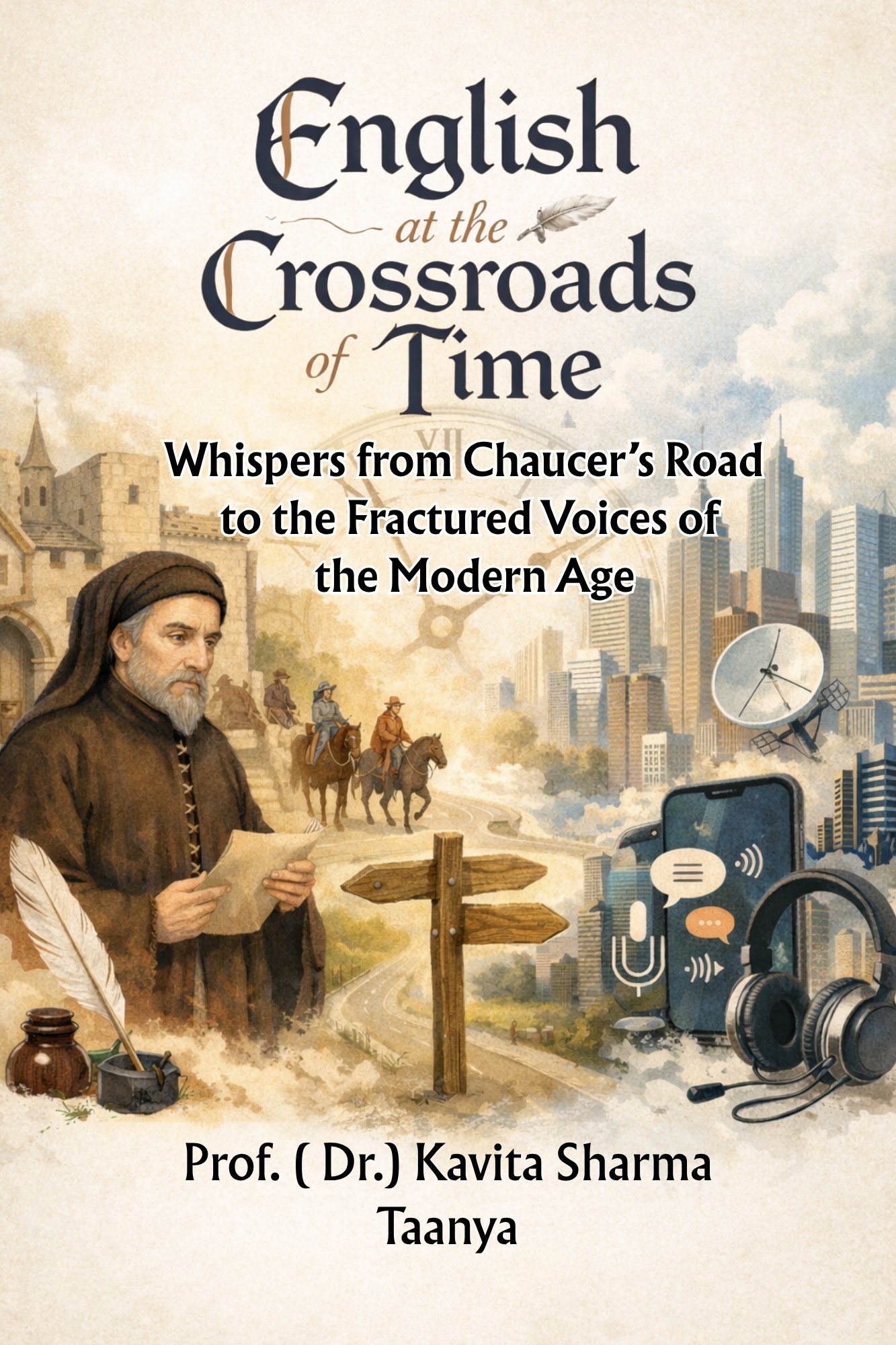
Language is never still. It travels with people, absorbs their anxieties, reflects their triumphs, and reshapes itself with every historical tremor. The story of English is therefore not merely a linguistic account-it is a record of human transformation. This book traces that unfolding journey, beginning with medieval pilgrims who carried their stories in earthy Middle English, and culminating in a digital age where words flicker across screens in fragmented, accelerated forms.
The opening chapter revisits the world of Geoffrey Chaucer, whose pilgrims offered English its early vernacular confidence. In their voices-comic, noble, devout, rebellious-we witness a language stepping out from the shadow of Latin and French into its own expressive authority. From there, the narrative moves into the Renaissance, when humanist thought and the revival of classical learning expanded vocabulary, imagination, and intellectual ambition.
The theatrical brilliance of William Shakespeare demonstrates how English became performance-flexible, inventive, and politically resonant. Drama did not merely entertain; it sculpted the language into a vehicle for psychological depth and rhetorical power. The Enlightenment then disciplined English through rational prose and standardized form, while Romanticism re-energized it with emotion and individual vision.
As the Victorian era stretched English across continents, industrial progress and imperial expansion complicated its moral landscape. The twentieth century fractured inherited certainties. Modernist experimentation disrupted syntax and narrative coherence, mirroring a world unsettled by war and technological upheaval. Postcolonial writers reclaimed and reshaped English, turning it into a chorus of diverse identities rather than a single imperial instrument.
Today, in the digital age, English lives simultaneously in scholarly archives, social media posts, spoken-word poetry, global classrooms, and artificial intelligence systems. It is at once standardized and endlessly reinvented-compressed into hashtags, expanded into global dialogue, translated across cultures in real time. The language that once travelled by manuscript now moves at the speed of light.
Chapters
-
Chaucer’s Pilgrims and the Birth of a Vernacular Voice
-
Renaissance Humanism and the Expanding English Imagination
-
Shakespeare’s Universe – Language as Performance and Power
-
Enlightenment Order and the Discipline of Reason
-
Romantic Revolt – Emotion, Nature, and the Individual Voice
-
Victorian Expansion – Empire, Industry, and Moral Complexity
-
Modernism and the Fractured Sentence
-
Postcolonial Echoes and the Multiplicity of English’s
-
Digital Age Voices – Fragmentation, Acceleration, and Reinvention
Downloads
Published
License

This work is licensed under a Creative Commons Attribution 4.0 International License.
Creative Commons Attribution 4.0 International (CC BY 4.0) — License Terms
The Creative Commons Attribution 4.0 International License (CC BY 4.0) is one of the most permissive open licenses. It allows others to use, share, and build upon a work for any purpose—including commercial use—provided that proper credit is given to the original creator.
1. Permissions Granted
Under CC BY 4.0, anyone may:
a) Share
Copy and redistribute the material in any medium or format (print, digital, audio, video, etc.).
b) Adapt
Remix, transform, translate, or build upon the material.
c) Commercial Use Allowed
The work may be used for commercial purposes, including resale, inclusion in paid products, or monetized distribution.
d) No Additional Permission Required
Users do not need to contact the author for permission, as long as they follow the license conditions.
2. Attribution Requirements (Core Condition)
Users must give appropriate credit to the original creator. Attribution should include:
- Name of the author/creator
- Title of the work (if available)
- Source (publisher, website, or platform)
- Link to the original work (if online)
- Link to the CC BY 4.0 license
- Indication of any changes made
Example Attribution:
“Title of Work” by Author Name is licensed under CC BY 4.0.
Adapted from the original available at [URL].
3. Indicating Changes
If the material is modified, translated, shortened, or otherwise altered, users must clearly state that changes were made.
Examples:
- “Translated from the original”
- “Adapted from…”
- “Modified version of…”
4. No Additional Restrictions
Users may not:
- Apply legal terms or technological measures (such as DRM) that restrict others from exercising the license rights
- Impose new licensing conditions that contradict CC BY 4.0
5. Rights Not Covered by the License
CC BY 4.0 does not automatically grant:
- Patent rights
- Trademark rights
- Privacy or publicity rights
- Moral rights where they cannot be waived by law
Users must ensure compliance with these separately.
6. Disclaimer of Warranties
The material is provided “as-is.”
The licensor (author/publisher) gives no guarantees regarding accuracy, suitability, or fitness for any purpose.
7. Termination and Reinstatement
- The license remains valid as long as the terms are followed.
- If a user violates the terms (e.g., fails to attribute), the rights terminate automatically.
- Rights may be reinstated if the violation is corrected within 30 days of discovery.
8. International Scope
CC BY 4.0 is designed to work worldwide and is not limited to any specific country’s copyright law.
Suggested Copyright Notice Using CC BY 4.0
© [Year] [Author Name].
This work is licensed under the Creative Commons Attribution 4.0 International License (CC BY 4.0).
To view a copy of this license, visit: https://creativecommons.org/licenses/by/4.0/
You are free to share and adapt this work for any purpose, even commercially, provided that appropriate credit is given.