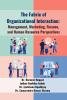
The Fabric of Organizational Interaction: Management, Marketing, Finance, and Human Resource Perspectives
Keywords:
Management, Marketing, Finance, Human Resource PerspectivesSynopsis
Organizations today are no longer defined by rigid hierarchies or isolated departments. Instead, they function as living systems-complex, adaptive, and deeply interconnected. Every decision, whether made in management, marketing, finance, or human resources, reverberates across the entire organizational fabric. This book, The Fabric of Organizational Interaction: Management, Marketing, Finance, and Human Resource Perspectives, is an attempt to explore and articulate this interconnected reality in a structured and meaningful way.
The motivation behind this work arises from a growing recognition that many organizational challenges do not stem from the absence of expertise within individual departments, but from gaps in interaction between them. A well-designed marketing strategy may fail due to financial constraints; a sound financial plan may collapse without human resource support; an efficient HR system may underperform if not aligned with organizational goals. These examples highlight a central premise of this book: effectiveness in modern organizations depends less on isolated excellence and more on integrated collaboration.
This book is designed to bridge the conceptual and practical divide between core functional areas. It does not treat management, marketing, finance, and human resources as separate silos, but as interdependent forces that collectively shape organizational outcomes. Each chapter examines not only the internal logic of these functions but also the ways in which they interact, influence, and reinforce one another. By doing so, the book offers a holistic perspective that is essential for understanding contemporary organizational dynamics.
The structure of the book reflects this integrative approach. It begins by establishing the theoretical foundations of organizational interaction, drawing upon systems thinking and behavioral perspectives. It then examines the role of management as the coordinating core, followed by an exploration of communication mechanisms that sustain organizational coherence. Subsequent chapters delve into the specific contributions of marketing, finance, and human resource management, highlighting their interdependencies. The later sections address cross-functional integration, the impact of digital transformation, and emerging trends that are reshaping the future of work and organizational design.
While the content is grounded in academic theory, the emphasis throughout the book remains on practical relevance. Real-world examples, case insights, and applied frameworks have been incorporated to ensure that readers can connect theoretical concepts with organizational realities. The intention is to make this book valuable not only for students and researchers but also for practitioners, managers, and decision-makers who navigate complex organizational environments.
In an era characterized by rapid technological change, global competition, and evolving workforce expectations, organizations must move beyond fragmented thinking. They must cultivate systems that encourage communication, coordination, and collaboration across all levels and functions. This book seeks to contribute to that shift by providing a comprehensive understanding of how organizational interaction can be designed, managed, and sustained.
It is hoped that this work will serve as a useful guide for those who aim to build more cohesive, responsive, and effective organizations. By viewing organizations as integrated systems rather than disconnected parts, readers may discover new ways to approach challenges, make decisions, and create value.
Chapters
-
Foundations of Organizational Interaction
-
Management as the Integrative Core
-
Communication and Coordination Mechanisms
-
Marketing Interactions in Organizational Systems
-
Financial Dynamics and Organizational Decision-Making
-
Human Resource Management and Organizational Synergy
-
Cross-Functional Integration and Conflict Management
-
Technology and Digital Transformation in Organizational Interaction
-
Future Trends and Strategic Integration
Downloads
References
Chapter 1: Foundations of Organizational Interaction
• Ludwig von Bertalanffy (1968). General System Theory: Foundations, Development, Applications. George Braziller.
• Stephen P. Robbins & Timothy A. Judge (2017). Organizational Behavior (17th ed.). Pearson.
• Richard L. Daft (2021). Organization Theory and Design (13th ed.). Cengage Learning.
• Daniel Katz & Robert L. Kahn (1978). The Social Psychology of Organizations (2nd ed.). Wiley.
Chapter 2: Management as the Integrative Core
• Harold Koontz & Heinz Weihrich (2015). Essentials of Management (10th ed.). McGraw-Hill.
• Henry Mintzberg (2009). Managing. Berrett-Koehler Publishers.
• Peter F. Drucker (2008). Management: Tasks, Responsibilities, Practices. HarperBusiness.
• Fred R. David (2019). Strategic Management: Concepts and Cases. Pearson.
Chapter 3: Communication and Coordination Mechanisms
• Mary Jo Hatch (2018). Organization Theory: Modern, Symbolic, and Postmodern Perspectives. Oxford University Press.
• Karl E. Weick (1995). Sensemaking in Organizations. Sage Publications.
• Philip M. Clampitt (2016). Communicating for Managerial Effectiveness. Sage Publications.
• Gareth R. Jones (2013). Organizational Theory, Design, and Change. Pearson.
Chapter 4: Marketing Interactions in Organizational Systems
• Philip Kotler & Kevin Lane Keller (2016). Marketing Management (15th ed.). Pearson.
• V. Kumar & Werner Reinartz (2016). Customer Relationship Management. Springer.
• George S. Day (1994). “The Capabilities of Market-Driven Organizations.” Journal of Marketing, 58(4), 37–52.
• Christian Grönroos (2007). Service Management and Marketing. Wiley.
Chapter 5: Financial Dynamics and Organizational Decision-Making
• Eugene F. Brigham & Joel F. Houston (2021). Fundamentals of Financial Management. Cengage Learning.
• Richard A. Brealey, Stewart C. Myers, & Franklin Allen (2020). Principles of Corporate Finance. McGraw-Hill.
• Robert S. Kaplan & David P. Norton (1996). “Using the Balanced Scorecard as a Strategic Management System.” Harvard Business Review.
• Charles T. Horngren et al. (2018). Cost Accounting: A Managerial Emphasis. Pearson.
Chapter 6: Human Resource Management and Organizational Synergy
• Gary Dessler (2020). Human Resource Management (16th ed.). Pearson.
• David A. DeCenzo, Stephen P. Robbins, & Susan L. Verhulst (2016). Fundamentals of Human Resource Management. Wiley.
• Dave Ulrich (1997). Human Resource Champions. Harvard Business School Press.
• Jeffrey Pfeffer (1998). The Human Equation. Harvard Business School Press.
Chapter 7: Cross-Functional Integration and Conflict Management
• Kenneth W. Thomas (1992). “Conflict and Conflict Management.” Journal of Organizational Behavior.
• Patrick Lencioni (2002). The Five Dysfunctions of a Team. Jossey-Bass.
• Jay R. Galbraith (2014). Design Organizations. Jossey-Bass.
• Lawrence R. Jauch & William F. Glueck (1988). Business Policy and Strategic Management. McGraw-Hill.
Chapter 8: Technology and Digital Transformation in Organizational Interaction
• Erik Brynjolfsson & Andrew McAfee (2014). The Second Machine Age. W.W. Norton.
• Jeanne W. Ross, Peter Weill, & David C. Robertson (2006). Enterprise Architecture as Strategy. Harvard Business School Press.
• Thomas H. Davenport & Jeanne G. Harris (2017). Competing in Analytics. Harvard Business Review Press.
• George Westerman et al. (2014). Leading Digital: Turning Technology into Business Transformation. Harvard Business Review Press.
Chapter 9: Future Trends and Strategic Integration
• John P. Kotter (2012). Leading Change. Harvard Business Review Press.
• Frederic Laloux (2014). Reinventing Organizations. Nelson Parker.
• Michael E. Porter & Mark R. Kramer (2011). “Creating Shared Value.” Harvard Business Review.
• World Economic Forum (2020). The Future of Jobs Report.
Downloads
Published
License

This work is licensed under a Creative Commons Attribution 4.0 International License.
Creative Commons Attribution 4.0 International (CC BY 4.0) — License Terms
The Creative Commons Attribution 4.0 International License (CC BY 4.0) is one of the most permissive open licenses. It allows others to use, share, and build upon a work for any purpose—including commercial use—provided that proper credit is given to the original creator.
1. Permissions Granted
Under CC BY 4.0, anyone may:
a) Share
Copy and redistribute the material in any medium or format (print, digital, audio, video, etc.).
b) Adapt
Remix, transform, translate, or build upon the material.
c) Commercial Use Allowed
The work may be used for commercial purposes, including resale, inclusion in paid products, or monetized distribution.
d) No Additional Permission Required
Users do not need to contact the author for permission, as long as they follow the license conditions.
2. Attribution Requirements (Core Condition)
Users must give appropriate credit to the original creator. Attribution should include:
- Name of the author/creator
- Title of the work (if available)
- Source (publisher, website, or platform)
- Link to the original work (if online)
- Link to the CC BY 4.0 license
- Indication of any changes made
Example Attribution:
“Title of Work” by Author Name is licensed under CC BY 4.0.
Adapted from the original available at [URL].
3. Indicating Changes
If the material is modified, translated, shortened, or otherwise altered, users must clearly state that changes were made.
Examples:
- “Translated from the original”
- “Adapted from…”
- “Modified version of…”
4. No Additional Restrictions
Users may not:
- Apply legal terms or technological measures (such as DRM) that restrict others from exercising the license rights
- Impose new licensing conditions that contradict CC BY 4.0
5. Rights Not Covered by the License
CC BY 4.0 does not automatically grant:
- Patent rights
- Trademark rights
- Privacy or publicity rights
- Moral rights where they cannot be waived by law
Users must ensure compliance with these separately.
6. Disclaimer of Warranties
The material is provided “as-is.”
The licensor (author/publisher) gives no guarantees regarding accuracy, suitability, or fitness for any purpose.
7. Termination and Reinstatement
- The license remains valid as long as the terms are followed.
- If a user violates the terms (e.g., fails to attribute), the rights terminate automatically.
- Rights may be reinstated if the violation is corrected within 30 days of discovery.
8. International Scope
CC BY 4.0 is designed to work worldwide and is not limited to any specific country’s copyright law.
Suggested Copyright Notice Using CC BY 4.0
© [Year] [Author Name].
This work is licensed under the Creative Commons Attribution 4.0 International License (CC BY 4.0).
To view a copy of this license, visit: https://creativecommons.org/licenses/by/4.0/
You are free to share and adapt this work for any purpose, even commercially, provided that appropriate credit is given.