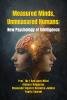
Measured Minds, Unmeasured Humans: New Psychology of Intelligence
Keywords:
Psychology, Intelligence, Minds, HumansSynopsis
In a world increasingly driven by numbers, rankings, and measurable outcomes, the concept of intelligence has often been confined to what can be calculated. From classrooms to corporate offices, individuals are evaluated, compared, and labelled based on scores that promise objectivity but frequently overlook the deeper layers of human capability. This book, Measured Minds, Unmeasured Humans: New Psychology of Intelligence, emerges from a growing realization that the essence of intelligence cannot be fully captured by tests, metrics, or algorithms.
The journey of this book begins with a simple yet profound question: What does it truly mean to be intelligent? For decades, intelligence has been associated with cognitive performance-logical reasoning, memory, and analytical skills. While these abilities are undeniably important, they represent only a fraction of what it means to understand, adapt, and thrive as a human being. There exists a vast domain of human potential-emotional depth, cultural awareness, creativity, ethical reasoning, and resilience-that remains largely unmeasured and, at times, undervalued.
This book does not seek to dismiss traditional measures of intelligence, but rather to place them within a broader and more humane context. It acknowledges the contributions of psychometric tools and scientific research while also recognizing their limitations. The intention is to move beyond reductionist perspectives and explore intelligence as a living, evolving phenomenon shaped by experience, environment, relationships, and purpose.
This work is intended for students, researchers, educators, and thinkers who are willing to question established norms and explore new possibilities. It is also for anyone who has ever felt defined-or limited-by a number, and who seeks a more expansive understanding of their own potential.
Chapters
-
Rethinking Intelligence – Beyond Numbers
-
The Rise and Limits of IQ
-
Multiple Intelligences – Expanding the Framework
-
Emotional Intelligence – The Power of Feeling and Understanding
-
Cultural Intelligence and Contextual Thinking
-
Creativity and Adaptive Intelligence
-
The Neuroscience of Intelligence
-
Intelligence, Technology, and Artificial Minds
-
Toward a Holistic Psychology of Intelligence
Downloads
References
Chapter 1: Rethinking Intelligence – Beyond Numbers
• Frames of Mind: The Theory of Multiple Intelligences - Howard Gardner
• Intelligence Reframed: Multiple Intelligences for the 21st Century
• The Mismeasure of Man - Stephen Jay Gould
• Mindset: The New Psychology of Success - Carol S. Dweck
Chapter 2: The Rise and Limits of IQ
• The Bell Curve: Intelligence and Class Structure in American Life - Richard J. Herrnstein, Charles Murray
• IQ Testing 101 - Alan S. Kaufman
• American Psychological Association (1995). Intelligence: Knowns and Unknowns
• The Intelligence of Nations
Chapter 3: Multiple Intelligences – Expanding the Framework
• Multiple Intelligences: New Horizons in Theory and Practice
• Emotional Intelligence - Daniel Goleman
• Working with Emotional Intelligence
• Intelligence and Personality - Hans J. Eysenck
Chapter 4: Emotional Intelligence – The Power of Feeling and Understanding
• Emotional Intelligence
• Emotional Intelligence 2.0 - Travis Bradberry, Jean Greaves
• The Emotionally Intelligent Manager - Peter Salovey
• Emotional Intelligence
Chapter 5: Cultural Intelligence and Contextual Thinking
• Cultural Intelligence: Individual Interactions Across Cultures - P. Christopher Earley, Soon Ang
• The Cultural Intelligence Difference - David Livermore
• OECD (2018). Global Competence Framework
• Cultures and Organizations: Software of the Mind - Geert Hofstede
Chapter 6: Creativity and Adaptive Intelligence
• Creativity: Flow and the Psychology of Discovery and Invention - Mihaly Csikszentmihalyi
• The Nature of Human Intelligence - Robert J. Sternberg
• Adaptive Intelligence
• Outliers: The Story of Success - Malcolm Gladwell
Chapter 7: The Neuroscience of Intelligence
• Principles of Neural Science - Eric R. Kandel
• The Brain That Changes Itself - Norman Doidge
• Neuroscience of Intelligence - Richard J. Haier
• National Institute of Neurological Disorders and Stroke – Brain Research Reports
Chapter 8: Intelligence, Technology, and Artificial Minds
• Artificial Intelligence: A Modern Approach - Stuart Russell, Peter Norvig
• Life 3.0: Being Human in the Age of Artificial Intelligence - Max Tegmark
• Human Compatible
• MIT – AI Research Publications
Chapter 9: Toward a Holistic Psychology of Intelligence
• Successful Intelligence
• The Theory of Moral Sentiments - Adam Smith
• The Happiness Hypothesis - Jonathan Haidt
• World Health Organization (2022). Mental Health and Well-being Reports
Downloads
Published
License

This work is licensed under a Creative Commons Attribution 4.0 International License.
Creative Commons Attribution 4.0 International (CC BY 4.0) — License Terms
The Creative Commons Attribution 4.0 International License (CC BY 4.0) is one of the most permissive open licenses. It allows others to use, share, and build upon a work for any purpose—including commercial use—provided that proper credit is given to the original creator.
1. Permissions Granted
Under CC BY 4.0, anyone may:
a) Share
Copy and redistribute the material in any medium or format (print, digital, audio, video, etc.).
b) Adapt
Remix, transform, translate, or build upon the material.
c) Commercial Use Allowed
The work may be used for commercial purposes, including resale, inclusion in paid products, or monetized distribution.
d) No Additional Permission Required
Users do not need to contact the author for permission, as long as they follow the license conditions.
2. Attribution Requirements (Core Condition)
Users must give appropriate credit to the original creator. Attribution should include:
- Name of the author/creator
- Title of the work (if available)
- Source (publisher, website, or platform)
- Link to the original work (if online)
- Link to the CC BY 4.0 license
- Indication of any changes made
Example Attribution:
“Title of Work” by Author Name is licensed under CC BY 4.0.
Adapted from the original available at [URL].
3. Indicating Changes
If the material is modified, translated, shortened, or otherwise altered, users must clearly state that changes were made.
Examples:
- “Translated from the original”
- “Adapted from…”
- “Modified version of…”
4. No Additional Restrictions
Users may not:
- Apply legal terms or technological measures (such as DRM) that restrict others from exercising the license rights
- Impose new licensing conditions that contradict CC BY 4.0
5. Rights Not Covered by the License
CC BY 4.0 does not automatically grant:
- Patent rights
- Trademark rights
- Privacy or publicity rights
- Moral rights where they cannot be waived by law
Users must ensure compliance with these separately.
6. Disclaimer of Warranties
The material is provided “as-is.”
The licensor (author/publisher) gives no guarantees regarding accuracy, suitability, or fitness for any purpose.
7. Termination and Reinstatement
- The license remains valid as long as the terms are followed.
- If a user violates the terms (e.g., fails to attribute), the rights terminate automatically.
- Rights may be reinstated if the violation is corrected within 30 days of discovery.
8. International Scope
CC BY 4.0 is designed to work worldwide and is not limited to any specific country’s copyright law.
Suggested Copyright Notice Using CC BY 4.0
© [Year] [Author Name].
This work is licensed under the Creative Commons Attribution 4.0 International License (CC BY 4.0).
To view a copy of this license, visit: https://creativecommons.org/licenses/by/4.0/
You are free to share and adapt this work for any purpose, even commercially, provided that appropriate credit is given.









