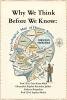
Why We Think Before We Know: A Psychological Map of Human Nature
Keywords:
Psychological, Psychological Map, Human, NatureSynopsis
There is a quiet mystery at the heart of human life: we often think before we truly know. Decisions are made in moments, judgments are formed without effort, and reactions arise before we can explain them. Only later do we construct reasons, narratives, and justifications that make our thoughts appear deliberate and informed. This book was born from that simple yet profound observation-that much of what we call “thinking” happens beneath the surface of awareness.
Why We Think Before We Know: A Psychological Map of Human Nature is an exploration of this hidden landscape. It does not assume that humans are purely rational beings who carefully analyse every decision. Instead, it recognizes that intuition, emotion, memory, and social influence play powerful roles in shaping how we perceive the world. Our minds are not just logical machines; they are living systems that respond, adapt, and interpret reality long before conscious reasoning takes control.
The chapters that follow are designed as a journey through the layers of human thought. We begin with the origins of thinking-how the mind starts forming patterns even before language and structured knowledge develop. From there, we move into the unconscious processes that silently guide our actions, the dual systems of intuition and logic, and the emotional forces that shape our perceptions. As the journey unfolds, we examine memory, biases, and the influence of society, revealing how deeply interconnected our thoughts are with our experiences and environment.
This book does not aim to present thinking as flawed or unreliable. On the contrary, these automatic processes are essential for survival. They allow us to navigate complex environments, make quick decisions, and respond to uncertainty. However, they also create blind spots-biases, illusions, and assumptions that can mislead us when left unexamined. Understanding these patterns is not about eliminating them, but about becoming aware of them.
A central theme of this work is awareness. When we begin to observe how our thoughts arise, we gain the ability to question them, refine them, and, when necessary, change them. Awareness bridges the gap between instinct and knowledge. It allows us to move from automatic reactions to thoughtful responses, from assumptions to understanding.
This book is written for anyone curious about the nature of their own mind-students, researchers, professionals, and everyday thinkers alike. It invites readers not only to learn about psychological concepts but also to reflect on their own thinking patterns. The goal is not merely to inform, but to transform the way we understand ourselves.
In a world overflowing with information, knowing more is often seen as the key to better decisions. Yet, knowledge alone is not enough if we do not understand how we think. By mapping the hidden processes that shape our thoughts, this book hopes to offer a deeper insight: that true understanding begins not with what we know, but with how we think.
Chapters
-
The Origins of Thought – Where Thinking Begins
-
The Unconscious Mind – The Hidden Driver
-
Intuition vs. Logic – The Dual Systems of Thinking
-
Emotions First, Reason Later
-
The Role of Memory in Shaping Thought
-
Cognitive Biases – Thinking Without Knowing
-
Social Influence and Collective Thinking
-
The Illusion of Control and Understanding
-
Becoming Aware – Bridging Thought and Knowledge
Downloads
References
Chapter 1: The Origins of Thought – Where Thinking Begins
• Jean Piaget (1952). The Origins of Intelligence in Children. International Universities Press.
• Alison Gopnik, Meltzoff, A. N., & Kuhl, P. K. (1999). The Scientist in the Crib. William Morrow.
• Antonio Damasio (1994). Descartes’ Error: Emotion, Reason, and the Human Brain. Putnam.
• American Psychological Association (2020). APA Dictionary of Psychology. https://dictionary.apa.org
Chapter 2: The Unconscious Mind – The Hidden Driver
• Sigmund Freud (1915/2001). The Unconscious. Penguin Classics.
• John A. Bargh & Chartrand, T. L. (1999). “The Unbearable Automaticity of Being.” American Psychologist, 54(7), 462–479. https://doi.org/10.1037/0003-066X.54.7.462
• Daniel L. Schacter (1996). Searching for Memory. Basic Books.
• Timothy D. Wilson (2002). Strangers to Ourselves. Harvard University Press.
Chapter 3: Intuition vs. Logic – The Dual Systems of Thinking
• Daniel Kahneman (2011). Thinking, Fast and Slow. Farrar, Straus, and Giroux.
• Amos Tversky & Kahneman, D. (1974). “Judgment under Uncertainty: Heuristics and Biases.” Science, 185(4157), 1124–1131. https://doi.org/10.1126/science.185.4157.1124
• Keith E. Stanovich & West, R. F. (2000). “Individual Differences in Reasoning.” Behavioural and Brain Sciences, 23(5), 645–665.
• Jonathan Evans (2008). “Dual-Processing Accounts of Reasoning.” Annual Review of Psychology, 59, 255–278.
Chapter 4: Emotions First, Reason Later
• Joseph LeDoux (1996). The Emotional Brain. Simon & Schuster.
• Antonio Damasio (1999). The Feeling of What Happens. Harcourt.
• Richard S. Lazarus (1991). Emotion and Adaptation. Oxford University Press.
• Paul Ekman (2003). Emotions Revealed. Times Books.
Chapter 5: The Role of Memory in Shaping Thought
• Elizabeth Loftus (1996). Eyewitness Testimony. Harvard University Press.
• Daniel L. Schacter (2001). The Seven Sins of Memory. Houghton Mifflin.
• Endel Tulving (1972). “Episodic and Semantic Memory.” In Organization of Memory. Academic Press.
• National Institute of Mental Health (2021). Memory and Learning Resources. https://www.nimh.nih.gov
Chapter 6: Cognitive Biases – Thinking Without Knowing
• Daniel Kahneman (2003). “Maps of Bounded Rationality.” American Economic Review, 93(5), 1449–1475.
• Richard H. Thaler (2015). Misbehaving. W.W. Norton.
• Cass R. Sunstein (2017). #Republic. Princeton University Press.
• Stanford University (2020). Cognitive Bias Resources (Stanford Encyclopaedia of Philosophy). https://plato.stanford.edu
Chapter 7: Social Influence and Collective Thinking
• Solomon Asch (1951). “Effects of Group Pressure upon the Modification and Distortion of Judgments.”
• Irving Janis (1972). Victims of Groupthink. Houghton Mifflin.
• Robert Cialdini (2006). Influence: The Psychology of Persuasion. Harper Business.
• Henri Tajfel & Turner, J. C. (1979). Social Identity Theory.
Chapter 8: The Illusion of Control and Understanding
• Ellen Langer (1975). “The Illusion of Control.” Journal of Personality and Social Psychology, 32(2), 311–328.
• Frank Keil (2006). “Explanation and Understanding.” Annual Review of Psychology.
• David Dunning & Kruger, J. (1999). “Unskilled and Unaware of It.” Journal of Personality and Social Psychology, 77(6), 1121–1134.
• Philip Tetlock (2005). Expert Political Judgment. Princeton University Press.
Chapter 9: Becoming Aware – Bridging Thought and Knowledge
• Daniel Goleman (1995). Emotional Intelligence. Bantam Books.
• Carol Dweck (2006). Mindset. Random House.
• Jon Kabat-Zinn (1990). Full Catastrophe Living. Delta.
• World Health Organization (2021). Mental Health and Cognitive Awareness Reports. https://www.who.int
Downloads
Published
License

This work is licensed under a Creative Commons Attribution 4.0 International License.
Creative Commons Attribution 4.0 International (CC BY 4.0) — License Terms
The Creative Commons Attribution 4.0 International License (CC BY 4.0) is one of the most permissive open licenses. It allows others to use, share, and build upon a work for any purpose—including commercial use—provided that proper credit is given to the original creator.
1. Permissions Granted
Under CC BY 4.0, anyone may:
a) Share
Copy and redistribute the material in any medium or format (print, digital, audio, video, etc.).
b) Adapt
Remix, transform, translate, or build upon the material.
c) Commercial Use Allowed
The work may be used for commercial purposes, including resale, inclusion in paid products, or monetized distribution.
d) No Additional Permission Required
Users do not need to contact the author for permission, as long as they follow the license conditions.
2. Attribution Requirements (Core Condition)
Users must give appropriate credit to the original creator. Attribution should include:
- Name of the author/creator
- Title of the work (if available)
- Source (publisher, website, or platform)
- Link to the original work (if online)
- Link to the CC BY 4.0 license
- Indication of any changes made
Example Attribution:
“Title of Work” by Author Name is licensed under CC BY 4.0.
Adapted from the original available at [URL].
3. Indicating Changes
If the material is modified, translated, shortened, or otherwise altered, users must clearly state that changes were made.
Examples:
- “Translated from the original”
- “Adapted from…”
- “Modified version of…”
4. No Additional Restrictions
Users may not:
- Apply legal terms or technological measures (such as DRM) that restrict others from exercising the license rights
- Impose new licensing conditions that contradict CC BY 4.0
5. Rights Not Covered by the License
CC BY 4.0 does not automatically grant:
- Patent rights
- Trademark rights
- Privacy or publicity rights
- Moral rights where they cannot be waived by law
Users must ensure compliance with these separately.
6. Disclaimer of Warranties
The material is provided “as-is.”
The licensor (author/publisher) gives no guarantees regarding accuracy, suitability, or fitness for any purpose.
7. Termination and Reinstatement
- The license remains valid as long as the terms are followed.
- If a user violates the terms (e.g., fails to attribute), the rights terminate automatically.
- Rights may be reinstated if the violation is corrected within 30 days of discovery.
8. International Scope
CC BY 4.0 is designed to work worldwide and is not limited to any specific country’s copyright law.
Suggested Copyright Notice Using CC BY 4.0
© [Year] [Author Name].
This work is licensed under the Creative Commons Attribution 4.0 International License (CC BY 4.0).
To view a copy of this license, visit: https://creativecommons.org/licenses/by/4.0/
You are free to share and adapt this work for any purpose, even commercially, provided that appropriate credit is given.