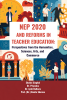
NEP 2020 and Reforms in Teacher Education: Perspectives from the Humanities, Sciences, Arts, and Commerce
Keywords:
NEP 2020, Reforms, Teacher, Education, Perspectives, Humanities, Sciences, Arts, CommerceSynopsis
Education has always been regarded as one of the most powerful instruments for social transformation, national development, and human progress. In every generation, teachers play a decisive role in shaping the intellectual abilities, moral values, creativity, and social consciousness of learners. The quality of any educational system therefore depends greatly on the quality of its teachers and the effectiveness of teacher education programs. In India, the introduction of the National Education Policy 2020 marks a historic step toward redefining the philosophy, structure, and future direction of education. Among its many reforms, the transformation of teacher education occupies a central and strategic position.
This book, NEP 2020 and Reforms in Teacher Education: Perspectives from the Humanities, Sciences, Arts, and Commerce, has been prepared with the objective of exploring the changing landscape of teacher education in the context of the National Education Policy 2020. The policy proposes a shift from fragmented and examination-oriented systems toward holistic, multidisciplinary, skill-oriented, and learner-centred education. Such a transformation requires teachers who are intellectually prepared, technologically competent, ethically grounded, and socially sensitive. This volume attempts to examine these reforms from multiple academic perspectives and provide a comprehensive understanding of their implications for educational institutions, educators, researchers, and policymakers.
The chapters included in this book discuss both the philosophical foundations and practical dimensions of teacher education reforms. The book begins by explaining the vision and objectives of NEP 2020 and tracing the historical evolution of teacher education in India. It further explores multidisciplinary learning approaches and the integration of humanities, sciences, arts, and commerce into teacher preparation systems. Special attention has been given to emerging areas such as digital pedagogy, STEM education, arts-based learning, entrepreneurship education, vocational training, and technology-enabled teaching practices.
One of the key strengths of the National Education Policy 2020 lies in its emphasis on holistic development and inclusive education. Modern classrooms are becoming increasingly diverse in terms of language, culture, social background, and learning needs. Therefore, teachers today are expected not only to possess subject expertise but also empathy, creativity, adaptability, communication skills, and ethical responsibility. This book highlights the importance of preparing educators who can create inclusive and participatory learning environments capable of responding to the demands of the twenty-first century.
It is hoped that this book will contribute meaningfully to ongoing academic discussions on educational reform and inspire further research in the field of teacher education. The editors and contributors believe that meaningful educational change can only be achieved when teachers are empowered intellectually, professionally, and socially. Through quality teacher education, India can move toward an educational system that promotes creativity, equity, innovation, and sustainable national development.
We express our gratitude to educators, scholars, researchers, institutions, and policymakers whose ideas and efforts continue to strengthen the field of teacher education. We also hope that readers will find this book informative, reflective, and valuable for understanding the transformative possibilities introduced by NEP 2020.
Chapters
-
Understanding the Vision of NEP 2020 in Teacher Education
-
Historical Evolution of Teacher Education in India
-
Multidisciplinary and Holistic Teacher Education under NEP 2020
-
Teacher Education in Humanities and Social Sciences
-
Scientific Temper and STEM-Oriented Teacher Preparation
-
Arts, Creativity, and Performing Arts in Teacher Education
-
Commerce, Entrepreneurship, and Vocational Dimensions of Teacher Education
-
Digital Transformation and Technology Integration in Teacher Training
-
Challenges, Policy Implications, and Future Directions in Teacher Education
Downloads
References
Chapter 1: Understanding the Vision of NEP 2020 in Teacher Education
1. Ministry of Education. (2020). National Education Policy 2020. Government of India.
2. National Council for Teacher Education. (2014). Norms and Standards for Teacher Education Programmes. New Delhi: NCTE.
3. John Dewey. (1938). Experience and Education. New York: Macmillan.
4. Paulo Freire. (1970). Pedagogy of the Oppressed. New York: Continuum.
Chapter 2: Historical Evolution of Teacher Education in India
1. Altekar, A. S. (2009). Education in Ancient India. Delhi: Isha Books.
2. Mahatma Gandhi. (1937). Basic Education. Ahmedabad: Navajivan Publishing House.
3. University Education Commission. (1948–49). Report of the University Education Commission. New Delhi: Government of India.
4. Education Commission. (1966). Education and National Development (Kothari Commission Report). New Delhi: Government of India.
Chapter 3: Multidisciplinary and Holistic Teacher Education under NEP 2020
1. Ministry of Education. (2020). National Education Policy 2020. Government of India.
2. UNESCO. (2021). Reimagining Our Futures Together: A New Social Contract for Education. Paris: UNESCO.
3. Gardner, H. (2011). Frames of Mind: The Theory of Multiple Intelligences. New York: Basic Books.
4. Nussbaum, M. C. (2010). Not for Profit: Why Democracy Needs the Humanities. Princeton University Press.
Chapter 4: Teacher Education in Humanities and Social Sciences
1. Freire, P. (1970). Pedagogy of the Oppressed. New York: Continuum.
2. Kumar, K. (2001). Prejudice and Pride: School Histories of the Freedom Struggle in India and Pakistan. New Delhi: Penguin Books.
3. National Council of Educational Research and Training. (2005). National Curriculum Framework 2005. New Delhi: NCERT.
4. Banks, J. A. (2015). Cultural Diversity and Education. New York: Routledge.
Chapter 5: Scientific Temper and STEM-Oriented Teacher Preparation
1. Bybee, R. W. (2013). The Case for STEM Education. Arlington: NSTA Press.
2. National Research Council. (2012). A Framework for K-12 Science Education. Washington, DC: National Academies Press.
3. Hattie, J. (2009). Visible Learning. London: Routledge.
4. Bransford, J., Brown, A., & Cocking, R. (2000). How People Learn. Washington, DC: National Academy Press.
Chapter 6: Arts, Creativity, and Performing Arts in Teacher Education
1. Eisner, E. W. (2002). The Arts and the Creation of Mind. Yale University Press.
2. Greene, M. (1995). Releasing the Imagination. San Francisco: Jossey-Bass.
3. Rabkin, N., & Redmond, R. (2004). Putting the Arts in the Picture. Chicago Arts Partnerships in Education.
4. UNESCO. (2006). Road Map for Arts Education. Lisbon: UNESCO.
Chapter 7: Commerce, Entrepreneurship, and Vocational Dimensions of Teacher Education
1. Drucker, P. F. (1985). Innovation and Entrepreneurship. New York: Harper & Row.
2. National Skill Development Corporation. (2021). Skill India Report. New Delhi: NSDC.
3. Hisrich, R., Peters, M., & Shepherd, D. (2017). Entrepreneurship. New York: McGraw-Hill Education.
4. International Labour Organization. (2020). Skills for a Greener Future. Geneva: ILO.
Chapter 8: Digital Transformation and Technology Integration in Teacher Training
1. Selwyn, N. (2016). Education and Technology: Key Issues and Debates. London: Bloomsbury Academic.
2. Bates, A. W. (2019). Teaching in a Digital Age. Vancouver: Tony Bates Associates Ltd.
3. UNESCO. (2020). Global Education Monitoring Report. Paris: UNESCO.
4. Siemens, G. (2005). Connectivism: A Learning Theory for the Digital Age. International Journal of Instructional Technology and Distance Learning, 2(1), 3–10.
Chapter 9: Challenges, Policy Implications, and Future Directions in Teacher Education
1. Ministry of Education. (2020). National Education Policy 2020. Government of India.
2. Darling-Hammond, L. (2017). Teacher Education Around the World: What Can We Learn from International Practice? European Journal of Teacher Education, 40(3), 291–309.
3. OECD. (2018). Teaching for the Future: Effective Classroom Practices. Paris: OECD Publishing.
4. Fullan, M. (2007). The New Meaning of Educational Change. New York: Teachers College Press.
5. Sahlberg, P. (2015). Finnish Lessons 2.0. New York: Teachers College Press.
Downloads
Published
License

This work is licensed under a Creative Commons Attribution 4.0 International License.
Creative Commons Attribution 4.0 International (CC BY 4.0) — License Terms
The Creative Commons Attribution 4.0 International License (CC BY 4.0) is one of the most permissive open licenses. It allows others to use, share, and build upon a work for any purpose—including commercial use—provided that proper credit is given to the original creator.
1. Permissions Granted
Under CC BY 4.0, anyone may:
a) Share
Copy and redistribute the material in any medium or format (print, digital, audio, video, etc.).
b) Adapt
Remix, transform, translate, or build upon the material.
c) Commercial Use Allowed
The work may be used for commercial purposes, including resale, inclusion in paid products, or monetized distribution.
d) No Additional Permission Required
Users do not need to contact the author for permission, as long as they follow the license conditions.
2. Attribution Requirements (Core Condition)
Users must give appropriate credit to the original creator. Attribution should include:
- Name of the author/creator
- Title of the work (if available)
- Source (publisher, website, or platform)
- Link to the original work (if online)
- Link to the CC BY 4.0 license
- Indication of any changes made
Example Attribution:
“Title of Work” by Author Name is licensed under CC BY 4.0.
Adapted from the original available at [URL].
3. Indicating Changes
If the material is modified, translated, shortened, or otherwise altered, users must clearly state that changes were made.
Examples:
- “Translated from the original”
- “Adapted from…”
- “Modified version of…”
4. No Additional Restrictions
Users may not:
- Apply legal terms or technological measures (such as DRM) that restrict others from exercising the license rights
- Impose new licensing conditions that contradict CC BY 4.0
5. Rights Not Covered by the License
CC BY 4.0 does not automatically grant:
- Patent rights
- Trademark rights
- Privacy or publicity rights
- Moral rights where they cannot be waived by law
Users must ensure compliance with these separately.
6. Disclaimer of Warranties
The material is provided “as-is.”
The licensor (author/publisher) gives no guarantees regarding accuracy, suitability, or fitness for any purpose.
7. Termination and Reinstatement
- The license remains valid as long as the terms are followed.
- If a user violates the terms (e.g., fails to attribute), the rights terminate automatically.
- Rights may be reinstated if the violation is corrected within 30 days of discovery.
8. International Scope
CC BY 4.0 is designed to work worldwide and is not limited to any specific country’s copyright law.
Suggested Copyright Notice Using CC BY 4.0
© [Year] [Author Name].
This work is licensed under the Creative Commons Attribution 4.0 International License (CC BY 4.0).
To view a copy of this license, visit: https://creativecommons.org/licenses/by/4.0/
You are free to share and adapt this work for any purpose, even commercially, provided that appropriate credit is given.