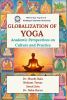
Globalization of Yoga: Academic Perspectives on Culture and Practice
Keywords:
Globalization, Yoga, Academic, Culture, PracticeSynopsis
Yoga, once rooted primarily in the spiritual and philosophical traditions of the Indian subcontinent, has evolved into a truly global phenomenon. Today it is practiced in diverse settings-from quiet monasteries and rural ashrams to urban studios, hospitals, schools, and digital platforms. This transformation reflects broader processes of globalization, cultural exchange, and modernization that have reshaped many aspects of human life. The present volume, Globalization of Yoga: Academic Perspectives on Culture and Practice, seeks to examine this remarkable journey through a scholarly lens while remaining accessible to a wide readership.
The motivation for this book arises from the recognition that yoga cannot be understood solely as a physical exercise or a spiritual discipline in isolation. It is a complex cultural system encompassing philosophy, ethics, health practices, social values, and historical experiences. As yoga travelled across borders, it encountered new interpretations, scientific scrutiny, commercial forces, and technological innovations. These interactions produced both enrichment and controversy-raising questions about authenticity, cultural ownership, inclusivity, and the balance between tradition and adaptation. This book aims to explore these issues thoughtfully, drawing on interdisciplinary perspectives from history, sociology, philosophy, health sciences, and cultural studies.
Each chapter addresses a distinct dimension of yoga’s global presence. The early chapters trace its historical origins and philosophical foundations highlighting the intellectual depth that underlies familiar practices. Subsequent chapters examine how colonial encounters, nationalist movements, and modern reformulations transformed yoga into a symbol of cultural identity and personal development. The discussion then shifts to its international dissemination, commercialization, and institutionalization, illustrating how yoga became embedded in the global wellness economy. Later chapters engage with contemporary debates about cultural appropriation, scientific research, therapeutic applications, and emerging future trends shaped by digital technology and policy initiatives.
This book does not advocate a single definition of yoga. Instead, it acknowledges the diversity of interpretations that have developed over time. For some, yoga is primarily a path to spiritual realization; for others, it is a method for physical fitness, stress management, or community building. Recognizing this plurality allows for a more nuanced understanding of how yoga functions in different cultural contexts. At the same time, the book emphasizes the importance of respecting its historical roots and ethical principles, ensuring that global expansion does not result in the loss of meaning or depth.
The intended audience includes students, researchers, educators, practitioners, and general readers interested in the intersection of culture, health, and globalization. By presenting evidence-based discussions alongside conceptual analysis, the volume seeks to bridge academic scholarship and practical engagement. It also aims to encourage critical reflection on how traditions adapt in a rapidly changing world and how individuals can participate responsibly in that process.
Ultimately, the globalization of yoga represents more than the spread of a practice; it reflects humanity’s enduring search for balance, well-being, and understanding across cultural boundaries. If this book contributes to a more informed, respectful, and inclusive appreciation of yoga, it will have achieved its purpose.
Chapters
-
Historical Origins of Yoga
-
Philosophical Foundations of Yogic Thought
-
Traditional Forms of Yoga Practice
-
Colonial Encounters and Modern Reformulations
-
Yoga’s Global Dissemination in the Twentieth Century
-
Commercialization and the Wellness Industry
-
Cultural Appropriation and Ethical Debates
-
Scientific Research and Therapeutic Applications
-
Future Directions: Yoga in a Globalized World
Downloads
References
Chapter 1 - Historical Origins of Yoga
1. Bryant, E. F. (2009). The Yoga Sūtras of Patañjali: A New Edition, Translation, and Commentary. North Point Press.
2. Eliade, M. (2009). Yoga: Immortality and Freedom. Princeton University Press.
3. Flood, G. (1996). An Introduction to Hinduism. Cambridge University Press.
Chapter 2 - Philosophical Foundations of Yogic Thought
1. Radhakrishnan, S. (1999). Indian Philosophy (Vols. 1–2). Oxford University Press.
2. Whicher, I. (1998). The Integrity of the Yoga Darśana. State University of New York Press.
3. Feuerstein, G. (2003). The Deeper Dimension of Yoga. Shambhala Publications.
Chapter 3 - Traditional Forms of Yoga Practice
1. Desikachar, T. K. V. (1999). The Heart of Yoga: Developing a Personal Practice. Inner Traditions.
2. Iyengar, B. K. S. (2005). Light on Life. Rodale Books.
3. Feuerstein, G. (2001). The Yoga Tradition: Its History, Literature, Philosophy and Practice. Hohm Press.
Chapter 4 - Colonial Encounters and Modern Reformulations
1. Alter, J. S. (2004). Yoga in Modern India: The Body between Science and Philosophy. Princeton University Press.
2. Singleton, M. (2010). Yoga Body: The Origins of Modern Posture Practice. Oxford University Press.
3. De Michelis, E. (2005). A History of Modern Yoga. Continuum.
Chapter 5 - Yoga’s Global Dissemination in the Twentieth Century
1. Strauss, S. (2005). Positioning Yoga: Balancing Acts across Cultures. Berg Publishers.
2. Jain, A. R. (2014). Selling Yoga: From Counterculture to Pop Culture. Oxford University Press.
3. Brown, C. W. (2016). The Yoga Tradition: From Philosophy to Practice. Routledge.
Chapter 6 - Commercialization and the Wellness Industry
1. Jain, A. R. (2014). Selling Yoga: From Counterculture to Pop Culture. Oxford University Press.
2. Carrette, J., & King, R. (2005). Selling Spirituality: The Silent Takeover of Religion. Routledge.
3. Singleton, M., & Byrne, J. (Eds.). (2008). Yoga in the Modern World. Routledge.
Chapter 7 - Cultural Appropriation and Ethical Debates
1. Jain, A. R. (2015). Yoga, identity, and cultural politics. In Selling Yoga. Oxford University Press.
2. Cook-Cottone, C., & Douglass, L. (2017). Yoga communities and social identity. International Journal of Yoga Therapy, 27(1), 9–19.
3. Strauss, S., & Mandelbaum, S. (2017). Cultures of Yoga. University of Virginia Press.
Chapter 8 - Scientific Research and Therapeutic Applications
1. Ross, A., & Thomas, S. (2010). The health benefits of yoga and exercise: A review of comparison studies. Journal of Alternative and Complementary Medicine, 16(1), 3–12.
2. Khalsa, S. B. S., & Butzer, B. (2016). Yoga in school settings: A research review. Annals of the New York Academy of Sciences, 1373(1), 45–55.
3. McCall, T. (2007). Yoga as Medicine. Bantam Books.
Chapter 9 - Future Directions: Yoga in a Globalized World
1. White, D. G. (Ed.). (2012). Yoga in Practice. Princeton University Press.
2. United Nations General Assembly. (2014). Resolution establishing the International Day of Yoga. United Nations.
3. Strauss, S., & Mandelbaum, S. (2017). Cultures of Yoga. University of Virginia Press.
Downloads
Published
License

This work is licensed under a Creative Commons Attribution 4.0 International License.
Creative Commons Attribution 4.0 International (CC BY 4.0) — License Terms
The Creative Commons Attribution 4.0 International License (CC BY 4.0) is one of the most permissive open licenses. It allows others to use, share, and build upon a work for any purpose—including commercial use—provided that proper credit is given to the original creator.
1. Permissions Granted
Under CC BY 4.0, anyone may:
a) Share
Copy and redistribute the material in any medium or format (print, digital, audio, video, etc.).
b) Adapt
Remix, transform, translate, or build upon the material.
c) Commercial Use Allowed
The work may be used for commercial purposes, including resale, inclusion in paid products, or monetized distribution.
d) No Additional Permission Required
Users do not need to contact the author for permission, as long as they follow the license conditions.
2. Attribution Requirements (Core Condition)
Users must give appropriate credit to the original creator. Attribution should include:
- Name of the author/creator
- Title of the work (if available)
- Source (publisher, website, or platform)
- Link to the original work (if online)
- Link to the CC BY 4.0 license
- Indication of any changes made
Example Attribution:
“Title of Work” by Author Name is licensed under CC BY 4.0.
Adapted from the original available at [URL].
3. Indicating Changes
If the material is modified, translated, shortened, or otherwise altered, users must clearly state that changes were made.
Examples:
- “Translated from the original”
- “Adapted from…”
- “Modified version of…”
4. No Additional Restrictions
Users may not:
- Apply legal terms or technological measures (such as DRM) that restrict others from exercising the license rights
- Impose new licensing conditions that contradict CC BY 4.0
5. Rights Not Covered by the License
CC BY 4.0 does not automatically grant:
- Patent rights
- Trademark rights
- Privacy or publicity rights
- Moral rights where they cannot be waived by law
Users must ensure compliance with these separately.
6. Disclaimer of Warranties
The material is provided “as-is.”
The licensor (author/publisher) gives no guarantees regarding accuracy, suitability, or fitness for any purpose.
7. Termination and Reinstatement
- The license remains valid as long as the terms are followed.
- If a user violates the terms (e.g., fails to attribute), the rights terminate automatically.
- Rights may be reinstated if the violation is corrected within 30 days of discovery.
8. International Scope
CC BY 4.0 is designed to work worldwide and is not limited to any specific country’s copyright law.
Suggested Copyright Notice Using CC BY 4.0
© [Year] [Author Name].
This work is licensed under the Creative Commons Attribution 4.0 International License (CC BY 4.0).
To view a copy of this license, visit: https://creativecommons.org/licenses/by/4.0/
You are free to share and adapt this work for any purpose, even commercially, provided that appropriate credit is given.