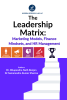
The Leadership Matrix: Marketing Models, Finance Mindsets, and HR Management
Keywords:
Leadership, Marketing, Models, Finance, HR ManagementSynopsis
Leadership in the twenty-first century is no longer confined to managing teams, supervising operations, or making executive decisions. The modern business environment demands leaders who can think strategically across multiple disciplines, understand customer behaviour, interpret financial realities, and cultivate a productive and engaged workforce. Organizations today operate in an interconnected ecosystem where marketing, finance, and human resource management are deeply intertwined.
The Leadership Matrix: Marketing Models, Finance Mindsets, and HR Management has been written to address this evolving leadership landscape. The book presents a comprehensive perspective on leadership by examining how marketing strategies, financial decision-making, and human resource practices collectively contribute to organizational success. Rather than treating these disciplines as separate areas of expertise, the book emphasizes their interdependence and demonstrates how leaders can leverage their combined strengths to achieve strategic objectives.
The concept of a leadership matrix serves as the central theme of this book. In an increasingly competitive and dynamic environment, leaders must understand how decisions made in one functional area affect outcomes in others. A marketing initiative may require financial investment and workforce training. Financial strategies may influence customer experience and employee engagement. Human resource policies may impact innovation, productivity, and market performance.
The book begins by exploring the foundations of modern leadership and organizational excellence. It examines the evolution of leadership theories, the strategic application of leadership styles, and the development of high-performance organizational cultures. These foundational concepts provide the context for understanding leadership as a multidimensional capability that extends beyond traditional management practices.
Subsequent chapters focus on strategic marketing leadership and customer-centric thinking, highlighting the importance of creating value for customers while building strong brands and sustainable market positions. The discussion extends to marketing models, digital transformation, and omnichannel strategies that help organizations remain competitive in rapidly changing markets.
Financial leadership forms another critical pillar of the book. Readers are introduced to financial literacy, profitability analysis, risk assessment, budgeting, forecasting, and performance management concepts. The goal is not to turn every leader into a financial expert but to develop a financial mindset that supports effective decision-making and responsible resource management.
Ultimately, leadership is not merely about directing others-it is about creating value, enabling growth, and inspiring collective achievement. By integrating marketing insight, financial discipline, and human resource excellence, leaders can build organizations that are resilient, innovative, and prepared for future challenges. It is my hope that this book will serve as a valuable resource for readers seeking to strengthen their leadership capabilities and contribute meaningfully to organizational success in an increasingly interconnected world.
Chapters
-
Foundations of Modern Leadership and Organizational Excellence
-
Strategic Marketing Leadership and Customer-Centric Thinking
-
Marketing Models for Sustainable Business Growth
-
Financial Mindsets for Effective Leadership
-
Strategic Finance and Performance Management
-
Human Resource Management in the Leadership Matrix
-
Leadership, People Analytics, and Workforce Transformation
-
Integrating Marketing, Finance, and HR for Competitive Advantage
-
Future Leadership Paradigms and Organizational Success
Downloads
References
Chapter 1: Foundations of Modern Leadership and Organizational Excellence
1. Northouse, P. G. (2024). Leadership: Theory and Practice (10th ed.). Sage Publications.
2. Yukl, G. (2020). Leadership in Organizations (9th ed.). Pearson.
3. Maxwell, J. C. (2018). Developing the Leader Within You 2.0. HarperCollins Leadership.
Chapter 2: Strategic Marketing Leadership and Customer-Centric Thinking
1. Kotler, P., Keller, K. L., & Chernev, A. (2025). Marketing Management (17th ed.). Pearson.
2. Kumar, V., & Reinartz, W. (2018). Customer Relationship Management: Concept, Strategy, and Tools (3rd ed.). Springer.
Chapter 3: Marketing Models for Sustainable Business Growth
1. Kotler, P., Kartajaya, H., & Setiawan, I. (2021). Marketing 5.0: Technology for Humanity. Wiley.
2. Osterwalder, A., & Pigneur, Y. (2010). Business Model Generation. Wiley.
Chapter 4: Financial Mindsets for Effective Leadership
1. Brigham, E. F., & Ehrhardt, M. C. (2022). Financial Management: Theory and Practice. Cengage Learning.
2. Higgins, R. C. (2021). Analysis for Financial Management (13th ed.). McGraw-Hill.
Chapter 5: Strategic Finance and Performance Management
1. Kaplan, R. S., & Norton, D. P. (1996). The Balanced Scorecard. Harvard Business School Press.
2. Damodaran, A. (2012). Investment Valuation (3rd ed.). Wiley.
Chapter 6: Human Resource Management in the Leadership Matrix
1. Dessler, G. (2024). Human Resource Management (17th ed.). Pearson.
2. Armstrong, M., & Taylor, S. (2023). Armstrong's Handbook of Human Resource Management Practice. Kogan Page.
Chapter 7: Leadership, People Analytics, and Workforce Transformation
1. Boudreau, J. W., & Cascio, W. F. (2017). The Search for Global Competence. Society for Human Resource Management.
2. Davenport, T. H., Harris, J., & Shapiro, J. (2010). Competing on Talent Analytics. Harvard Business Review, 88(10), 52–58.
Chapter 8: Integrating Marketing, Finance, and HR for Competitive Advantage
1. Porter, M. E. (1985). Competitive Advantage. Free Press.
2. Hrebiniak, L. G. (2013). Making Strategy Work. Pearson.
Chapter 9: Future Leadership Paradigms and Organizational Success
1. Schwab, K. (2017). The Fourth Industrial Revolution. Crown Business.
2. Iansiti, M., & Lakhani, K. R. (2020). Competing in the Age of AI. Harvard Business Review Press.
Downloads
Published
License

This work is licensed under a Creative Commons Attribution 4.0 International License.
Creative Commons Attribution 4.0 International (CC BY 4.0) — License Terms
The Creative Commons Attribution 4.0 International License (CC BY 4.0) is one of the most permissive open licenses. It allows others to use, share, and build upon a work for any purpose—including commercial use—provided that proper credit is given to the original creator.
1. Permissions Granted
Under CC BY 4.0, anyone may:
a) Share
Copy and redistribute the material in any medium or format (print, digital, audio, video, etc.).
b) Adapt
Remix, transform, translate, or build upon the material.
c) Commercial Use Allowed
The work may be used for commercial purposes, including resale, inclusion in paid products, or monetized distribution.
d) No Additional Permission Required
Users do not need to contact the author for permission, as long as they follow the license conditions.
2. Attribution Requirements (Core Condition)
Users must give appropriate credit to the original creator. Attribution should include:
- Name of the author/creator
- Title of the work (if available)
- Source (publisher, website, or platform)
- Link to the original work (if online)
- Link to the CC BY 4.0 license
- Indication of any changes made
Example Attribution:
“Title of Work” by Author Name is licensed under CC BY 4.0.
Adapted from the original available at [URL].
3. Indicating Changes
If the material is modified, translated, shortened, or otherwise altered, users must clearly state that changes were made.
Examples:
- “Translated from the original”
- “Adapted from…”
- “Modified version of…”
4. No Additional Restrictions
Users may not:
- Apply legal terms or technological measures (such as DRM) that restrict others from exercising the license rights
- Impose new licensing conditions that contradict CC BY 4.0
5. Rights Not Covered by the License
CC BY 4.0 does not automatically grant:
- Patent rights
- Trademark rights
- Privacy or publicity rights
- Moral rights where they cannot be waived by law
Users must ensure compliance with these separately.
6. Disclaimer of Warranties
The material is provided “as-is.”
The licensor (author/publisher) gives no guarantees regarding accuracy, suitability, or fitness for any purpose.
7. Termination and Reinstatement
- The license remains valid as long as the terms are followed.
- If a user violates the terms (e.g., fails to attribute), the rights terminate automatically.
- Rights may be reinstated if the violation is corrected within 30 days of discovery.
8. International Scope
CC BY 4.0 is designed to work worldwide and is not limited to any specific country’s copyright law.
Suggested Copyright Notice Using CC BY 4.0
© [Year] [Author Name].
This work is licensed under the Creative Commons Attribution 4.0 International License (CC BY 4.0).
To view a copy of this license, visit: https://creativecommons.org/licenses/by/4.0/
You are free to share and adapt this work for any purpose, even commercially, provided that appropriate credit is given.









