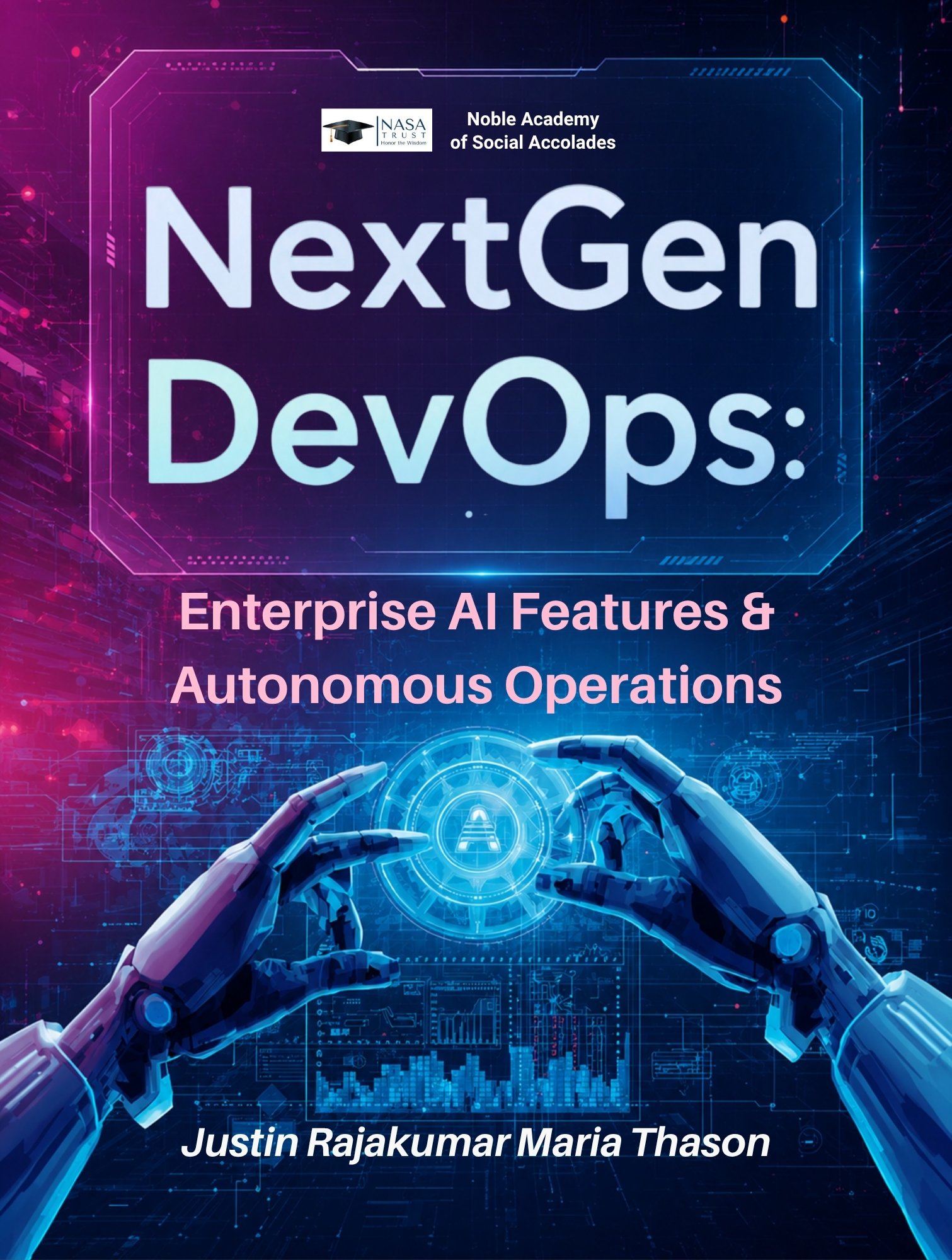
NextGen DevOps: Enterprise AI Features & Autonomous Operations
Keywords:
NextGen DevOps: Enterprise AI Autonomous Features, NextGen DevOps, Feature of DevOps, DevOps AI Engineering, DevOps SRE, DevOps Kubernetees, DevOps Terroform, DevOps, DevOps Platform Engg, DevOps Cloud Native, DevOps 2035Synopsis
Why This Book Exists
Every enterprise technology book faces the same risk: it describes a snapshot of tooling that will look dated within eighteen months. This book was written with that risk in mind, and the choice made throughout is to prioritize the reasoning behind enterprise practice over the specific vendor, version, or benchmark that happens to be current at the time of writing. Tools change constantly. The underlying problems — how to move change into production safely, how to keep a distributed system observable, how to grant a machine enough authority to be useful without enough to be dangerous — change far more slowly, if they change at all.
This book grew out of a simple observation, stated plainly in Chapter 1 and revisited in every chapter after it: the enterprise operating models of the pre-2000 era were not primitive versions of what we do today. They were coherent systems, well adapted to their constraints, built around controls — change approval, segregation of duties, capacity planning, disaster recovery testing — that existed for concrete, well-understood reasons. DevOps, cloud engineering, platform engineering, SRE, DevSecOps, and now AI and agentic operations are not replacements for that discipline. They are the same discipline, re-implemented as automation, so that the trade-off between speed and safety — which was real and unavoidable when every control required a human and a form — stops being a trade-off at all. That reframing is the thesis this book returns to, chapter after chapter, technology after technology: automation does not remove control, it relocates it into code, which is what finally allows organizations to be both fast and safe rather than choosing between them.
Who This Book Is For
This is a book for people who are accountable for enterprise technology decisions and their consequences — platform engineers building the golden paths that hundreds of other engineers will depend on; SRE and operations leaders responsible for keeping distributed systems reliable under real load; security and governance professionals who need to reason about AI and agentic systems without either dismissing the risk or being paralyzed by it; and technology executives who need to sponsor multi-year transformation programmes and explain, credibly, what they will produce.
It assumes no single starting point. A reader coming from a mainframe or client-server background will find Chapter 1 a deliberately unromantic account of what that era actually got right and where its assumptions broke down. A reader who has spent a career in cloud-native environments may find the early chapters familiar and will get more from the AI, agentic, and governance material in the second half. The book is built so that each chapter stands on the shoulders of the ones before it — Kubernetes assumes the cloud material in Chapter 3; agentic AI assumes the single-model AI engineering discipline in Chapter 8; multi-agent systems assume everything in the chapter before it — but a reader with existing expertise in a given layer should feel free to start wherever their gap actually is.
What This Book Argues
Three convictions run underneath every chapter, and it is worth stating them here rather than leaving the reader to infer them from twenty chapters of detail.
First, autonomy is a cost, not a feature. Whether the subject is a Terraform pipeline, a Kubernetes controller, a single AI agent, or a coordinated system of many agents, this book consistently argues for the least autonomous design that solves the problem, and for autonomy that is earned incrementally, on evidence, bounded by reversibility, and enforced technically rather than by instruction. Readers who come to this book expecting an uncritical case for maximal automation will instead find a repeated, deliberately unfashionable argument: most enterprise tasks want a well-engineered workflow with a model or a human in one or two steps, not a population of autonomous agents negotiating with each other. Where the book does endorse deeper autonomy, it does so because a specific, named limitation forced the move — never because autonomy is presented as inherently more advanced.
Second, governance that is not built into the delivery path will be routed around. This idea appears in the discussion of change advisory boards in Chapter 1, in the platform-as-compliance-mechanism argument of Chapter 4, in the AI governance chapters, and in the case studies that close the book. A policy nobody can find at the point of work is a policy that does not exist. The organizations described in this book that succeeded at governing fast-moving technology did so by making the governed path faster and better than the alternative, not by making the ungoverned path merely against the rules.
Third, nothing in this book should be taken as a substitute for verification against current sources. AI capabilities, cloud provider offerings, regulatory obligations, and the state of standards bodies all move faster than any printed material can track. Wherever a specific figure, deadline, or capability claim would age badly, this book has tried to say so explicitly and to point toward the primary source instead. Readers should treat every "verify current guidance" note in this text as a serious instruction, not a formality.
How the Book Is Organized
The seventeen chapters move deliberately from foundation to frontier.
Chapters 1 and 2 establish the historical grounding: what enterprise IT looked like before 2000, and how the pressures of the following twenty-five years produced the DevOps movement as a series of responses to moving bottlenecks rather than a single invention. Chapters 3 through 7 cover the operational substrate that every later chapter depends on — cloud engineering, platform engineering, Kubernetes, Terraform, and site reliability engineering — treated not as isolated tools but as a connected system of practices that share a common vocabulary of blast radius, golden paths, and graduated authority.
Chapters 8 through 10 shift the book's centre of gravity to AI: first the engineering discipline required to run AI systems in production responsibly, then single-agent systems and the specific reliability and security problems they introduce, then multi-agent coordination and the honest case for why it is usually not the right answer. Chapters 11 and 12 address governance and security directly, arguing that AI governance is an operating capability requiring its own workforce and structure, and that zero trust architecture for AI systems must assume that the model can never reliably distinguish an instruction from data — a constraint that shapes everything else in that chapter.
Chapters 13 and 14 address two domains that will matter increasingly over the next decade: autonomous incident management built on a digital twin, and the cryptographic migration that quantum computing eventually forces on every enterprise regardless of how far away the threat feels today. Chapter 15 returns to multi-agent systems with a sharper focus on where they belong in the broader autonomous enterprise architecture. Chapter 16 makes the case, at length, that AI governance fails when it is a document and succeeds when it is a staffed, measured, embedded operating capability — and describes what that staffing actually looks like. Chapter 17 closes the book with the case study that makes every other chapter's value legible to a board: enterprise FinOps, and the portfolio-level lessons that emerge when twenty transformation efforts are read together rather than one at a time.
A Note on Honesty About Uncertainty
Readers will notice a recurring pattern in this book's treatment of contested or fast-moving topics: rather than offering false confidence, chapters frequently state plainly what is known, what is genuinely unsettled, and what the reader must verify independently before acting. This is a deliberate editorial choice. A textbook that overstates its certainty about quantum computing timelines, AI regulatory deadlines, or the current maturity of a given tool does its readers a disservice that compounds with every year the book remains in print. Where this book expresses caution, that caution is the content, not a hedge around it.
Acknowledgment of Scope
No single volume can be authoritative on cloud engineering, Kubernetes, Terraform, site reliability engineering, AI systems, agentic architecture, multi-agent coordination, AI governance, zero trust security, digital twins, post-quantum cryptography, and enterprise FinOps simultaneously. Each of these topics supports — and has — entire books of its own. What this volume offers instead is the connective structure between them: the argument that these are not separate disciplines competing for budget and attention, but a single coherent operating model for the enterprise that is still being built, chapter by chapter, in organizations doing this work right now.
The reader is invited to treat this book the way its own thesis recommends treating enterprise controls in general: understand why each practice exists before deciding whether to keep it, automate it, or replace it — and never mistake the absence of a rule for the absence of a reason.
Chapters
-
NEXTGEN DEVOPS — Enterprise IT Before 20001.1 Introduction: Why Study What Came Before 1 1.2 What "Enterprise IT" Means 3 1.3 A Periodization of Enterprise Computing, 1950–2000 3 1.4 The Centralized Paradigm: Mainframe Computing 4 1.4.1 What a Mainframe Is 4 1.4.2 Architecture 5 1.4.3 The Technol
-
DevOps Evolution, 2000–20252.1 Introduction: The Constraint That Moved 15 2.2 A Note on Periodization 16 2.3 Phase 1 — 2001–2005: Agile Pressure on a Sequential Model 16 2.4 Phase 2 — 2005–2010: Integration, Configuration, and the Arrival of Cloud 17 2.5 Phase 3 — 2010–2015: The Mo
-
Cloud Engineering3.1 Introduction: What Cloud Engineering Actually Is 24 3.2 The Shared Responsibility Model 25 3.2.1 How Responsibility Shifts by Service Model 25 3.2.2 The Backup Trap 26 3.2.3 Concentration and Correlated Risk 26 3.3 Service Models 27 3.3.1 The Compute
-
Platform Engineering4.1 Introduction: The Load Problem 34 4.2 The Platform as a Product 35 4.2.1 What Treating It as a Product Actually Requires 35 4.2.2 Pull, Not Push 36 4.2.3 The Thinnest Viable Platform 36 4.3 Developer Experience 36 4.3.1 The Three Dimensions 37 4.3.2 M
-
DevOps in Kubernetes5.1 Introduction: What Kubernetes Is, and Whether You Need It 43 5.1.1 The Core Idea 44 5.1.2 Do You Need It? 44 5.2 Containers and Images 45 5.2.1 The Image 45 5.2.2 Registry and Supply Chain 45 5.3 Architecture and the Control Plane 46 5.3.1 Components
-
DevOps in Terraform6.1 Introduction: The Execution Model 54 6.1.1 How Terraform Works 55 6.1.2 The Licensing Split 56 6.2 Providers 56 6.2.1 Version Pinning 56 6.2.2 Aliases and Multi-Region, Multi-Account 57 6.2.3 Authentication 57 6.3 State 58 6.3.1 Why It Exists 58 6.3.2
-
DevOps for Site Reliability Engineering7.1 Introduction: What SRE Actually Is 66 7.1.1 Origin 66 7.1.2 SRE, DevOps, and Platform Engineering 67 7.2 Service Levels 67 7.2.1 The Three Terms 67 7.2.2 Writing a Good SLI 68 7.2.3 The Golden Signals 68 7.2.4 Choosing the Target 68 7.3 Error Budgets
-
DevOps AI Engineering8.1 Introduction 76 8.1.1 What AI Engineering Is 76 8.1.2 Where Enterprise AI Actually Fails 77 8.2 Choosing an Approach 78 8.2.1 Does This Need AI At All? 78 8.2.2 The Escalation Ladder 78 8.2.3 Build, Buy, or Host 79 8.3 Data Foundations 79 8.3.1 What A
-
DevOps Agentic AI9.1 What "Agentic" Actually Means 86 9.1.1 A Spectrum, Not a Category 86 9.1.2 When Agency Genuinely Pays 87 9.2 Anatomy of the Agent Loop 87 9.3 Architectures 88 9.3.1 The Patterns 88 9.3.2 Choosing 89 9.4 Tools 89 9.4.1 Design Principles 89 9.4.2 The T
Downloads
References
Chapter 1: NEXTGEN DEVOPS — Enterprise IT Before 2000
1. Ceruzzi, P. E. (2003). A History of Modern Computing (2nd ed.). MIT Press. ISBN 978-0-262-53203-7. MIT Press — A History of Modern Computing
2. Haigh, T., & Ceruzzi, P. E. (2021). A New History of Modern Computing. MIT Press. https://doi.org/10.7551/mitpress/11436.001.0001
3. Gray, J., & Reuter, A. (1992). Transaction Processing: Concepts and Techniques. Morgan Kaufmann. ISBN 978-0-08-051955-5.
4. IBM. (2026). The IBM System/360: The $5 Billion Gamble That Changed Computing. IBM History. The System/360 was introduced in 1964 and established a compatible mainframe family.
5. IBM. (n.d.). The S/360: A Turning Point in Mainframe History. IBM Documentation.
6. Royce, W. W. (1970). Managing the development of large software systems. Proceedings of IEEE WESCON, 26, 1–9. Royce paper archive copy
7. Rose, S., Borchert, O., Mitchell, S., & Connelly, S. (2020). Zero Trust Architecture (NIST SP 800-207). National Institute of Standards and Technology. https://doi.org/10.6028/NIST.SP.800-207
8. Campbell-Kelly, M., Aspray, W., Ensmenger, N., & Yost, J. R. (2013). Computer: A History of the Information Machine (3rd ed.). Westview Press. ISBN 978-0-8133-4590-1.
Chapter 2: DevOps Evolution, 2000–2025
1. Beck, K., Beedle, M., van Bennekum, A., Cockburn, A., Cunningham, W., Fowler, M., et al. (2001). Manifesto for Agile Software Development.
2. Humble, J., & Farley, D. (2010). Continuous Delivery: Reliable Software Releases through Build, Test, and Deployment Automation. Addison-Wesley Professional. ISBN 978-0-321-60191-9. Continuous Delivery — publisher information
3. Forsgren, N., Humble, J., & Kim, G. (2018). Accelerate: The Science of Lean Software and DevOps. IT Revolution Press. ISBN 978-1-942788-33-1. Accelerate — IT Revolution
4. DORA. (2024). Accelerate State of DevOps Report 2024. Google Cloud.
5. Amazon Web Services. (2006). Announcing Amazon Elastic Compute Cloud (Amazon EC2) — Beta. AWS.
6. Puppet. (n.d.). The Puppet Story. Puppet was founded in 2005 to address manual infrastructure configuration and helped establish declarative configuration management practices.
7. Beyer, B., Jones, C., Petoff, J., & Murphy, N. R. (Eds.). (2016). Site Reliability Engineering: How Google Runs Production Systems. O'Reilly Media. Google SRE Book
8. SLSA Community. (2026). Supply-chain Levels for Software Artifacts Specification, Version 1.2. Linux Foundation.
9. National Telecommunications and Information Administration. (2021). The Minimum Elements for a Software Bill of Materials (SBOM). U.S. Department of Commerce. NTIA SBOM Minimum Elements
10. Kim, G., Humble, J., Debois, P., & Willis, J. (2021). The DevOps Handbook (2nd ed.). IT Revolution Press. The DevOps Handbook
Chapter 3: Cloud Engineering
1. Amazon Web Services. (2021). Shared Responsibility Model. In AWS Risk and Compliance.
2. Microsoft. (2026). Shared Responsibility in the Cloud. Microsoft Azure Documentation.
3. Google Cloud. (2023). Shared Responsibilities and Shared Fate on Google Cloud. Google Cloud Architecture Framework.
4. Amazon Web Services. (2024). AWS Well-Architected Framework. AWS Well-Architected Framework
5. Microsoft. (2026). Azure Well-Architected Framework. Microsoft Learn. Azure Well-Architected Framework
6. Google Cloud. (2026). Google Cloud Well-Architected Framework. Google Cloud Architecture Center. Google Cloud Well-Architected Framework
7. FinOps Foundation. (2025). FinOps Framework. Linux Foundation.
8. National Institute of Standards and Technology. (2011). The NIST Definition of Cloud Computing (NIST SP 800-145). https://doi.org/10.6028/NIST.SP.800-145 NIST SP 800-145
9. National Institute of Standards and Technology. (2012). Cloud Computing Synopsis and Recommendations (NIST SP 800-146). https://doi.org/10.6028/NIST.SP.800-146 NIST SP 800-146
10. Amazon Web Services. (2006). Amazon EC2 Beta. AWS News Blog.
Chapter 4: Platform Engineering
1. Skelton, M., & Pais, M. (2019). Team Topologies: Organizing Business and Technology Teams for Fast Flow. IT Revolution Press. ISBN 978-1-942788-81-2.
2. Forsgren, N., Storey, M.-A., Maddila, C., Zimmermann, T., Houck, B., & Butler, J. (2021). The SPACE of developer productivity: There's more to it than you think. ACM Queue, 19(1), 20–48. https://doi.org/10.1145/3454122.3454124
3. Noda, A., Storey, M.-A., Forsgren, N., & Greiler, M. (2023). DevEx: What actually drives productivity? Communications of the ACM, 66(11), 44–49. https://doi.org/10.1145/3610285
4. Cloud Native Computing Foundation. (2023). Platforms White Paper. CNCF Platforms Working Group. CNCF Platforms White Paper
5. Backstage Project Authors. (2026). Backstage Documentation. Cloud Native Computing Foundation. Backstage Documentation
6. Skelton, M., & Pais, M. (2019). Monoliths vs. microservices is missing the point—start with team cognitive load. IT Revolution.
7. DORA. (2024). Accelerate State of DevOps Report 2024. Google Cloud. The report includes findings on platform engineering, developer productivity, and delivery performance.
8. Humble, J., Molesky, J., & O'Reilly, B. (2020). Lean Enterprise: How High Performance Organizations Innovate at Scale. O'Reilly Media. Lean Enterprise — O'Reilly
Chapter 5: Kubernetes
1. Kubernetes Authors. (2026). Kubernetes Components. Kubernetes Documentation.
2. Kubernetes Authors. (2026). Concepts: Workloads, Pods, Deployments, StatefulSets, and Controllers. Kubernetes Documentation. Kubernetes Workloads Documentation
3. Kubernetes Authors. (2024). Pod Security Admission. Kubernetes Documentation.
4. Kubernetes Authors. (2025). Security Checklist. Kubernetes Documentation.
5. Kubernetes Authors. (2025). Security Concepts. Kubernetes Documentation.
6. Allclair, T., & Stoelinga, S. (2022). Kubernetes v1.25: Pod Security Admission Controller in stable. Kubernetes Blog.
7. Open Container Initiative. (2026). OCI Image Format Specification. Linux Foundation. OCI Image Specification
8. Burns, B., Beda, J., & Hightower, K. (2022). Kubernetes: Up & Running (3rd ed.). O'Reilly Media. Kubernetes: Up & Running
9. Cloud Native Computing Foundation. (2026). Cloud Native Security Whitepaper. CNCF. CNCF Cloud Native Security Whitepaper
10. Kubernetes Authors. (2026). Resource Management for Pods and Containers. Kubernetes Documentation. Kubernetes Resource Management
Chapter 6: Terraform
1. HashiCorp. (2026). Terraform State. HashiCorp Developer Documentation.
2. HashiCorp. (2026). Purpose of Terraform State. HashiCorp Developer Documentation.
3. HashiCorp. (2026). Manage Sensitive Data in Your Configuration. HashiCorp Developer Documentation.
4. HashiCorp. (2026). State Storage and Locking. Terraform Documentation.
5. HashiCorp. (2026). Remote State. Terraform Documentation.
6. HashiCorp. (2026). Terraform Configuration Language Style Guide.
7. HashiCorp. (2026). Protect Sensitive Input Variables. Terraform Tutorials. The documentation explicitly notes that sensitive values may still be stored in state.
8. Brikman, Y. (2022). Terraform: Up & Running (3rd ed.). O'Reilly Media. Terraform: Up & Running
9. OpenTofu Project. (2026). OpenTofu Documentation. Linux Foundation. OpenTofu Documentation
10. HashiCorp. (2026). Terraform Backends: State Storage and Locking. The documentation explains how backends store state and coordinate concurrent operations.
Chapter 7: Site Reliability Engineering
1. Beyer, B., Jones, C., Petoff, J., & Murphy, N. R. (Eds.). (2016). Site Reliability Engineering: How Google Runs Production Systems. O'Reilly Media. Site Reliability Engineering — Google
2. Beyer, B., Murphy, N. R., Rensin, D. K., Kawahara, K., & Thorne, S. (Eds.). (2018). The Site Reliability Workbook: Practical Ways to Implement SRE. O'Reilly Media. The Site Reliability Workbook
3. Google. (2018). Alerting on SLOs. In The Site Reliability Workbook. Alerting on SLOs
4. Google. (2016). Service level objectives. In Site Reliability Engineering. Service Level Objectives
5. Prometheus Authors. (2026). Instrumentation Best Practices. Prometheus Documentation. Prometheus Instrumentation Practices
6. OpenTelemetry Authors. (2026). OpenTelemetry Documentation: Signals. Cloud Native Computing Foundation. OpenTelemetry Signals
7. Allspaw, J. (2012). Blameless postmortems and a just culture. Etsy Engineering. Blameless Postmortems
8. Basiri, A., Behnam, N., de Rooij, R., Hochstein, L., Kosewski, L., Reynolds, J., & Rosenthal, C. (2016). Chaos engineering. IEEE Software, 33(3), 35–41. https://doi.org/10.1109/MS.2016.60 IEEE DOI — Chaos Engineering
9. Dean, J., & Barroso, L. A. (2013). The tail at scale. Communications of the ACM, 56(2), 74–80. https://doi.org/10.1145/2408776.2408794 The Tail at Scale DOI
10. DORA. (2024). Accelerate State of DevOps Report 2024. Google Cloud.
Chapter 8: AI Engineering
1. Tabassi, E. (2023). Artificial Intelligence Risk Management Framework (AI RMF 1.0). National Institute of Standards and Technology. NIST AI 100-1. https://doi.org/10.6028/NIST.AI.100-1
2. Autio, C., Schwartz, R., Dunietz, J., Jain, S., Stanley, M., Tabassi, E., et al. (2024). Artificial Intelligence Risk Management Framework: Generative Artificial Intelligence Profile. NIST AI 600-1. National Institute of Standards and Technology. NIST Generative AI Profile
3. Lewis, P., Perez, E., Piktus, A., Petroni, F., Karpukhin, V., Goyal, N., et al. (2020). Retrieval-augmented generation for knowledge-intensive NLP tasks. Advances in Neural Information Processing Systems, 33.
4. Mitchell, M., Wu, S., Zaldivar, A., Barnes, P., Vasserman, L., Hutchinson, B., et al. (2019). Model cards for model reporting. In Proceedings of the Conference on Fairness, Accountability, and Transparency, 220–229. https://doi.org/10.1145/3287560.3287596 Model Cards DOI
5. Vaswani, A., Shazeer, N., Parmar, N., Uszkoreit, J., Jones, L., Gomez, A. N., et al. (2017). Attention is all you need. Advances in Neural Information Processing Systems, 30. Attention Is All You Need
6. OWASP Foundation. (2025). OWASP Top 10 for Large Language Model Applications. OWASP GenAI Security Project
7. DORA. (2024). Accelerate State of DevOps Report 2024. Google Cloud. The report includes empirical analysis of AI adoption and software delivery outcomes.
8. Liu, N. F., Lin, K., Hewitt, J., Paranjape, A., Bevilacqua, M., Petroni, F., & Liang, P. (2024). Lost in the middle: How language models use long contexts. Transactions of the Association for Computational Linguistics, 12, 157–173. https://doi.org/10.1162/tacl_a_00638
9. National Institute of Standards and Technology. (2023). AI RMF Playbook. NIST. NIST AI RMF Playbook
10. OWASP Foundation. (2025). Prompt Injection and Excessive Agency Guidance. OWASP GenAI Security Project. OWASP GenAI Security
Chapter 9: Agentic AI
1. Yao, S., Zhao, J., Yu, D., Du, N., Shafran, I., Narasimhan, K., & Cao, Y. (2023). ReAct: Synergizing reasoning and acting in language models. International Conference on Learning Representations (ICLR).
2. Schick, T., Dwivedi-Yu, J., Dessì, R., Raileanu, R., Lomeli, M., Hambro, E., et al. (2023). Toolformer: Language models can teach themselves to use tools. Advances in Neural Information Processing Systems, 36.
3. Shinn, N., Cassano, F., Gopinath, A., Narasimhan, K., & Yao, S. (2023). Reflexion: Language agents with verbal reinforcement learning. Advances in Neural Information Processing Systems, 36.
4. Wu, Q., Bansal, G., Zhang, J., Wu, Y., Li, B., Zhu, E., et al. (2024). AutoGen: Enabling next-gen LLM applications via multi-agent conversation. Conference on Language Modeling (COLM 2024).
5. Liu, N. F., Lin, K., Hewitt, J., Paranjape, A., Bevilacqua, M., Petroni, F., & Liang, P. (2024). Lost in the middle: How language models use long contexts. Transactions of the Association for Computational Linguistics, 12, 157–173. https://doi.org/10.1162/tacl_a_00638
6. Tabassi, E. (2023). Artificial Intelligence Risk Management Framework (AI RMF 1.0). NIST AI 100-1. https://doi.org/10.6028/NIST.AI.100-1
7. OWASP Foundation. (2025). OWASP Top 10 for LLM and Generative AI Applications. Particular relevance: prompt injection, excessive agency, insecure output handling, and sensitive-information disclosure. OWASP GenAI Security Project
8. Yao, S., et al. (2023). ReAct: Synergizing Reasoning and Acting in Language Models — Project and Code.
9. Shinn, N., et al. (2023). Reflexion: Language Agents with Verbal Reinforcement Learning. NeurIPS 2023.
10. Wu, Q., et al. (2023/2024). AutoGen: Enabling Next-Gen LLM Applications via Multi-Agent Conversation. Microsoft Research.
Downloads
Published
License

This work is licensed under a Creative Commons Attribution 4.0 International License.
Creative Commons Attribution 4.0 International (CC BY 4.0) — License Terms
The Creative Commons Attribution 4.0 International License (CC BY 4.0) is one of the most permissive open licenses. It allows others to use, share, and build upon a work for any purpose—including commercial use—provided that proper credit is given to the original creator.
1. Permissions Granted
Under CC BY 4.0, anyone may:
a) Share
Copy and redistribute the material in any medium or format (print, digital, audio, video, etc.).
b) Adapt
Remix, transform, translate, or build upon the material.
c) Commercial Use Allowed
The work may be used for commercial purposes, including resale, inclusion in paid products, or monetized distribution.
d) No Additional Permission Required
Users do not need to contact the author for permission, as long as they follow the license conditions.
2. Attribution Requirements (Core Condition)
Users must give appropriate credit to the original creator. Attribution should include:
- Name of the author/creator
- Title of the work (if available)
- Source (publisher, website, or platform)
- Link to the original work (if online)
- Link to the CC BY 4.0 license
- Indication of any changes made
Example Attribution:
“Title of Work” by Author Name is licensed under CC BY 4.0.
Adapted from the original available at [URL].
3. Indicating Changes
If the material is modified, translated, shortened, or otherwise altered, users must clearly state that changes were made.
Examples:
- “Translated from the original”
- “Adapted from…”
- “Modified version of…”
4. No Additional Restrictions
Users may not:
- Apply legal terms or technological measures (such as DRM) that restrict others from exercising the license rights
- Impose new licensing conditions that contradict CC BY 4.0
5. Rights Not Covered by the License
CC BY 4.0 does not automatically grant:
- Patent rights
- Trademark rights
- Privacy or publicity rights
- Moral rights where they cannot be waived by law
Users must ensure compliance with these separately.
6. Disclaimer of Warranties
The material is provided “as-is.”
The licensor (author/publisher) gives no guarantees regarding accuracy, suitability, or fitness for any purpose.
7. Termination and Reinstatement
- The license remains valid as long as the terms are followed.
- If a user violates the terms (e.g., fails to attribute), the rights terminate automatically.
- Rights may be reinstated if the violation is corrected within 30 days of discovery.
8. International Scope
CC BY 4.0 is designed to work worldwide and is not limited to any specific country’s copyright law.
Suggested Copyright Notice Using CC BY 4.0
© [Year] [Author Name].
This work is licensed under the Creative Commons Attribution 4.0 International License (CC BY 4.0).
To view a copy of this license, visit: https://creativecommons.org/licenses/by/4.0/
You are free to share and adapt this work for any purpose, even commercially, provided that appropriate credit is given.