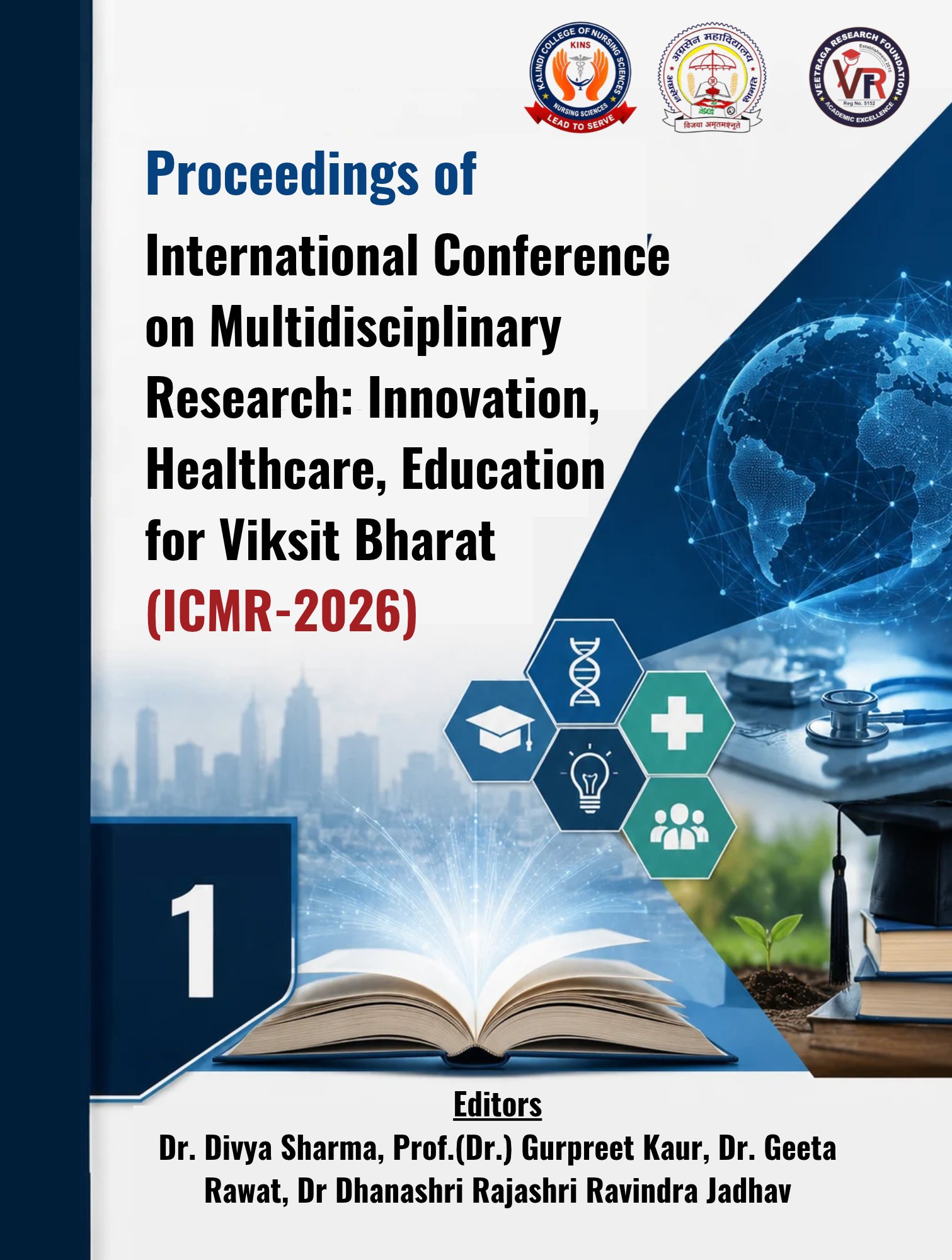
Conference Proceedings of ICMR-2026 (International Conference on Multidisciplinary Research: Innovation, Healthcare, Education for Viksit Bharat)
Keywords:
Multidisciplinary, Healthcare, Law, Education, PsychologySynopsis
This volume brings together selected research contributions presented as part of ICMR-2026. The chapters represent diverse disciplinary perspectives and methodological approaches reflecting the multidisciplinary character of the conference.
Each contribution has been compiled and edited for inclusion in the conference proceedings. The authors retain responsibility for the originality, accuracy, interpretation and scholarly claims presented in their respective chapters.
The editors have attempted to maintain consistency in formatting and presentation while preserving the academic content and disciplinary character of individual contributions.
The volume is intended to facilitate academic exchange and provide a consolidated record of research presented at the conference.
Chapters
-
Chapter 1: Artificial Intelligence Adoption and Operational Efficiency in Modern Business Enterprises
-
Chapter 2: Artificial Intelligence and Emerging Practices in English Language Learning
-
Chapter 3: Artificial Intelligence Assisted Learning and Academic Achievement among University Students
-
Chapter 4: Behavioural Biases and Portfolio Decisions among Individual Equity Investors
-
Chapter 5: Changing Family Structures and Intergenerational Relationships in Urban Communities
-
Chapter 6: Collaborative Learning Practices and Critical Thinking Skills among Secondary Students
-
Chapter 7: Cyberbullying Experiences and Psychological Adjustment among University Students
-
Chapter 8: Digital Assessment Literacy among Teachers in Secondary Education
-
Chapter 9: Digital Citizenship Education and Responsible Technology Use among Adolescents
-
Chapter 10: Digital Portfolio Assessment and Reflective Learning among Undergraduate Students
-
Chapter 11: Emotional Intelligence and Coping Strategies among College Students
-
Chapter 12: Family Communication and Emotional Regulation among Adolescents
-
Chapter 13: Inquiry-Based Learning and Scientific Reasoning among School Students
-
Chapter 14: Interactive Multimedia Learning and Conceptual Understanding among Secondary Students
-
Chapter 15: Media Literacy Education and Critical Awareness among Adolescent Learners
-
Chapter 16: Metacognitive Learning Strategies and Academic Performance among College Students
-
अध्याय 17: NEP 2020 के परिप्रेक्ष्य में उच्च शिक्षा में अकादमिक बैंक ऑफ क्रेडिट की उपयोगिता
-
अध्याय 18: NEP 2020 के संदर्भ में शिक्षा में कौशल विकास और भविष्यपरक रोजगार तैयारी का अध्ययन
-
Chapter 19: Online Assessment Practices and Student Learning Outcomes in Higher Education
-
Chapter 20: Peer Feedback and Academic Writing Development among University Students 145
-
Chapter 21: Peer Support and Psychological Adjustment during Early Adulthood
-
Chapter 22: Teacher Feedback Practices and Student Academic Motivation in Secondary Education
-
Chapter 23: Teacher Leadership and School Improvement in Contemporary Educational Institutions
-
Chapter 24: Teacher Work Engagement and Instructional Quality in Higher Education
-
Chapter 25: Virtual Learning Environments and Student Satisfaction in Higher Education
-
Chapter 26: Work-Life Balance and Mental Well-Being among Working Adults 192
-
Chapter 27: Working Capital Management and Financial Performance of Small and Medium Enterprises 200
-
अध्याय 28: आधुनिक हिंदी साहित्य में हाशिए के समुदायों की अभिव्यक्ति और पहचान
-
अध्याय 29: उच्च शिक्षा में डिजिटल नागरिकता और उत्तरदायी प्रौद्योगिकी उपयोग व्यवहार का अध्ययन
-
अध्याय 30: गृह विज्ञान एवं खाद्य प्रौद्योगिकी के माध्यम से घरेलू खाद्य सुरक्षा और सतत पोषण प्रबंधन का मूल्यांकन
-
अध्याय 31: ग्रामीण शिक्षा में तकनीकी संसाधनों की उपलब्धता और शैक्षिक अवसरों का विश्लेषण
-
अध्याय 32: नई शिक्षा व्यवस्था में हिंदी भाषा शिक्षण की उभरती प्रवृत्तियाँ
-
अध्याय 33: प्रारंभिक शिक्षा में गतिविधि आधारित शिक्षण और अवधारणात्मक समझ के विकास का विश्लेषण
-
अध्याय 34: मानवाधिकार और कानून के परिप्रेक्ष्य में कृत्रिम बुद्धिमत्ता आधारित निगरानी की संवैधानिक समीक्षा
-
अध्याय 35: विद्यालयी शिक्षा में अनुभवात्मक शिक्षण और विद्यार्थियों की रचनात्मक क्षमता का संबंध
-
अध्याय 36: विद्यालयी शिक्षा में डिजिटल कहानी कथन और रचनात्मक अभिव्यक्ति के मध्य संबंध
-
अध्याय 37: विद्यालयी शिक्षा में सहयोगात्मक अधिगम और सामाजिक कौशल विकास का विश्लेषण
-
अध्याय 38: शिक्षा में माइक्रोलर्निंग रणनीतियों द्वारा ज्ञान प्रतिधारण और अधिगम दक्षता का अध्ययन
-
अध्याय 39: शैक्षिक मनोविज्ञान में बुद्धिलब्धि, भावनात्मक बुद्धिमत्ता और शैक्षणिक अनुकूलन का तुलनात्मक अध्ययन
-
अध्याय 40: समावेशी शिक्षा में सहायक प्रौद्योगिकी द्वारा विशेष आवश्यकता वाले विद्यार्थियों का सशक्तीकरण
Downloads
Published
License

This work is licensed under a Creative Commons Attribution 4.0 International License.
Creative Commons Attribution 4.0 International (CC BY 4.0) — License Terms
The Creative Commons Attribution 4.0 International License (CC BY 4.0) is one of the most permissive open licenses. It allows others to use, share, and build upon a work for any purpose—including commercial use—provided that proper credit is given to the original creator.
1. Permissions Granted
Under CC BY 4.0, anyone may:
a) Share
Copy and redistribute the material in any medium or format (print, digital, audio, video, etc.).
b) Adapt
Remix, transform, translate, or build upon the material.
c) Commercial Use Allowed
The work may be used for commercial purposes, including resale, inclusion in paid products, or monetized distribution.
d) No Additional Permission Required
Users do not need to contact the author for permission, as long as they follow the license conditions.
2. Attribution Requirements (Core Condition)
Users must give appropriate credit to the original creator. Attribution should include:
- Name of the author/creator
- Title of the work (if available)
- Source (publisher, website, or platform)
- Link to the original work (if online)
- Link to the CC BY 4.0 license
- Indication of any changes made
Example Attribution:
“Title of Work” by Author Name is licensed under CC BY 4.0.
Adapted from the original available at [URL].
3. Indicating Changes
If the material is modified, translated, shortened, or otherwise altered, users must clearly state that changes were made.
Examples:
- “Translated from the original”
- “Adapted from…”
- “Modified version of…”
4. No Additional Restrictions
Users may not:
- Apply legal terms or technological measures (such as DRM) that restrict others from exercising the license rights
- Impose new licensing conditions that contradict CC BY 4.0
5. Rights Not Covered by the License
CC BY 4.0 does not automatically grant:
- Patent rights
- Trademark rights
- Privacy or publicity rights
- Moral rights where they cannot be waived by law
Users must ensure compliance with these separately.
6. Disclaimer of Warranties
The material is provided “as-is.”
The licensor (author/publisher) gives no guarantees regarding accuracy, suitability, or fitness for any purpose.
7. Termination and Reinstatement
- The license remains valid as long as the terms are followed.
- If a user violates the terms (e.g., fails to attribute), the rights terminate automatically.
- Rights may be reinstated if the violation is corrected within 30 days of discovery.
8. International Scope
CC BY 4.0 is designed to work worldwide and is not limited to any specific country’s copyright law.
Suggested Copyright Notice Using CC BY 4.0
© [Year] [Author Name].
This work is licensed under the Creative Commons Attribution 4.0 International License (CC BY 4.0).
To view a copy of this license, visit: https://creativecommons.org/licenses/by/4.0/
You are free to share and adapt this work for any purpose, even commercially, provided that appropriate credit is given.