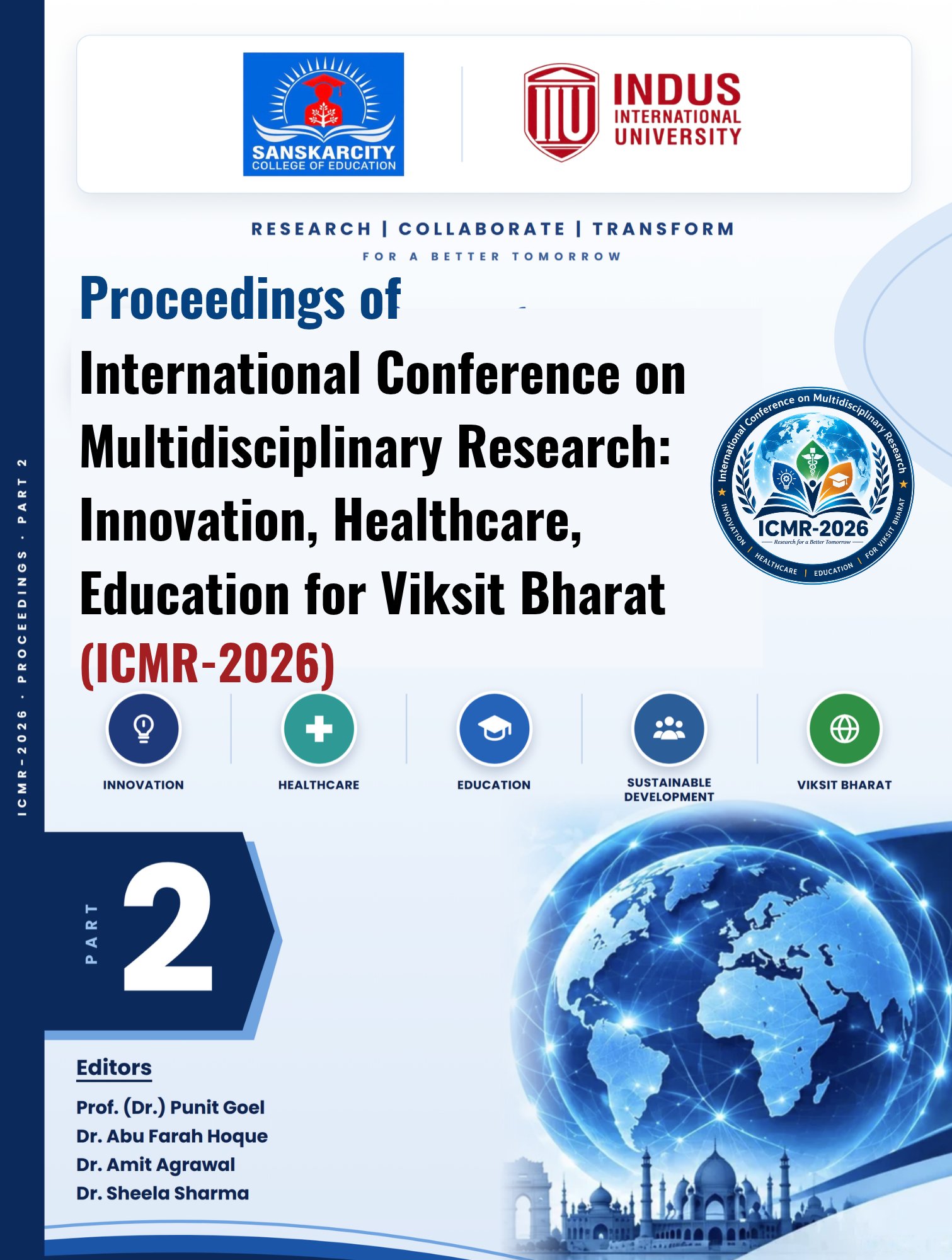
Conference Proceedings of International Conference On Multidisciplinary Research: Contemporary Perspectives in English Literature, Sociology, Hindi and Home Science For Viksit Bharat
Keywords:
Multidisciplinary, Research, English Literature, Sociology, Hindi, Home Science, Viksit Bharat, Conference ProceedingsSynopsis
ICMR-2026 is envisioned as a dynamic international platform for multidisciplinary and interdisciplinary research. The conference brings together researchers, academicians, educators, healthcare professionals, students, policymakers, industry experts, innovators and practitioners from diverse academic and professional domains.
The conference encourages research that addresses contemporary challenges through innovation, emerging technologies, evidence-based practices and cross-disciplinary collaboration.
Special emphasis is placed on Artificial Intelligence, digital transformation, healthcare innovation, educational technology, social development, sustainability and human-centred approaches.
Through research presentations, academic discussions, expert interactions and networking opportunities, ICMR-2026 seeks to strengthen knowledge partnerships and contribute to India's vision of Viksit Bharat@2047.
Chapters
-
Chapter 1: Academic Goal Orientation and Learning Persistence among University Students
-
Chapter 2: Academic Procrastination and Learning Engagement among Undergraduate Students
-
Chapter 3: Academic Resilience and Educational Achievement among College Students
-
Chapter 4: Collaborative Problem-Solving and Learning Achievement among Secondary Students
-
Chapter 5: Digital Accounting Technologies and Financial Reporting Efficiency in Business Organizations
-
Chapter 6: Digital Banking Services and Customer Satisfaction in the Contemporary Banking Sector
-
Chapter 7: Digital Distraction and Academic Concentration among University Learners
-
Chapter 8: Ecological Consciousness and Climate Narratives in Contemporary English Fiction
-
Chapter 9: Green Marketing Practices and Sustainable Consumer Behaviour in Urban Markets
-
Chapter 10: Inclusive Education Practices and Social Participation among Diverse Learners
-
Chapter 11: Inclusive Teaching Practices And Learning Outcomes In Diverse Classrooms
-
Chapter 12: Loneliness and Social Connectedness in the Digital Communication Era
-
Chapter 13: Mindfulness Practices and Perceived Stress among College Students
-
अध्याय 14: NEP 2020 के अंतर्गत शिक्षा में बहुभाषिकता और भाषायी समावेशन की संभावनाएँ
-
अध्याय 15: NEP 2020 के परिप्रेक्ष्य में व्यावसायिक शिक्षा और रोजगारपरक कौशल विकास
-
अध्याय 16: NEP 2020 के संदर्भ में उच्च शिक्षा में बहुविषयक अधिगम की संभावनाएँ
-
अध्याय 17: NEP 2020 के संदर्भ में शिक्षक शिक्षा के बदलते स्वरूप और व्यावसायिक दक्षता का अध्ययन
-
अध्याय 18: NEP 2020 के संदर्भ में शिक्षा में प्रौद्योगिकी एकीकरण और डिजिटल समानता की चुनौतियाँ
-
Chapter 19: Online Social Validation and Self-Concept among Emerging Adults
-
Chapter 20: Parental Involvement and Academic Motivation among School-Going Adolescents
-
Chapter 21: Perceived Organizational Support and Employee Psychological Resilience
-
Chapter 22: School-Based Assessment and Learning Improvement among Secondary Learners
-
Chapter 23: Self-Regulated Learning Strategies and Academic Achievement among Undergraduates
-
Chapter 24: Sleep Quality and Academic Performance among Higher Education Students
-
Chapter 25: Social-Emotional Learning and Classroom Adjustment among Adolescent Students
-
Chapter 26: Socioeconomic Factors and Educational Aspirations among Secondary School Students
-
Chapter 27: Student-Centred Pedagogy and Active Learning in Undergraduate Classrooms
-
Chapter 28: Teacher Self-Efficacy and Classroom Management Practices in Secondary Schools
-
Chapter 29: Technology, Youth Culture, and Emerging Forms of Social Identity
-
Chapter 30: Technology-Enhanced Teaching and Classroom Participation among Undergraduate Learners
-
अध्याय 31: उच्च शिक्षा में कृत्रिम बुद्धिमत्ता आधारित शिक्षण से अकादमिक सहभागिता का मूल्यांकन
-
अध्याय 32: उच्च शिक्षा में शैक्षिक नेतृत्व और शिक्षक नवाचार संस्कृति के मध्य संबंध
-
अध्याय 33: गृह विज्ञान और वस्त्र विज्ञान के संदर्भ में पर्यावरण-अनुकूल परिधान चयन एवं उपभोक्ता जागरूकता का अध्ययन
-
अध्याय 34: मनोविज्ञान के परिप्रेक्ष्य में सकारात्मक पालन-पोषण और किशोर मानसिक लचीलापन का प्रभाव
-
अध्याय 35: विद्यालयी शिक्षा में शिक्षक भावनात्मक बुद्धिमत्ता और कक्षा प्रबंधन प्रभावशीलता का अध्ययन
-
अध्याय 36: विधायी कानून के अंतर्गत साइबर अपराध नियंत्रण और व्यक्तिगत डेटा संरक्षण का समकालीन अध्ययन
-
अध्याय 37: शिक्षा में खेल आधारित अधिगम द्वारा विद्यार्थियों की संज्ञानात्मक सहभागिता का विकास
-
अध्याय 38: शिक्षा में परियोजना आधारित अधिगम द्वारा समस्या समाधान कौशल के विकास का विश्लेषण
-
अध्याय 39: सोशल मीडिया का युवा पीढ़ी की हिंदी भाषा पर प्रभाव
-
अध्याय 40: हिंदी साहित्य में पर्यावरण चेतना और प्रकृति विमर्श का अध्ययन
-
अध्याय 41: त्रिशंकु लोकसभा और गठबंधन की परिस्थितियों में भारतीय राष्ट्रपति: संवैधानिक विवेक, बहुमत परीक्षण और संस्थागत निष्पक्षता
-
अध्याय 42: माध्यमिक विद्यार्थियों की शैक्षिक उपलब्धि में सामाजिक पूंजी की भूमिका
-
अध्याय 43: कृत्रिम बुद्धिमत्ता के बढ़ते उपयोग से युवाओं के सामाजिक व्यवहार में परिवर्तन
Downloads
Downloads
Published
License

This work is licensed under a Creative Commons Attribution 4.0 International License.
Creative Commons Attribution 4.0 International (CC BY 4.0) — License Terms
The Creative Commons Attribution 4.0 International License (CC BY 4.0) is one of the most permissive open licenses. It allows others to use, share, and build upon a work for any purpose—including commercial use—provided that proper credit is given to the original creator.
1. Permissions Granted
Under CC BY 4.0, anyone may:
a) Share
Copy and redistribute the material in any medium or format (print, digital, audio, video, etc.).
b) Adapt
Remix, transform, translate, or build upon the material.
c) Commercial Use Allowed
The work may be used for commercial purposes, including resale, inclusion in paid products, or monetized distribution.
d) No Additional Permission Required
Users do not need to contact the author for permission, as long as they follow the license conditions.
2. Attribution Requirements (Core Condition)
Users must give appropriate credit to the original creator. Attribution should include:
- Name of the author/creator
- Title of the work (if available)
- Source (publisher, website, or platform)
- Link to the original work (if online)
- Link to the CC BY 4.0 license
- Indication of any changes made
Example Attribution:
“Title of Work” by Author Name is licensed under CC BY 4.0.
Adapted from the original available at [URL].
3. Indicating Changes
If the material is modified, translated, shortened, or otherwise altered, users must clearly state that changes were made.
Examples:
- “Translated from the original”
- “Adapted from…”
- “Modified version of…”
4. No Additional Restrictions
Users may not:
- Apply legal terms or technological measures (such as DRM) that restrict others from exercising the license rights
- Impose new licensing conditions that contradict CC BY 4.0
5. Rights Not Covered by the License
CC BY 4.0 does not automatically grant:
- Patent rights
- Trademark rights
- Privacy or publicity rights
- Moral rights where they cannot be waived by law
Users must ensure compliance with these separately.
6. Disclaimer of Warranties
The material is provided “as-is.”
The licensor (author/publisher) gives no guarantees regarding accuracy, suitability, or fitness for any purpose.
7. Termination and Reinstatement
- The license remains valid as long as the terms are followed.
- If a user violates the terms (e.g., fails to attribute), the rights terminate automatically.
- Rights may be reinstated if the violation is corrected within 30 days of discovery.
8. International Scope
CC BY 4.0 is designed to work worldwide and is not limited to any specific country’s copyright law.
Suggested Copyright Notice Using CC BY 4.0
© [Year] [Author Name].
This work is licensed under the Creative Commons Attribution 4.0 International License (CC BY 4.0).
To view a copy of this license, visit: https://creativecommons.org/licenses/by/4.0/
You are free to share and adapt this work for any purpose, even commercially, provided that appropriate credit is given.