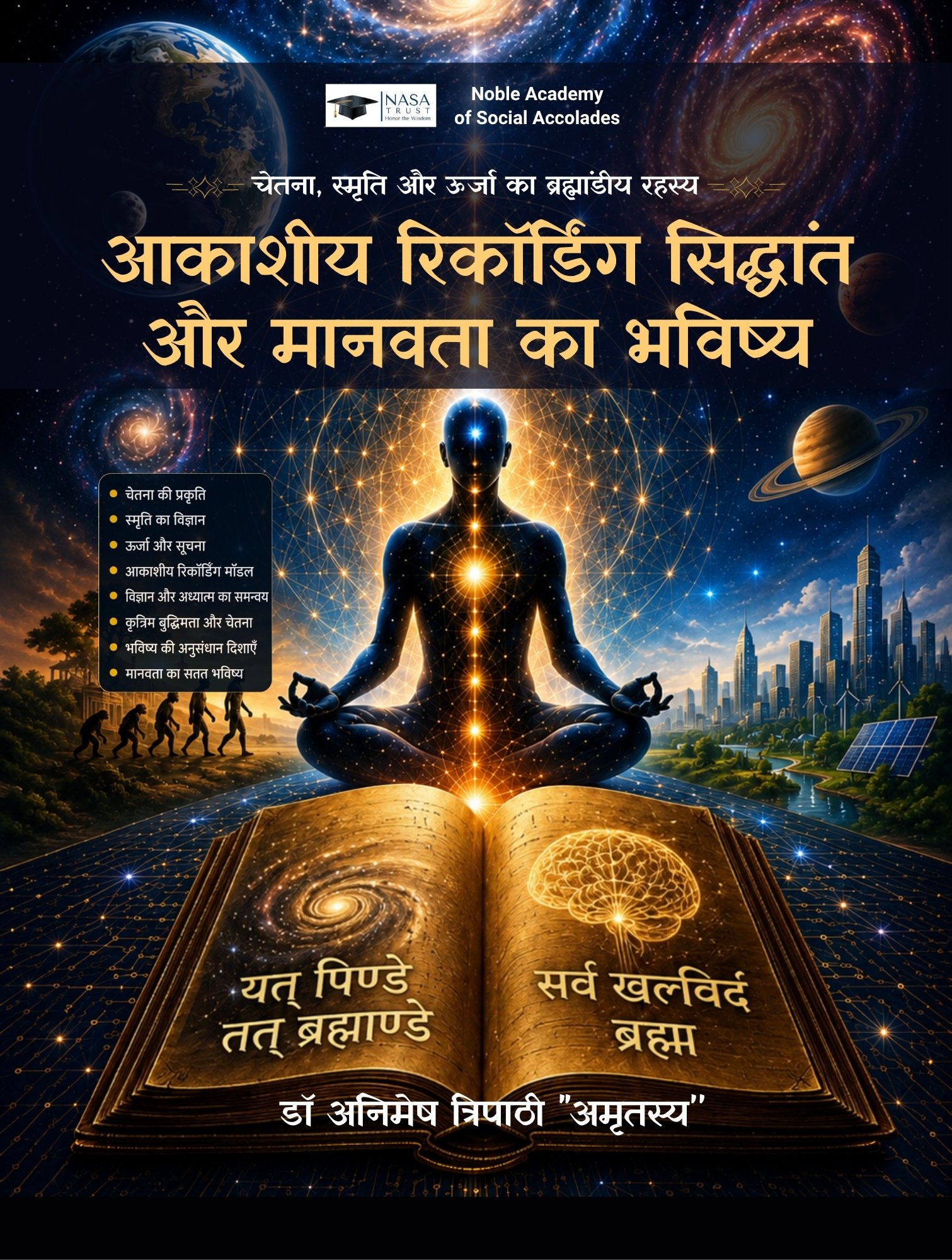
आकाशीय रिकॉर्डिंग सिद्धांत और मानवता का भविष्य
Synopsis
यह पुस्तक “आकाशीय रिकॉर्डिंग सिद्धांत: मानवता का भविष्य” चेतना, स्मृति, सूचना और ब्रह्माण्डीय वास्तविकता के मध्य संभावित संबंधों का एक अंतःविषयक अध्ययन प्रस्तुत करती है। इसका उद्देश्य भारतीय दार्शनिक परंपरा, विशेषकर वेद, उपनिषद, योग और वेदांत में वर्णित आकाश की अवधारणा का आधुनिक विज्ञान के प्रमुख क्षेत्रों—जैसे न्यूरोसाइंस, संज्ञान-विज्ञान, सूचना सिद्धांत, क्वांटम भौतिकी, ब्रह्माण्ड-विज्ञान तथा कृत्रिम बुद्धिमत्ता—के साथ तुलनात्मक एवं समन्वित विश्लेषण करना है। यह अध्ययन इस मूल प्रश्न की पड़ताल करता है कि क्या चेतना और स्मृति को केवल जैविक मस्तिष्क की क्रियाओं तक सीमित समझा जा सकता है, अथवा वे किसी व्यापक ब्रह्माण्डीय सूचना-संरचना से भी संबद्ध हो सकती हैं।इस पुस्तक में प्रतिपादित “आकाशीय रिकॉर्डिंग सिद्धांत” एक वैचारिक एवं अनुसंधानपरक मॉडल है, जो यह परिकल्पना प्रस्तुत करता है कि ब्रह्माण्ड में सूचना का संरक्षण केवल भौतिक माध्यमों तक सीमित न होकर किसी व्यापक संरचनात्मक या ब्रह्माण्डीय स्तर पर भी संभव हो सकता है। यह सिद्धांत यह दावा नहीं करता कि इस संभावना का वैज्ञानिक रूप से अंतिम प्रमाण उपलब्ध है, बल्कि इसे एक शोध-परिकल्पना के रूप में प्रस्तुत करता है, जिसकी पुष्टि, समीक्षा अथवा खंडन भविष्य के वैज्ञानिक अनुसंधानों द्वारा किया जाना अपेक्षित है। इस प्रकार पुस्तक का उद्देश्य किसी आध्यात्मिक विश्वास को वैज्ञानिक तथ्य घोषित करना नहीं, बल्कि विभिन्न ज्ञान-परंपराओं के मध्य संवाद स्थापित करना और नए अनुसंधान प्रश्नों को जन्म देना है।अध्ययन में चेतना की प्रकृति, स्मृति की संरचना, सूचना के संरक्षण, कृत्रिम बुद्धिमत्ता, डिजिटल स्मृति, क्वांटम सूचना, सामूहिक चेतना तथा मानव सभ्यता के भावी विकास जैसे विषयों का विश्लेषण किया गया है। साथ ही यह भी विवेचना की गई है कि यदि चेतना और सूचना के संबंध में वर्तमान वैज्ञानिक समझ का विस्तार होता है, तो उसका प्रभाव शिक्षा, चिकित्सा, मनोविज्ञान, नैतिकता, शासन, कृत्रिम बुद्धिमत्ता तथा वैश्विक मानव सभ्यता पर किस प्रकार पड़ सकता है।इस पुस्तक में गुणात्मक, तुलनात्मक तथा विश्लेषणात्मक अनुसंधान पद्धति का उपयोग किया गया है। वैदिक एवं उपनिषदिक साहित्य, भारतीय दार्शनिक ग्रंथों, आधुनिक वैज्ञानिक शोध-पत्रों, न्यूरोसाइंस, सूचना सिद्धांत तथा समकालीन चेतना अध्ययन से प्राप्त अवधारणाओं का समन्वित अध्ययन करते हुए एक अंतःविषयक विमर्श विकसित किया गया है। अध्ययन का उद्देश्य किसी एक अनुशासन की श्रेष्ठता सिद्ध करना नहीं, बल्कि विविध ज्ञान-परंपराओं के मध्य बौद्धिक संवाद स्थापित करना है।यह शोध निष्कर्ष प्रस्तुत करता है कि चेतना, स्मृति और सूचना के संबंध में अभी भी अनेक ऐसे प्रश्न अनुत्तरित हैं, जिनके समाधान के लिए विज्ञान, दर्शन और अध्यात्म के बीच सहयोगात्मक अनुसंधान की आवश्यकता है। आकाशीय रिकॉर्डिंग सिद्धांत इस दिशा में एक वैचारिक रूपरेखा प्रस्तुत करता है, जो भविष्य के शोधकर्ताओं के लिए नए अनुसंधान क्षेत्र खोल सकता है। यह ग्रंथ इस विश्वास के साथ प्रस्तुत किया गया है कि मानवता का भविष्य केवल तकनीकी प्रगति पर नहीं, बल्कि चेतना, ज्ञान, नैतिकता और वैज्ञानिक विवेक के संतुलित विकास पर निर्भर करेगा। इस दृष्टि से यह पुस्तक चेतना अध्ययन, सूचना विज्ञान, दर्शन और ब्रह्माण्ड-विज्ञान के क्षेत्र में अंतःविषयक अनुसंधान के लिए एक आधारभूत वैचारिक योगदान देने का प्रयास है।
Chapters
-
अध्याय 1 : शोध की पृष्ठभूमि,उद्देश्य एवं समस्या का निर्धारण
-
अध्याय–2: वैचारिक एवं दार्शनिक आधारभूमि
-
अध्याय–3: मानव चेतना का विज्ञान
-
अध्याय–4: स्मृति , सूचना और ऊर्जा का ब्रह्माण्डीय तंत्र
-
अध्याय–5: आकाशीय रिकॉर्डिंग सिद्धांत का प्रतिपादन
-
अध्याय–6: विज्ञान और अध्यात्म का समन्वय
-
अध्याय–7: मानव चेतना एवं सभ्यता का विकास
-
अध्याय–8: कृत्रिम बुद्धिमत्ता और आकाशीय रिकॉर्डिंग सिद्धांत
-
अध्याय–9: मानवता का भविष्य
-
अध्याय–10 : आकाशीय रिकॉर्डिंग सिद्धांत की प्रक्रिया और क्रियाविधि
-
अध्याय–11: समेकित निष्कर्ष एवं समग्र प्रतिमान
Downloads
References
Aerts, Diederik. The One: How an Ancient Idea Holds the Future of Physics. Brussels: Brussels University Press, 2023.
Agarwal, B. D. Indian Philosophy and Consciousness. New Delhi: Motilal Banarsidass, 2012.
Albert, David Z. Quantum Mechanics and Experience. Cambridge, MA: Harvard University Press, 1992.
Alexander, Christopher. The Nature of Order. 4 vols. Berkeley: Center for Environmental Structure, 2002–2005.
Alur, Rajeev. Principles of Cyber-Physical Systems. Cambridge, MA: MIT Press, 2015.
Anderson, John R. Cognitive Psychology and Its Implications. 8th ed. New York: Worth Publishers, 2015.
Anderson, Philip W. "More Is Different." Science 177, no. 4047 (1972): 393–396.
Annas, Julia. Ancient Philosophy: A Very Short Introduction. Oxford: Oxford University Press, 2000.
Arbib, Michael A. The Handbook of Brain Theory and Neural Networks. Cambridge, MA: MIT Press, 2003.
Aristotle. De Anima (On the Soul). Translated by J. A. Smith. Oxford: Clarendon Press, 1931.
Atkinson, Rita L., Richard C. Atkinson, Edward E. Smith, and Daryl J. Bem. Introduction to Psychology. New York: Harcourt Brace, 1990.
Aurobindo, Sri. The Life Divine. Pondicherry: Sri Aurobindo Ashram, 1977.
Aurobindo, Sri. The Synthesis of Yoga. Pondicherry: Sri Aurobindo Ashram, 1999.
Austin, J. L. Sense and Sensibilia. Oxford: Oxford University Press, 1962.
Ayer, A. J. Language, Truth and Logic. London: Victor Gollancz, 1936.
Baars, Bernard J. A Cognitive Theory of Consciousness. Cambridge: Cambridge University Press, 1988.
Baars, Bernard J. In the Theater of Consciousness. Oxford: Oxford University Press, 1997.
Baars, Bernard J., Nicole Gage, and James L. McClelland. Cognition, Brain, and Consciousness. 3rd ed. Amsterdam: Elsevier, 2019.
Barbour, Ian G. Religion and Science. New York: HarperCollins, 1997.
Barbour, Julian. The End of Time. Oxford: Oxford University Press, 1999.
Bateson, Gregory. Mind and Nature: A Necessary Unity. New York: Dutton, 1979.
Beauregard, Mario, and Denyse O'Leary. The Spiritual Brain. New York: HarperOne, 2007.
Bell, John S. Speakable and Unspeakable in Quantum Mechanics. Cambridge: Cambridge University Press, 1987.
Bennett, Charles H. "Logical Reversibility of Computation." IBM Journal of Research and Development 17, no. 6 (1973): 525–532.
Bennett, Maxwell R., and Peter M. S. Hacker. Philosophical Foundations of Neuroscience. Oxford: Blackwell, 2003.
Bergson, Henri. Matter and Memory. Translated by Nancy Margaret Paul and W. Scott Palmer. New York: Zone Books, 1988.
Bhattacharya, Ramkrishna. Studies on Indian Materialism. London: Anthem Press, 2011.
Bohm, David. Causality and Chance in Modern Physics. London: Routledge, 1957.
Bohm, David. Wholeness and the Implicate Order. London: Routledge, 1980.
Bohm, David, and B. J. Hiley. The Undivided Universe. London: Routledge, 1993.
Bohr, Niels. Atomic Physics and Human Knowledge. New York: Wiley, 1958.
Born, Max. Natural Philosophy of Cause and Chance. Oxford: Oxford University Press, 1949.
Bostrom, Nick. Superintelligence: Paths, Dangers, Strategies. Oxford: Oxford University Press, 2014.
Bourget, David, and David J. Chalmers, eds. What Do Philosophers Believe? Oxford: Oxford University Press, 2014.
Boyd, Richard. "Scientific Realism." In The Stanford Encyclopedia of Philosophy, edited by Edward N. Zalta. Stanford, CA: Stanford University, latest edition.
Braddon-Mitchell, David, and Frank Jackson. Philosophy of Mind and Cognition. Oxford: Blackwell, 2007.
Broad, C. D. The Mind and Its Place in Nature. London: Routledge & Kegan Paul, 1925.
Brooks, Rodney A. Flesh and Machines. New York: Pantheon Books, 2002.
Brown, Harold I. Perception, Theory and Commitment. Chicago: University of Chicago Press, 1977.
Brown, Michael F. The Channeling Zone. Cambridge, MA: Harvard University Press, 1997.
Bruner, Jerome S. Acts of Meaning. Cambridge, MA: Harvard University Press, 1990.
Bunge, Mario. Scientific Research. 2 vols. Berlin: Springer, 1967.
Burtt, E. A. The Metaphysical Foundations of Modern Physical Science. London: Routledge, 2003.
Butterfield, Jeremy, and John Earman, eds. Philosophy of Physics. Amsterdam: Elsevier, 2007.
Campbell, Joseph. The Hero with a Thousand Faces. 3rd ed. Novato, CA: New World Library, 2008.
Capra, Fritjof. The Tao of Physics: An Exploration of the Parallels between Modern Physics and Eastern Mysticism. 5th ed. Boston: Shambhala Publications, 2010.
Capra, Fritjof. The Web of Life: A New Scientific Understanding of Living Systems. New York: Anchor Books, 1996.
Capra, Fritjof, and Pier Luigi Luisi. The Systems View of Life: A Unifying Vision. Cambridge: Cambridge University Press, 2014.
Carnap, Rudolf. The Logical Structure of the World. Berkeley: University of California Press, 1967.
Carroll, Sean. From Eternity to Here: The Quest for the Ultimate Theory of Time. New York: Dutton, 2010.
Carroll, Sean. The Big Picture: On the Origins of Life, Meaning, and the Universe Itself. New York: Dutton, 2016.
Chalmers, David J. The Conscious Mind: In Search of a Fundamental Theory. New York: Oxford University Press, 1996.
Chalmers, David J., ed. Philosophy of Mind: Classical and Contemporary Readings. Oxford: Oxford University Press, 2002.
Churchland, Patricia S. Brain-Wise: Studies in Neurophilosophy. Cambridge, MA: MIT Press, 2002.
Churchland, Paul M. Matter and Consciousness. Rev. ed. Cambridge, MA: MIT Press, 1988.
Clark, Andy. Being There: Putting Brain, Body, and World Together Again. Cambridge, MA: MIT Press, 1997.
Clark, Andy. Surfing Uncertainty: Prediction, Action, and the Embodied Mind. Oxford: Oxford University Press, 2016.
Cover, Thomas M., and Joy A. Thomas. Elements of Information Theory. 2nd ed. Hoboken, NJ: Wiley, 2006.
Crick, Francis. The Astonishing Hypothesis: The Scientific Search for the Soul. New York: Scribner, 1994.
Curie, Marie. Radioactivity. New York: Dover Publications, 2003.
Damasio, Antonio. Descartes' Error: Emotion, Reason, and the Human Brain. New York: Putnam, 1994.
Damasio, Antonio. The Feeling of What Happens: Body and Emotion in the Making of Consciousness. New York: Harcourt Brace, 1999.
Damasio, Antonio. Self Comes to Mind: Constructing the Conscious Brain. New York: Pantheon Books, 2010.
Darwin, Charles. On the Origin of Species. London: John Murray, 1859.
Davidson, Donald. Essays on Actions and Events. Oxford: Oxford University Press, 1980.
Davidson, Richard J., and Sharon Begley. The Emotional Life of Your Brain. New York: Hudson Street Press, 2012.
Davies, Paul. The Mind of God: The Scientific Basis for a Rational World. New York: Simon & Schuster, 1992.
Davies, Paul. The Fifth Miracle: The Search for the Origin of Life. London: Penguin Books, 1998.
Davies, Paul. The Goldilocks Enigma: Why Is the Universe Just Right for Life? Boston: Houghton Mifflin, 2006.
Deacon, Terrence W. Incomplete Nature: How Mind Emerged from Matter. New York: W. W. Norton, 2012.
Dehaene, Stanislas. Consciousness and the Brain: Deciphering How the Brain Codes Our Thoughts. New York: Viking, 2014.
Dennett, Daniel C. Consciousness Explained. Boston: Little, Brown and Company, 1991.
Dennett, Daniel C. Freedom Evolves. New York: Viking, 2003.
Dennett, Daniel C. From Bacteria to Bach and Back: The Evolution of Minds. New York: W. W. Norton, 2017.
Deutsch, David. The Fabric of Reality. London: Penguin Books, 1997.
Deutsch, David. The Beginning of Infinity. London: Allen Lane, 2011.
Dirac, Paul A. M. The Principles of Quantum Mechanics. 4th ed. Oxford: Oxford University Press, 1958.
Dobzhansky, Theodosius. Genetics and the Origin of Species. New York: Columbia University Press, 1937.
Dreyfus, Hubert L. What Computers Still Can't Do. Cambridge, MA: MIT Press, 1992.
Dretske, Fred I. Knowledge and the Flow of Information. Cambridge, MA: MIT Press, 1981.
Duncan, John. How Intelligence Happens. New Haven: Yale University Press, 2010.
Dyson, Freeman J. Infinite in All Directions. New York: Harper & Row, 1988.
Dyson, George. Darwin among the Machines. Reading, MA: Addison-Wesley, 1997.
Eccles, John C. The Human Mystery. Berlin: Springer-Verlag, 1979.
Eccles, John C., and Karl R. Popper. The Self and Its Brain. Berlin: Springer International, 1977.
Eddington, Arthur S. The Nature of the Physical World. Cambridge: Cambridge University Press, 1928.
Edelman, Gerald M. Bright Air, Brilliant Fire: On the Matter of the Mind. New York: Basic Books, 1992.
Edelman, Gerald M. Wider Than the Sky: The Phenomenal Gift of Consciousness. New Haven: Yale University Press, 2004.
Einstein, Albert. Ideas and Opinions. New York: Crown Publishers, 1954.
Einstein, Albert. Relativity: The Special and the General Theory. New York: Crown Publishers, 1961.
Einstein, Albert, Boris Podolsky, and Nathan Rosen. "Can Quantum-Mechanical Description of Physical Reality Be Considered Complete?" Physical Review 47, no. 10 (1935): 777–780.
Ellis, George F. R. How Can Physics Underlie the Mind? Berlin: Springer, 2016.
Engel, Andreas K., Karl J. Friston, and Danica Kragic, eds. The Pragmatic Turn: Toward Action-Oriented Views in Cognitive Science. Cambridge, MA: MIT Press, 2016.
Evans, Jonathan St. B. T. Thinking and Reasoning. London: Psychology Press, 2010.
Eysenck, Michael W., and Mark T. Keane. Cognitive Psychology: A Student's Handbook. 8th ed. London: Psychology Press, 2020.
Feigl, Herbert. The "Mental" and the "Physical": The Essay and a Postscript. Minneapolis: University of Minnesota Press, 1967.
Feynman, Richard P. The Character of Physical Law. Cambridge, MA: MIT Press, 1967.
Feynman, Richard P., Robert B. Leighton, and Matthew Sands. The Feynman Lectures on Physics. 3 vols. Reading, MA: Addison-Wesley, 1964–1965.
Floridi, Luciano. Information: A Very Short Introduction. Oxford: Oxford University Press, 2010.
Floridi, Luciano. The Philosophy of Information. Oxford: Oxford University Press, 2011.
Floridi, Luciano, ed. The Blackwell Guide to the Philosophy of Computing and Information. Oxford: Blackwell Publishing, 2004.
Friston, Karl. "The Free-Energy Principle: A Unified Brain Theory?" Nature Reviews Neuroscience 11, no. 2 (2010): 127–138.
Friston, Karl. Active Inference: The Free Energy Principle in Mind, Brain, and Behavior. Cambridge, MA: MIT Press, 2022.
Fromm, Erich. The Art of Being. New York: Continuum, 1992.
Fromm, Erich. To Have or To Be? New York: Harper & Row, 1976.
Gage, Fred H. "Neurogenesis in the Adult Brain." Journal of Neuroscience 22, no. 3 (2002): 612–613.
Gardner, Howard. Frames of Mind: The Theory of Multiple Intelligences. New York: Basic Books, 1983.
Gazzaniga, Michael S. Human: The Science Behind What Makes Us Unique. New York: HarperCollins, 2008.
Gazzaniga, Michael S., Richard B. Ivry, and George R. Mangun. Cognitive Neuroscience: The Biology of the Mind. 5th ed. New York: W. W. Norton, 2019.
Gleick, James. Chaos: Making a New Science. New York: Viking, 1987.
Gleick, James. The Information: A History, a Theory, a Flood. New York: Pantheon Books, 2011.
Gödel, Kurt. On Formally Undecidable Propositions of Principia Mathematica and Related Systems. New York: Dover Publications, 1992.
Goldstein, Rebecca. Incompleteness: The Proof and Paradox of Kurt Gödel. New York: W. W. Norton, 2005.
Goodfellow, Ian, Yoshua Bengio, and Aaron Courville. Deep Learning. Cambridge, MA: MIT Press, 2016.
Greene, Brian. The Elegant Universe. New York: W. W. Norton, 1999.
Greene, Brian. The Fabric of the Cosmos. New York: Alfred A. Knopf, 2004.
Greene, Brian. Until the End of Time. New York: Alfred A. Knopf, 2020.
Griffin, David Ray. Unsnarling the World-Knot: Consciousness, Freedom, and the Mind-Body Problem. Berkeley: University of California Press, 1998.
Griffiths, David J. Introduction to Quantum Mechanics. 3rd ed. Cambridge: Cambridge University Press, 2023.
Grinspoon, David. Earth in Human Hands: Shaping Our Planet's Future. New York: Grand Central Publishing, 2016.
Grossberg, Stephen. Conscious Mind, Resonant Brain. New York: Oxford University Press, 2021.
Hacking, Ian. Representing and Intervening. Cambridge: Cambridge University Press, 1983.
Hameroff, Stuart R., and Roger Penrose. "Consciousness in the Universe: A Review of the 'Orch OR' Theory." Physics of Life Reviews 11, no. 1 (2014): 39–78.
Hanson, Norwood Russell. Patterns of Discovery. Cambridge: Cambridge University Press, 1958.
Hardcastle, Valerie Gray. Consciousness and Cognitive Neuroscience. Amsterdam: John Benjamins, 1998.
Hardy, G. H. A Mathematician's Apology. Cambridge: Cambridge University Press, 1940.
Harman, Gilbert. Thought. Princeton, NJ: Princeton University Press, 1973.
Hartle, James B. Gravity: An Introduction to Einstein's General Relativity. San Francisco: Addison-Wesley, 2003.
Hawking, Stephen. A Brief History of Time. New York: Bantam Books, 1988.
Hawking, Stephen. Black Holes and Baby Universes and Other Essays. New York: Bantam Books, 1993.
Hawking, Stephen. The Universe in a Nutshell. New York: Bantam Books, 2001.
Hawking, Stephen, and Leonard Mlodinow. The Grand Design. New York: Bantam Books, 2010.
Heisenberg, Werner. Physics and Philosophy: The Revolution in Modern Science. New York: Harper & Row, 1958.
Hofstadter, Douglas R. Gödel, Escher, Bach: An Eternal Golden Braid. New York: Basic Books, 1979.
Hofstadter, Douglas R. I Am a Strange Loop. New York: Basic Books, 2007.
Horgan, John. The End of Science. Reading, MA: Addison-Wesley, 1996.
Hume, David. An Enquiry Concerning Human Understanding. Oxford: Oxford University Press, 2007.
Ihde, Don. Experimental Phenomenology. Albany: State University of New York Press, 1986.
Isham, Christopher J. Lectures on Quantum Theory. London: Imperial College Press, 1995.
Jackson, Frank. From Metaphysics to Ethics: A Defence of Conceptual Analysis. Oxford: Oxford University Press, 1998.
James, William. The Principles of Psychology. 2 vols. New York: Henry Holt, 1890.
James, William. The Varieties of Religious Experience. New York: Longmans, Green, and Co., 1902.
Jeannerod, Marc. Motor Cognition: What Actions Tell the Self. Oxford: Oxford University Press, 2006.
Jevons, F. R. Science Observed. London: George Allen & Unwin, 1973.
Johnson, Mark. The Meaning of the Body. Chicago: University of Chicago Press, 2007.
Jung, Carl Gustav. The Structure and Dynamics of the Psyche. Princeton, NJ: Princeton University Press, 1969.
Jung, Carl Gustav. Synchronicity: An Acausal Connecting Principle. Princeton, NJ: Princeton University Press, 1973.
Kahneman, Daniel. Thinking, Fast and Slow. New York: Farrar, Straus and Giroux, 2011.
Kaku, Michio. Hyperspace. New York: Oxford University Press, 1994.
Kaku, Michio. Parallel Worlds. New York: Doubleday, 2005.
Kaku, Michio. The Future of the Mind. New York: Doubleday, 2014.
Kandel, Eric R., James H. Schwartz, Thomas M. Jessell, Steven A. Siegelbaum, and A. J. Hudspeth. Principles of Neural Science. 5th ed. New York: McGraw-Hill, 2013.
Kant, Immanuel. Critique of Pure Reason. Translated by Paul Guyer and Allen W. Wood. Cambridge: Cambridge University Press, 1998.
Koch, Christof. Consciousness: Confessions of a Romantic Reductionist. Cambridge, MA: MIT Press, 2012.
Koch, Christof. The Feeling of Life Itself: Why Consciousness Is Widespread but Can't Be Computed. Cambridge, MA: MIT Press, 2019.
Kolb, Bryan, and Ian Q. Whishaw. An Introduction to Brain and Behavior. 6th ed. New York: Worth Publishers, 2021.
Kuhn, Thomas S. The Structure of Scientific Revolutions. 4th ed. Chicago: University of Chicago Press, 2012.
Kurzweil, Ray. The Age of Spiritual Machines. New York: Viking, 1999.
Kurzweil, Ray. How to Create a Mind. New York: Viking, 2012.
Lakoff, George, and Mark Johnson. Philosophy in the Flesh: The Embodied Mind and Its Challenge to Western Thought. New York: Basic Books, 1999.
Landauer, Rolf. "Irreversibility and Heat Generation in the Computing Process." IBM Journal of Research and Development 5, no. 3 (1961): 183–191.
Lanza, Robert, and Bob Berman. Biocentrism: How Life and Consciousness Are the Keys to Understanding the True Nature of the Universe. Dallas: BenBella Books, 2009.
Laszlo, Ervin. Science and the Akashic Field: An Integral Theory of Everything. Rochester, VT: Inner Traditions, 2004.
Laszlo, Ervin. The Connectivity Hypothesis: Foundations of an Integral Science of Quantum, Cosmos, Life, and Consciousness. Albany: State University of New York Press, 2003.
LeDoux, Joseph. The Emotional Brain. New York: Simon & Schuster, 1996.
LeDoux, Joseph. Synaptic Self: How Our Brains Become Who We Are. New York: Viking, 2002.
Libet, Benjamin. Mind Time: The Temporal Factor in Consciousness. Cambridge, MA: Harvard University Press, 2004.
Llinás, Rodolfo R. I of the Vortex: From Neurons to Self. Cambridge, MA: MIT Press, 2001.
Lloyd, Seth. Programming the Universe: A Quantum Computer Scientist Takes on the Cosmos. New York: Alfred A. Knopf, 2006.
Locke, John. An Essay Concerning Human Understanding. Edited by Peter H. Nidditch. Oxford: Oxford University Press, 1975.
Lorenz, Edward N. The Essence of Chaos. Seattle: University of Washington Press, 1993.
Lorenz, Konrad. Behind the Mirror: A Search for a Natural History of Human Knowledge. New York: Harcourt Brace Jovanovich, 1977.
Lovelock, James. Gaia: A New Look at Life on Earth. Oxford: Oxford University Press, 1979.
Lucas, John R. The Freedom of the Will. Oxford: Clarendon Press, 1970.
Luisi, Pier Luigi. The Emergence of Life: From Chemical Origins to Synthetic Biology. Cambridge: Cambridge University Press, 2006.
Maturana, Humberto R., and Francisco J. Varela. The Tree of Knowledge: The Biological Roots of Human Understanding. Boston: Shambhala Publications, 1987.
Maxwell, James Clerk. Matter and Motion. Mineola, NY: Dover Publications, 1991.
McCarthy, John. "Programs with Common Sense." In Proceedings of the Teddington Conference on the Mechanization of Thought Processes, 75–91. London: Her Majesty's Stationery Office, 1959.
McGinn, Colin. The Problem of Consciousness. Oxford: Blackwell, 1991.
McGinn, Colin. Consciousness and Its Objects. Oxford: Oxford University Press, 2004.
McGilchrist, Iain. The Master and His Emissary. New Haven: Yale University Press, 2009.
McLuhan, Marshall. Understanding Media: The Extensions of Man. New York: McGraw-Hill, 1964.
Metzinger, Thomas. Being No One: The Self-Model Theory of Subjectivity. Cambridge, MA: MIT Press, 2003.
Metzinger, Thomas. The Ego Tunnel: The Science of the Mind and the Myth of the Self. New York: Basic Books, 2009.
Minsky, Marvin. The Society of Mind. New York: Simon & Schuster, 1986.
Mitchell, Melanie. Complexity: A Guided Tour. New York: Oxford University Press, 2009.
Moravec, Hans. Mind Children: The Future of Robot and Human Intelligence. Cambridge, MA: Harvard University Press, 1988.
Morin, Edgar. On Complexity. Cresskill, NJ: Hampton Press, 2008.
Mlodinow, Leonard. Subliminal: How Your Unconscious Mind Rules Your Behavior. New York: Pantheon Books, 2012.
Mlodinow, Leonard. Elastic: Flexible Thinking in a Time of Change. New York: Pantheon Books, 2018.
Montague, P. Read. Your Brain Is (Almost) Perfect. New York: Plume, 2006.
Mumford, Lewis. Technics and Civilization. Chicago: University of Chicago Press, 2010.
Nagel, Thomas. "What Is It Like to Be a Bat?" The Philosophical Review 83, no. 4 (1974): 435–450.
Nagel, Thomas. Mind and Cosmos: Why the Materialist Neo-Darwinian Conception of Nature Is Almost Certainly False. New York: Oxford University Press, 2012.
Newell, Allen. Unified Theories of Cognition. Cambridge, MA: Harvard University Press, 1990.
Newton, Isaac. Philosophiæ Naturalis Principia Mathematica. London: Joseph Streater, 1687.
Newton, Isaac. Opticks. 4th ed. London: William Innys, 1730.
Nørretranders, Tor. The User Illusion: Cutting Consciousness Down to Size. New York: Viking, 1998.
Noë, Alva. Action in Perception. Cambridge, MA: MIT Press, 2004.
Noë, Alva. Out of Our Heads: Why You Are Not Your Brain. New York: Hill and Wang, 2009.
Nunez, Paul L. Brain, Mind, and the Structure of Reality. New York: Oxford University Press, 2010.
Nunez, Paul L., and Ramesh Srinivasan. Electric Fields of the Brain. 2nd ed. New York: Oxford University Press, 2006.
Oizumi, Masafumi, Larissa Albantakis, and Giulio Tononi. "From the Phenomenology to the Mechanisms of Consciousness: Integrated Information Theory 3.0." PLoS Computational Biology 10, no. 5 (2014): e1003588.
Ornstein, Robert E. The Psychology of Consciousness. New York: Penguin Books, 1977.
Ouspensky, P. D. Tertium Organum. New York: Alfred A. Knopf, 1922.
Pagels, Heinz R. The Cosmic Code: Quantum Physics as the Language of Nature. New York: Simon & Schuster, 1982.
Parfit, Derek. Reasons and Persons. Oxford: Oxford University Press, 1984.
Peacocke, Christopher. A Study of Concepts. Cambridge, MA: MIT Press, 1992.
Penfield, Wilder. The Mystery of the Mind. Princeton, NJ: Princeton University Press, 1975.
Penrose, Roger. The Emperor's New Mind. Oxford: Oxford University Press, 1989.
Penrose, Roger. Shadows of the Mind. Oxford: Oxford University Press, 1994.
Penrose, Roger. The Road to Reality. London: Jonathan Cape, 2004.
Piaget, Jean. The Construction of Reality in the Child. New York: Basic Books, 1954.
Planck, Max. The Philosophy of Physics. New York: W. W. Norton, 1936.
Planck, Max. Scientific Autobiography and Other Papers. New York: Philosophical Library, 1949.
Plate, Tony A. Holographic Reduced Representation: Distributed Representation for Cognitive Structures. Stanford, CA: CSLI Publications, 2003.
Popper, Karl R. Conjectures and Refutations. London: Routledge & Kegan Paul, 1963.
Popper, Karl R. The Logic of Scientific Discovery. London: Hutchinson, 1959.
Popper, Karl R. Objective Knowledge: An Evolutionary Approach. Oxford: Clarendon Press, 1972.
Pribram, Karl H. Languages of the Brain. Englewood Cliffs, NJ: Prentice-Hall, 1971.
Pribram, Karl H. Brain and Perception: Holonomy and Structure in Figural Processing. Hillsdale, NJ: Lawrence Erlbaum Associates, 1991.
Putnam, Hilary. Mind, Language and Reality. Cambridge: Cambridge University Press, 1975.
Putnam, Hilary. Representation and Reality. Cambridge, MA: MIT Press, 1988.
Quine, W. V. O. From a Logical Point of View. 2nd ed. Cambridge, MA: Harvard University Press, 1980.
Quine, W. V. O. Word and Object. Cambridge, MA: MIT Press, 1960.
Ramachandran, V. S. Phantoms in the Brain. New York: William Morrow, 1998.
Ramachandran, V. S. The Tell-Tale Brain: A Neuroscientist's Quest for What Makes Us Human. New York: W. W. Norton, 2011.
Rosen, Robert. Life Itself: A Comprehensive Inquiry into the Nature, Origin, and Fabrication of Life. New York: Columbia University Press, 1991.
Rovelli, Carlo. Reality Is Not What It Seems: The Journey to Quantum Gravity. New York: Riverhead Books, 2017.
Rovelli, Carlo. Helgoland. New York: Riverhead Books, 2021.
Russell, Bertrand. The Analysis of Mind. London: George Allen & Unwin, 1921.
Russell, Bertrand. Human Knowledge: Its Scope and Limits. London: George Allen & Unwin, 1948.
Russell, Stuart, and Peter Norvig. Artificial Intelligence: A Modern Approach. 4th ed. Hoboken, NJ: Pearson, 2021.
Sagan, Carl. Cosmos. New York: Random House, 1980.
Sagan, Carl. The Demon-Haunted World: Science as a Candle in the Dark. New York: Random House, 1995.
Sapolsky, Robert M. Behave: The Biology of Humans at Our Best and Worst. New York: Penguin Press, 2017.
Sapolsky, Robert M. Determined: A Science of Life without Free Will. New York: Penguin Press, 2023.
Searle, John R. Intentionality: An Essay in the Philosophy of Mind. Cambridge: Cambridge University Press, 1983.
Searle, John R. The Rediscovery of the Mind. Cambridge, MA: MIT Press, 1992.
Searle, John R. Mind: A Brief Introduction. Oxford: Oxford University Press, 2004.
Shannon, Claude E. "A Mathematical Theory of Communication." Bell System Technical Journal 27, nos. 3–4 (1948): 379–423, 623–656.
Shannon, Claude E., and Warren Weaver. The Mathematical Theory of Communication. Urbana: University of Illinois Press, 1949.
Sheldrake, Rupert. A New Science of Life. Los Angeles: J. P. Tarcher, 1981.
Sheldrake, Rupert. The Presence of the Past: Morphic Resonance and the Habits of Nature. Rochester, VT: Park Street Press, 2011.
Smolin, Lee. The Life of the Cosmos. New York: Oxford University Press, 1997.
Smolin, Lee. Time Reborn. Boston: Houghton Mifflin Harcourt, 2013.
Sperry, Roger W. "Mind, Brain, and Humanist Values." Bulletin of the Atomic Scientists 31, no. 7 (1975): 30–34.
Stapp, Henry P. Mindful Universe: Quantum Mechanics and the Participating Observer. Berlin: Springer, 2007.
Sternberg, Robert J. Cognitive Psychology. 7th ed. Boston: Cengage Learning, 2017.
Susskind, Leonard. The Black Hole War. New York: Little, Brown and Company, 2008.
Susskind, Leonard. The Theoretical Minimum: What You Need to Know to Start Doing Physics. New York: Basic Books, 2013.
Swinburne, Richard. Mind, Brain, and Free Will. Oxford: Oxford University Press, 2013.
Śaṅkarācārya. Brahma Sūtra Bhāṣya. Varanasi: Chaukhamba Sanskrit Series.
Śaṅkarācārya. Vivekacūḍāmaṇi. Varanasi: Chaukhamba Vidyabhavan.
Śaṅkarācārya. Upadeśasāhasrī. Varanasi: Chaukhamba Sanskrit Pratishthan.
Śrīmad Bhagavad Gītā with Śaṅkara Bhāṣya. Gorakhpur: Gita Press.
Tegmark, Max. Life 3.0: Being Human in the Age of Artificial Intelligence. New York: Alfred A. Knopf, 2017.
Teilhard de Chardin, Pierre. The Phenomenon of Man. New York: Harper & Row, 1959.
Thompson, Evan. Mind in Life: Biology, Phenomenology, and the Sciences of Mind. Cambridge, MA: Harvard University Press, 2007.
Thompson, Evan. Waking, Dreaming, Being: Self and Consciousness in Neuroscience, Meditation, and Philosophy. New York: Columbia University Press, 2015.
Tononi, Giulio. "An Information Integration Theory of Consciousness." BMC Neuroscience 5, no. 42 (2004).
Tononi, Giulio. Phi: A Voyage from the Brain to the Soul. New York: Pantheon Books, 2012.
Tulving, Endel. Elements of Episodic Memory. Oxford: Oxford University Press, 1983.
Turing, Alan M. "Computing Machinery and Intelligence." Mind 59, no. 236 (1950): 433–460.
Tyler, Christopher W., ed. Human Symmetry Perception and Its Computational Analysis. Utrecht: VSP, 1996.
Uexküll, Jakob von. A Foray into the Worlds of Animals and Humans. Minneapolis: University of Minnesota Press, 2010.
Upinder Singh. Political Violence in Ancient India. Cambridge, MA: Harvard University Press, 2017.
Varela, Francisco J., Evan Thompson, and Eleanor Rosch. The Embodied Mind: Cognitive Science and Human Experience. Cambridge, MA: MIT Press, 1991.
Vedānta Deśika. Śatadūṣaṇī. Chennai: Sri Hayagriva Vidyapeetham.
Velmans, Max. Understanding Consciousness. 2nd ed. London: Routledge, 2009.
Velmans, Max, and Susan Schneider, eds. The Blackwell Companion to Consciousness. 2nd ed. Oxford: Wiley-Blackwell, 2017.
von Bertalanffy, Ludwig. General System Theory. New York: George Braziller, 1968.
von Neumann, John. Mathematical Foundations of Quantum Mechanics. Princeton, NJ: Princeton University Press, 1955.
Watson, John B. Behaviourism. Chicago: University of Chicago Press, 1925.
Weaver, Warren. "Recent Contributions to the Mathematical Theory of Communication." In The Mathematical Theory of Communication, by Claude E. Shannon and Warren Weaver. Urbana: University of Illinois Press, 1949.
Wheeler, John Archibald. Geons, Black Holes, and Quantum Foam: A Life in Physics. New York: W. W. Norton, 1998.
Whitehead, Alfred North. Process and Reality. New York: Free Press, 1978.
Wiener, Norbert. Cybernetics: Or Control and Communication in the Animal and the Machine. 2nd ed. Cambridge, MA: MIT Press, 1961.
Wilber, Ken. The Spectrum of Consciousness. Wheaton, IL: Quest Books, 1977.
Wilber, Ken. Sex, Ecology, Spirituality. Boston: Shambhala Publications, 1995.
Wilson, Edward O. Consilience: The Unity of Knowledge. New York: Alfred A. Knopf, 1998.
Wolfram, Stephen. A New Kind of Science. Champaign, IL: Wolfram Media, 2002.
Xenakis, Iannis. Formalized Music. Stuyvesant, NY: Pendragon Press, 1992.
Young, J. Z. Philosophy and the Brain. Oxford: Oxford University Press, 1987.
Yates, Frances A. The Art of Memory. London: Routledge & Kegan Paul, 1966.
Zajonc, Arthur. Catching the Light: The Entwined History of Light and Mind. Oxford: Oxford University Press, 1993.
Zeki, Semir. Inner Vision: An Exploration of Art and the Brain. Oxford: Oxford University Press, 1999.
Zeman, Adam. Consciousness: A User's Guide. New Haven: Yale University Press, 2002.
Zohar, Danah. The Quantum Self. London: Bloomsbury, 1990.
Zohar, Danah, and Ian Marshall. The Quantum Society. London: Flamingo, 1994.
Zurek, Wojciech H. "Decoherence, Einselection, and the Quantum Origins of the Classical." Reviews of Modern Physics 75, no. 3 (2003): 715–775.
वेद
Ṛgveda Saṁhitā. Various critical editions.
Yajurveda Saṁhitā (Śukla and Kṛṣṇa Recensions). Various editions.
Sāmaveda Saṁhitā. Various editions.
Atharvaveda Saṁhitā. Various editions.
उपनिषद
Bṛhadāraṇyaka Upaniṣad. Chāndogya Upaniṣad. Īśā Upaniṣad. Kena Upaniṣad. Kaṭha Upaniṣad. Muṇḍaka Upaniṣad. Māṇḍūkya Upaniṣad. Taittirīya Upaniṣad. Aitareya Upaniṣad. Praśna Upaniṣad. Śvetāśvatara Upaniṣad.
बौद्ध मूल ग्रंथ
Abhidhammapiṭaka. Pali Text Society Edition. London: Pali Text Society.
Aṅguttara Nikāya. Translated by Bhikkhu Bodhi. Boston: Wisdom Publications, 2012.
Dhammapada. Translated by Acharya Buddharakkhita. Kandy: Buddhist Publication Society, 1985.
Dīgha Nikāya. Translated by Maurice Walshe. Boston: Wisdom Publications, 1995.
Majjhima Nikāya. Translated by Bhikkhu Ñāṇamoli and Bhikkhu Bodhi. Boston: Wisdom Publications, 1995.
Saṃyutta Nikāya. Translated by Bhikkhu Bodhi. Boston: Wisdom Publications, 2000.
Vinayapiṭaka. London: Pali Text Society.
Nāgārjuna. Mūlamadhyamakakārikā. Translated by Jay L. Garfield. New York: Oxford University Press, 1995.
Vasubandhu. Abhidharmakośabhāṣya. Translated by Louis de La Vallée Poussin. Berkeley: Asian Humanities Press, 1988–1990.
जैन मूल ग्रंथ
Ācārāṅga Sūtra. Translated by Hermann Jacobi. Oxford: Clarendon Press, 1884.
Kalpa Sūtra. Translated by Hermann Jacobi. Oxford: Clarendon Press, 1884.
Kundakunda. Samayasāra. Various scholarly editions.
Umāsvāti. Tattvārtha Sūtra. Translated by Nathmal Tatia. San Francisco: HarperCollins, 1994.
Uttarādhyayana Sūtra. Translated by Hermann Jacobi. Delhi: Motilal Banarsidass.
भारतीय दर्शन
Dasgupta, Surendranath. A History of Indian Philosophy. 5 vols. Cambridge: Cambridge University Press, 1922–1955.
Hiriyanna, M. Outlines of Indian Philosophy. London: George Allen & Unwin, 1932.
Mohanty, J. N. Classical Indian Philosophy. Lanham, MD: Rowman & Littlefield, 2000.
Radhakrishnan, Sarvepalli. Indian Philosophy. 2 vols. London: George Allen & Unwin, 1923–1927.
Radhakrishnan, Sarvepalli, and Charles A. Moore, eds. A Sourcebook in Indian Philosophy. Princeton, NJ: Princeton University Press, 1957.
Sharma, Chandradhar. A Critical Survey of Indian Philosophy. Delhi: Motilal Banarsidass, 1960.
प्रमुख अंतरराष्ट्रीय शोध-पत्र एवं जर्नल
Artificial Intelligence · Behavioral and Brain Sciences · Brain · Cell · Consciousness and Cognition · Current Biology · Entropy · Frontiers in Human Neuroscience · IEEE Transactions on Neural Networks and Learning Systems · Information Sciences · Journal of Consciousness Studies · Journal of Cognitive Neuroscience · Journal of Neuroscience · Mind · Nature · Nature Human Behaviour · Nature Neuroscience · Nature Physics · Neuron · Philosophical Review · Philosophy of Science · Physical Review A · Physical Review D · Physical Review Letters · PLoS Computational Biology · Proceedings of the National Academy of Sciences (PNAS) · Reviews of Modern Physics · Science · Science Advances · Trends in Cognitive Sciences
इस शोध से विशेष रूप से संबंधित अनुशंसित स्रोत
Baars, Bernard J. A Cognitive Theory of Consciousness.
Chalmers, David J. The Conscious Mind.
Damasio, Antonio. Self Comes to Mind.
Floridi, Luciano. The Philosophy of Information.
Kandel, Eric R., et al. Principles of Neural Science.
Koch, Christof. The Feeling of Life Itself.
Penrose, Roger. The Road to Reality.
Rovelli, Carlo. Reality Is Not What It Seems.
Shannon, Claude E., and Warren Weaver. The Mathematical Theory of Communication.
Tononi, Giulio. Phi: A Voyage from the Brain to the Soul.
Varela, Francisco J., Evan Thompson, and Eleanor Rosch. The Embodied Mind.
Wiener, Norbert. Cybernetics.
अतिरिक्त संदर्भ — तंत्रिका विज्ञान, कृत्रिम बुद्धिमत्ता एवं संज्ञान
Aru, Jaan, Matthew E. Larkum, and colleagues. "Coupling the State and Contents of Consciousness." Frontiers in Systems Neuroscience 14 (2020).
Atiya, Amir F. Neural Networks and Statistical Learning. London: Springer, 2018.
Barrett, Lisa Feldman. How Emotions Are Made: The Secret Life of the Brain. Boston: Houghton Mifflin Harcourt, 2017.
Bechtel, William. Mental Mechanisms: Philosophical Perspectives on Cognitive Neuroscience. New York: Routledge, 2008.
Bechtel, William, and Adele Abrahamsen. Dynamic Mechanistic Explanation: Computational Modeling of Circadian Rhythms as an Exemplar for Cognitive Science. Cambridge, MA: MIT Press, 2011.
Bengio, Yoshua. Learning Deep Architectures for AI. Boston: Now Publishers, 2009.
Bishop, Christopher M. Pattern Recognition and Machine Learning. New York: Springer, 2006.
Buzsáki, György. Rhythms of the Brain. New York: Oxford University Press, 2006.
Buzsáki, György. The Brain from Inside Out. New York: Oxford University Press, 2019.
Clark, Andy, and David Chalmers. "The Extended Mind." Analysis 58, no. 1 (1998): 7–19.
Cowan, Nelson. Working Memory Capacity. New York: Psychology Press, 2005.
Dehaene, Stanislas, Jean-Pierre Changeux, and Lionel Naccache. "The Global Neuronal Workspace Model of Conscious Access." Neuron 70, no. 2 (2011): 200–227.
Dehaene, Stanislas. Reading in the Brain. New York: Viking, 2009.
Frith, Chris. Making Up the Mind: How the Brain Creates Our Mental World. Oxford: Blackwell Publishing, 2007.
Gallagher, Shaun. How the Body Shapes the Mind. Oxford: Oxford University Press, 2005.
Gallagher, Shaun, and Dan Zahavi. The Phenomenological Mind. 3rd ed. London: Routledge, 2021.
Gazzaniga, Michael S. Who's in Charge? Free Will and the Science of the Brain. New York: HarperCollins, 2011.
Hassabis, Demis, and David Silver. "The AlphaGo Moment." Nature 529 (2016): 484–489.
Hebb, Donald O. The Organization of Behavior. New York: Wiley, 1949.
Hinton, Geoffrey E. "Deep Learning—A Technology with the Potential to Transform Health Care." JAMA 320, no. 11 (2018): 1101–1102.
Isaacson, Walter. The Innovators. New York: Simon & Schuster, 2014.
Kahneman, Daniel, Olivier Sibony, and Cass R. Sunstein. Noise: A Flaw in Human Judgment. New York: Little, Brown and Company, 2021.
Kaplan, Jerry. Artificial Intelligence: What Everyone Needs to Know. New York: Oxford University Press, 2016.
Krizhevsky, Alex, Ilya Sutskever, and Geoffrey E. Hinton. "ImageNet Classification with Deep Convolutional Neural Networks." Communications of the ACM 60, no. 6 (2017): 84–90.
LeCun, Yann, Yoshua Bengio, and Geoffrey Hinton. "Deep Learning." Nature 521, no. 7553 (2015): 436–444.
Levine, Joseph. Purple Haze: The Puzzle of Consciousness. Oxford: Oxford University Press, 2001.
Marr, David. Vision. San Francisco: W. H. Freeman, 1982.
Merzenich, Michael M. Soft-Wired: How the New Science of Brain Plasticity Can Change Your Life. San Francisco: Parnassus Publishing, 2013.
Metzinger, Thomas, ed. Neural Correlates of Consciousness. Cambridge, MA: MIT Press, 2000.
Nisbett, Richard E. Mindware: Tools for Smart Thinking. New York: Farrar, Straus and Giroux, 2015.
O'Reilly, Randall C., and Yuko Munakata. Computational Explorations in Cognitive Neuroscience. Cambridge, MA: MIT Press, 2000.
Pessoa, Luiz. The Cognitive-Emotional Brain. Cambridge, MA: MIT Press, 2013.
Russell, Stuart. Human Compatible: Artificial Intelligence and the Problem of Control. New York: Viking, 2019.
Seth, Anil. Being You: A New Science of Consciousness. New York: Dutton, 2021.
Silver, David, et al. "Mastering the Game of Go without Human Knowledge." Nature 550, no. 7676 (2017): 354–359.
Singer, Wolf. "Consciousness and the Binding Problem." Annals of the New York Academy of Sciences 929 (2001): 123–146.
अतिरिक्त संदर्भ — भौतिकी एवं ब्रह्माण्ड विज्ञान
Aaronson, Scott. Quantum Computing since Democritus. Cambridge: Cambridge University Press, 2013.
Aad, Georges, et al. "Observation of a New Particle in the Search for the Standard Model Higgs Boson with the ATLAS Detector at the LHC." Physics Letters B 716, no. 1 (2012): 1–29.
Abbott, B. P., et al. "Observation of Gravitational Waves from a Binary Black Hole Merger." Physical Review Letters 116, no. 6 (2016): 061102.
Baggott, Jim. Beyond Measure: Modern Physics, Philosophy, and the Meaning of Quantum Theory. Oxford: Oxford University Press, 2004.
Ball, Philip. Beyond Weird: Why Everything You Thought You Knew about Quantum Physics Is Different. Chicago: University of Chicago Press, 2018.
Barrow, John D. Theories of Everything. Oxford: Oxford University Press, 1991.
Barrow, John D. The Book of Universes. London: Bodley Head, 2011.
Bekenstein, Jacob D. "Black Holes and Entropy." Physical Review D 7, no. 8 (1973): 2333–2346.
Bennett, Charles H., and Gilles Brassard. "Quantum Cryptography: Public Key Distribution and Coin Tossing." In Proceedings of the IEEE International Conference on Computers, Systems and Signal Processing, 175–179. New York: IEEE, 1984.
Bousso, Raphael. "The Holographic Principle." Reviews of Modern Physics 74, no. 3 (2002): 825–874.
Carroll, Sean M. The Particle at the End of the Universe. New York: Dutton, 2012.
Carroll, Sean M. Something Deeply Hidden: Quantum Worlds and the Emergence of Spacetime. New York: Dutton, 2019.
Deutsch, David. "Quantum Theory, the Church–Turing Principle and the Universal Quantum Computer." Proceedings of the Royal Society A 400, no. 1818 (1985): 97–117.
Everett, Hugh III. "Relative State Formulation of Quantum Mechanics." Reviews of Modern Physics 29, no. 3 (1957): 454–462.
Frieden, B. Roy. Physics from Fisher Information. Cambridge: Cambridge University Press, 1998.
Gell-Mann, Murray. The Quark and the Jaguar. New York: W. H. Freeman, 1994.
Guth, Alan H. The Inflationary Universe. Reading, MA: Addison-Wesley, 1997.
Hossenfelder, Sabine. Lost in Math. New York: Basic Books, 2018.
Hossenfelder, Sabine. Existential Physics. New York: Viking, 2022.
Kiefer, Claus. Quantum Gravity. 3rd ed. Oxford: Oxford University Press, 2012.
Krauss, Lawrence M. A Universe from Nothing. New York: Free Press, 2012.
Linde, Andrei. Particle Physics and Inflationary Cosmology. Chur, Switzerland: Harwood Academic, 1990.
Lloyd, Seth. "Computational Capacity of the Universe." Physical Review Letters 88, no. 23 (2002): 237901.
Misner, Charles W., Kip S. Thorne, and John Archibald Wheeler. Gravitation. San Francisco: W. H. Freeman, 1973.
Preskill, John. "Quantum Computing in the NISQ Era and Beyond." Quantum 2 (2018): 79.
Susskind, Leonard, and James Lindesay. An Introduction to Black Holes, Information and the String Theory Revolution. Singapore: World Scientific, 2005.
Thorne, Kip S. Black Holes and Time Warps. New York: W. W. Norton, 1994.
Weinberg, Steven. Dreams of a Final Theory. New York: Pantheon Books, 1992.
Weinberg, Steven. The First Three Minutes. 2nd ed. New York: Basic Books, 1993.
Wootters, William K., and Wojciech H. Zurek. "A Single Quantum Cannot Be Cloned." Nature 299 (1982): 802–803.
Zeilinger, Anton. Dance of the Photons. New York: Farrar, Straus and Giroux, 2010.
Zurek, Wojciech H. "Pointer Basis of Quantum Apparatus: Into What Mixture Does the Wave Packet Collapse?" Physical Review D 24, no. 6 (1981): 1516–1525.
नवीन बहुविषयी शोध क्षेत्रों के प्रमुख जर्नल
Nature Physics · Nature Machine Intelligence · Nature Reviews Neuroscience · Nature Human Behaviour · Nature Communications · Science · Science Advances · Physical Review Letters · Physical Review X · Quantum · npj Quantum Information · Journal of Consciousness Studies · Consciousness and Cognition · Artificial Intelligence · Neural Networks · Journal of Artificial Intelligence Research (JAIR) · IEEE Transactions on Pattern Analysis and Machine Intelligence · IEEE Transactions on Neural Networks and Learning Systems · Entropy · Information Sciences
भारतीय दर्शन एवं संस्कृत भाष्य
Abhinavagupta. Īśvarapratyabhijñā-Vimarśinī. Edited by K. A. Subramania Iyer. Delhi: Motilal Banarsidass, 1986.
Abhinavagupta. Tantrāloka. Edited by Mukund Ram Shastri. Srinagar: Kashmir Series of Texts and Studies.
Bhāskara. Bhāskara Bhāṣya on the Brahma Sūtras. Varanasi: Chowkhamba Sanskrit Series.
Gambhirananda, Swami, trans. Eight Upanishads with the Commentary of Śaṅkarācārya. 2 vols. Kolkata: Advaita Ashrama, 1957.
Gambhirananda, Swami, trans. Bhagavad Gītā with the Commentary of Śaṅkarācārya. Kolkata: Advaita Ashrama, 2000.
Madhvācārya. Brahma Sūtra Bhāṣya. Udupi: Sri Krishna Math Publications.
Rāmānuja. Śrībhāṣya. Chennai: Sri Ramakrishna Math.
Rāmānuja. Vedārtha Saṅgraha. Chennai: Sri Ramakrishna Math.
Radhakrishnan, Sarvepalli. The Principal Upanishads. London: George Allen & Unwin, 1953.
Radhakrishnan, Sarvepalli. The Bhagavadgītā. London: George Allen & Unwin, 1948.
Swami Vivekananda. The Complete Works of Swami Vivekananda. 9 vols. Kolkata: Advaita Ashrama.
चेतना अध्ययन
Bayne, Tim. The Unity of Consciousness. Oxford: Oxford University Press, 2010.
Block, Ned. "On a Confusion about a Function of Consciousness." Behavioral and Brain Sciences 18, no. 2 (1995): 227–247.
Metzinger, Thomas, ed. Conscious Experience. Paderborn: Imprint Academic, 1995.
Revonsuo, Antti. Consciousness: The Science of Subjectivity. New York: Psychology Press, 2010.
Seth, Anil K., and Tim Bayne. "Theories of Consciousness." Nature Reviews Neuroscience 23 (2022): 439–452.
Tononi, Giulio, and Christof Koch. "Consciousness: Here, There and Everywhere?" Philosophical Transactions of the Royal Society B 370 (2015): 20140167.
कृत्रिम बुद्धिमत्ता
Bostrom, Nick. Deep Utopia: Life and Meaning in a Solved World. Oxford: Oxford University Press, 2024.
Mitchell, Melanie. Artificial Intelligence: A Guide for Thinking Humans. New York: Farrar, Straus and Giroux, 2019.
Nilsson, Nils J. The Quest for Artificial Intelligence. Cambridge: Cambridge University Press, 2010.
Pearl, Judea. The Book of Why. New York: Basic Books, 2018.
Russell, Stuart. Human Compatible: Artificial Intelligence and the Problem of Control. New York: Viking, 2019.
सूचना विज्ञान एवं जटिलता
Barabási, Albert-László. Network Science. Cambridge: Cambridge University Press, 2016.
Mitchell, Melanie. Complexity: A Guided Tour. Oxford: Oxford University Press, 2009.
Newman, M. E. J. Networks: An Introduction. Oxford: Oxford University Press, 2010.
Shannon, Claude E. Collected Papers. Edited by Neil J. A. Sloane and Aaron D. Wyner. New York: IEEE Press, 1993.
नवीन शोध-पत्र (2020–2025)
Dehaene, Stanislas. "Conscious Processing and the Global Neuronal Workspace." Neuron 110, no. 1 (2022): 7–20.
Friston, Karl, et al. "Active Inference and Artificial Intelligence." Nature Reviews Neuroscience 22 (2021): 629–640.
LeCun, Yann. "A Path toward Autonomous Machine Intelligence." OpenReview (2022).
Seth, Anil K. "The Real Problem." Trends in Cognitive Sciences 27, no. 1 (2023): 1–3.
Published
License

This work is licensed under a Creative Commons Attribution 4.0 International License.
Creative Commons Attribution 4.0 International (CC BY 4.0) — License Terms
The Creative Commons Attribution 4.0 International License (CC BY 4.0) is one of the most permissive open licenses. It allows others to use, share, and build upon a work for any purpose—including commercial use—provided that proper credit is given to the original creator.
1. Permissions Granted
Under CC BY 4.0, anyone may:
a) Share
Copy and redistribute the material in any medium or format (print, digital, audio, video, etc.).
b) Adapt
Remix, transform, translate, or build upon the material.
c) Commercial Use Allowed
The work may be used for commercial purposes, including resale, inclusion in paid products, or monetized distribution.
d) No Additional Permission Required
Users do not need to contact the author for permission, as long as they follow the license conditions.
2. Attribution Requirements (Core Condition)
Users must give appropriate credit to the original creator. Attribution should include:
- Name of the author/creator
- Title of the work (if available)
- Source (publisher, website, or platform)
- Link to the original work (if online)
- Link to the CC BY 4.0 license
- Indication of any changes made
Example Attribution:
“Title of Work” by Author Name is licensed under CC BY 4.0.
Adapted from the original available at [URL].
3. Indicating Changes
If the material is modified, translated, shortened, or otherwise altered, users must clearly state that changes were made.
Examples:
- “Translated from the original”
- “Adapted from…”
- “Modified version of…”
4. No Additional Restrictions
Users may not:
- Apply legal terms or technological measures (such as DRM) that restrict others from exercising the license rights
- Impose new licensing conditions that contradict CC BY 4.0
5. Rights Not Covered by the License
CC BY 4.0 does not automatically grant:
- Patent rights
- Trademark rights
- Privacy or publicity rights
- Moral rights where they cannot be waived by law
Users must ensure compliance with these separately.
6. Disclaimer of Warranties
The material is provided “as-is.”
The licensor (author/publisher) gives no guarantees regarding accuracy, suitability, or fitness for any purpose.
7. Termination and Reinstatement
- The license remains valid as long as the terms are followed.
- If a user violates the terms (e.g., fails to attribute), the rights terminate automatically.
- Rights may be reinstated if the violation is corrected within 30 days of discovery.
8. International Scope
CC BY 4.0 is designed to work worldwide and is not limited to any specific country’s copyright law.
Suggested Copyright Notice Using CC BY 4.0
© [Year] [Author Name].
This work is licensed under the Creative Commons Attribution 4.0 International License (CC BY 4.0).
To view a copy of this license, visit: https://creativecommons.org/licenses/by/4.0/
You are free to share and adapt this work for any purpose, even commercially, provided that appropriate credit is given.