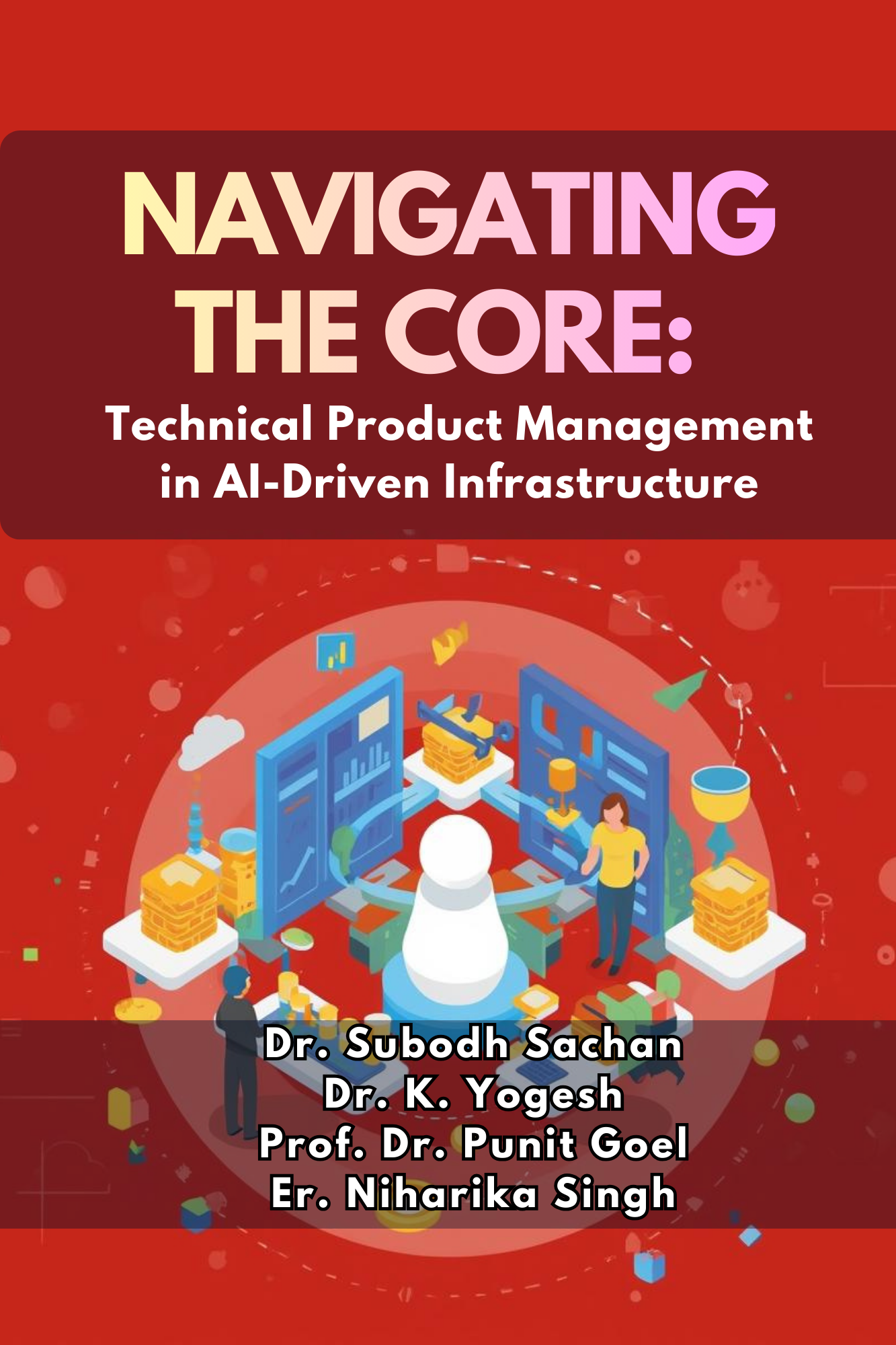
Navigating the Core: Technical Product Management in AI-Driven Infrastructure
Keywords:
Technical Product Management (TPM), AI-Driven Infrastructure, Cloud and Distributed Systems, Wissira Press, Wissira Press Academic Books, Wissira Press PublicationsSynopsis
Why This Book Now?
In today’s era of unprecedented technological acceleration, product management is no longer the sole domain of customer-facing apps or consumer-driven innovation. The backbone of modern enterprises—cloud infrastructure, distributed systems, and artificial intelligence (AI)—requires product leaders who can think both strategically and technically. Yet, many frameworks and conversations around product management continue to focus on surface-level experiences, leaving the crucial work of technical product managers (TPMs) in infrastructure and AI underexplored.
This book arises from a growing realization: the professionals who lead from the middle are shaping the future. These individuals do not always sit at the executive table, nor do they exclusively write production code. Instead, they thrive in the tension-filled space where engineering realities meet business ambitions. As AI technologies redefine industries and infrastructure underpin every digital experience, there is an urgent need for a guide that addresses the unique challenges and opportunities faced by TPMs in these domains.
From Experience to Practice
The ideas presented here are not theoretical abstractions but grounded in lived experience and practice. Over the past decade, I have witnessed firsthand how TPMs navigate trade-offs between scalability and speed, compliance and experimentation, innovation, and stability. Their influence is not always visible, yet it is deeply impactful. This book distills those lessons into practical strategies, frameworks, and case studies that readers can immediately apply to their own contexts.
By blending stories from cloud-native transformations, AI-driven product launches, and global-scale infrastructure projects, the book aims to connect abstract leadership principles with actionable steps. Each chapter is designed to move seamlessly from concepts to practice, equipping readers with tools to make better decisions, inspire teams, and deliver outcomes that matter.
Chapters
-
Chapter 1: The Essence of Leading from the Middle
-
Chapter 2: Foundations of Technical Fluency
-
Chapter 3: Stakeholder Management and Influence Without Authority
-
Chapter 4: Product Strategy in Infrastructure & AI
-
Chapter 5: Building the Product Roadmap
-
Chapter 6: Execution and Delivery Excellence
-
Chapter 7: Metrics, Measurement, and Success Criteria
-
Chapter 8: Leading Through Challenges
-
Chapter 9: The Future of Infrastructure & AI Product Management
Downloads
Published
License

This work is licensed under a Creative Commons Attribution 4.0 International License.
Creative Commons Attribution 4.0 International (CC BY 4.0) — License Terms
The Creative Commons Attribution 4.0 International License (CC BY 4.0) is one of the most permissive open licenses. It allows others to use, share, and build upon a work for any purpose—including commercial use—provided that proper credit is given to the original creator.
1. Permissions Granted
Under CC BY 4.0, anyone may:
a) Share
Copy and redistribute the material in any medium or format (print, digital, audio, video, etc.).
b) Adapt
Remix, transform, translate, or build upon the material.
c) Commercial Use Allowed
The work may be used for commercial purposes, including resale, inclusion in paid products, or monetized distribution.
d) No Additional Permission Required
Users do not need to contact the author for permission, as long as they follow the license conditions.
2. Attribution Requirements (Core Condition)
Users must give appropriate credit to the original creator. Attribution should include:
- Name of the author/creator
- Title of the work (if available)
- Source (publisher, website, or platform)
- Link to the original work (if online)
- Link to the CC BY 4.0 license
- Indication of any changes made
Example Attribution:
“Title of Work” by Author Name is licensed under CC BY 4.0.
Adapted from the original available at [URL].
3. Indicating Changes
If the material is modified, translated, shortened, or otherwise altered, users must clearly state that changes were made.
Examples:
- “Translated from the original”
- “Adapted from…”
- “Modified version of…”
4. No Additional Restrictions
Users may not:
- Apply legal terms or technological measures (such as DRM) that restrict others from exercising the license rights
- Impose new licensing conditions that contradict CC BY 4.0
5. Rights Not Covered by the License
CC BY 4.0 does not automatically grant:
- Patent rights
- Trademark rights
- Privacy or publicity rights
- Moral rights where they cannot be waived by law
Users must ensure compliance with these separately.
6. Disclaimer of Warranties
The material is provided “as-is.”
The licensor (author/publisher) gives no guarantees regarding accuracy, suitability, or fitness for any purpose.
7. Termination and Reinstatement
- The license remains valid as long as the terms are followed.
- If a user violates the terms (e.g., fails to attribute), the rights terminate automatically.
- Rights may be reinstated if the violation is corrected within 30 days of discovery.
8. International Scope
CC BY 4.0 is designed to work worldwide and is not limited to any specific country’s copyright law.
Suggested Copyright Notice Using CC BY 4.0
© [Year] [Author Name].
This work is licensed under the Creative Commons Attribution 4.0 International License (CC BY 4.0).
To view a copy of this license, visit: https://creativecommons.org/licenses/by/4.0/
You are free to share and adapt this work for any purpose, even commercially, provided that appropriate credit is given.









