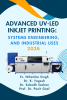
Advanced UV-LED Inkjet Printing: Systems Engineering, and Industrial Uses
Keywords:
UV-LED Inkjet Printing, Digital Printing Technology, UV-LED Curing Systems, Wissira Press, Books by Wissira, Wissira Research Lab, Wissira Press Academic BooksSynopsis
The evolution of digital manufacturing has redefined how modern industries design, decorate, personalize, and functionalize products. At the forefront of this transformation stands UV-LED inkjet printing—a technology that unites digital precision with energy-efficient ultraviolet curing to deliver high-performance, sustainable, and scalable printing solutions.
Advanced UV-LED Inkjet Printing: Systems Engineering and Industrial Uses is conceived as a comprehensive reference that explores this technology from an integrated systems perspective. While UV-LED inkjet printing is often appreciated for its exceptional print quality and instant curing capability, its true potential lies in the synergy between materials science, mechanical engineering, electronics integration, process control, and industrial application strategies. This book examines that synergy in depth.
UV-LED curing represents a significant leap beyond conventional mercury-based UV systems. By enabling lower-temperature processing, reduced power consumption, minimal maintenance, and extended lamp life, UV-LED systems align closely with global sustainability and environmental compliance objectives. Their ability to print on heat-sensitive substrates—including plastics, films, textiles, glass, metals, and composites—has expanded application possibilities across packaging, labelling, electronics, automotive interiors, architectural décor, biomedical devices, and additive manufacturing.
However, technological advancement is rarely a matter of hardware alone. True innovation emerges when systems engineering principles are applied to integrate printheads, ink formulations, curing modules, motion systems, software control, and workflow automation into optimized industrial platforms. This book therefore emphasizes the engineering architecture of UV-LED inkjet systems—covering droplet formation physics, ink rheology, curing kinetics, thermal management, substrate interaction, colour science, and inline quality assurance. By presenting both component-level analysis and system-level integration, it provides readers with a holistic understanding necessary for research, development, and large-scale deployment.
Industrial adoption further requires alignment with production economics, regulatory standards, and market demands. Accordingly, this volume also examines commercialization pathways, return-on-investment considerations, sustainability metrics, and emerging market opportunities. Real-world case discussions demonstrate how UV-LED inkjet printing enhances productivity, customization, and functional performance in diverse industrial contexts.
We extend our sincere appreciation to the contributors, reviewers, and institutions whose support has enriched this publication. It is our hope that Advanced UV-LED Inkjet Printing: Systems Engineering and Industrial Uses will serve as both a technical reference and an inspiration—advancing innovation, collaboration, and sustainable growth in the rapidly expanding world of UV-LED digital printing.
Chapters
-
Chapter 1: Introduction to UV LED Inkjet Printing Technology
-
Chapter 2: Chemistry of UV LED Inkjet Inks
-
Chapter 3: Formulation and Rheology of UV LED Inkjet Inks
-
Chapter 4: Substrate Compatibility and Surface Interaction
-
Chapter 5: Digital Finishing Systems: Mechanics and Design
-
Chapter 6: Print Quality and Process Control
-
Chapter 7: Environmental and Safety Considerations
-
Chapter 8: Market Applications in Packaging
-
Chapter 9: Textile and Apparel Printing Applications
-
Chapter 10: Electronics and Functional Printing
Downloads
Published
License

This work is licensed under a Creative Commons Attribution 4.0 International License.
Creative Commons Attribution 4.0 International (CC BY 4.0) — License Terms
The Creative Commons Attribution 4.0 International License (CC BY 4.0) is one of the most permissive open licenses. It allows others to use, share, and build upon a work for any purpose—including commercial use—provided that proper credit is given to the original creator.
1. Permissions Granted
Under CC BY 4.0, anyone may:
a) Share
Copy and redistribute the material in any medium or format (print, digital, audio, video, etc.).
b) Adapt
Remix, transform, translate, or build upon the material.
c) Commercial Use Allowed
The work may be used for commercial purposes, including resale, inclusion in paid products, or monetized distribution.
d) No Additional Permission Required
Users do not need to contact the author for permission, as long as they follow the license conditions.
2. Attribution Requirements (Core Condition)
Users must give appropriate credit to the original creator. Attribution should include:
- Name of the author/creator
- Title of the work (if available)
- Source (publisher, website, or platform)
- Link to the original work (if online)
- Link to the CC BY 4.0 license
- Indication of any changes made
Example Attribution:
“Title of Work” by Author Name is licensed under CC BY 4.0.
Adapted from the original available at [URL].
3. Indicating Changes
If the material is modified, translated, shortened, or otherwise altered, users must clearly state that changes were made.
Examples:
- “Translated from the original”
- “Adapted from…”
- “Modified version of…”
4. No Additional Restrictions
Users may not:
- Apply legal terms or technological measures (such as DRM) that restrict others from exercising the license rights
- Impose new licensing conditions that contradict CC BY 4.0
5. Rights Not Covered by the License
CC BY 4.0 does not automatically grant:
- Patent rights
- Trademark rights
- Privacy or publicity rights
- Moral rights where they cannot be waived by law
Users must ensure compliance with these separately.
6. Disclaimer of Warranties
The material is provided “as-is.”
The licensor (author/publisher) gives no guarantees regarding accuracy, suitability, or fitness for any purpose.
7. Termination and Reinstatement
- The license remains valid as long as the terms are followed.
- If a user violates the terms (e.g., fails to attribute), the rights terminate automatically.
- Rights may be reinstated if the violation is corrected within 30 days of discovery.
8. International Scope
CC BY 4.0 is designed to work worldwide and is not limited to any specific country’s copyright law.
Suggested Copyright Notice Using CC BY 4.0
© [Year] [Author Name].
This work is licensed under the Creative Commons Attribution 4.0 International License (CC BY 4.0).
To view a copy of this license, visit: https://creativecommons.org/licenses/by/4.0/
You are free to share and adapt this work for any purpose, even commercially, provided that appropriate credit is given.