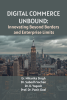
Digital Commerce Unbound: Innovating Beyond Borders and Enterprise Limits
Keywords:
Digital Commerce Ecosystems, Borderless Digital Trade, AI-Driven Commerce Platforms, Wissira Press, Books by Wissira, Wissira Academic Publications, Wissira Research LabSynopsis
We are living through a moment in history where commerce is no longer confined by geography, infrastructure, or institutional boundaries. Markets are no longer “entered” they are accessed instantly. Enterprises no longer scale gradually they expand exponentially. In this era of continuous digital acceleration, the question is not whether commerce will evolve, but how boldly organizations are willing to reimagine its limits.
Digital Commerce Unbound: Innovating Beyond Borders and Enterprise Limits emerges from this very inflection point. It is written for leaders, architects of transformation, policy thinkers, entrepreneurs, technologists, and scholars who recognize that digital commerce is no longer an extension of traditional business it is a new operating paradigm altogether.
The architecture of global trade has shifted. Artificial intelligence now anticipates consumer demand before it fully forms. Cloud-native infrastructures dissolve physical constraints. Blockchain technologies are redefining trust and transparency in cross-border transactions. Platform ecosystems orchestrate supply, distribution, payments, and personalization within unified digital environments. Meanwhile, fintech innovation is collapsing the distance between markets, enabling instant settlements, embedded finance, and decentralized financial participation at scale.
Yet the transformation of commerce is not merely technological it is structural and philosophical. Enterprises are moving beyond hierarchical silos toward composable architectures and API-driven ecosystems. Governance boards are navigating algorithmic accountability, data sovereignty, and ethical automation. Regulators are grappling with digital currencies, platform monopolies, and cross-border taxation. Consumers, empowered by hyper-connectivity, now demand personalization, transparency, and purpose in equal measure.
This book explores how organizations can innovate without being constrained by traditional enterprise boundaries. It examines AI-native commerce systems, real-time risk analytics, digital identity frameworks, dynamic pricing intelligence, cross-border compliance automation, decentralized marketplaces, and scalable cloud commerce infrastructures. Rather than treating innovation as a departmental initiative, we position it as a systemic transformation one that integrates strategy, technology, governance, and human experience into a cohesive digital fabric.
What distinguishes Digital Commerce Unbound is its integrated and forward-looking perspective. It bridges technical depth with strategic insight. It connects enterprise architecture with regulatory foresight. It aligns digital acceleration with ethical responsibility. Each chapter combines analytical rigor, practical frameworks, and real-world illustrations to equip readers with both conceptual clarity and operational direction.
This book invites you to step into that future unbound, adaptive, and strategically empowered.
Chapters
-
Chapter 1: The New Architecture of Global Commerce
-
Chapter 2: Artificial Intelligence in Commerce
-
Chapter 3: Blockchain and Decentralized Commerce
-
Chapter 4: Intelligent Supply Chains and Inventory Optimization
-
Chapter 5: Financial Innovation and Embedded Fintech
-
Chapter 6: Borderless Commerce and Global Market Access
-
Chapter 7: Human-Centered Design and Digital Experience
-
Chapter 8: Data Governance and Ethical AI
-
Chapter 9: Scaling Innovation Across Boards
-
Chapter 10: Future Horizons in Commerce
Downloads
References
Platform Revolution by Parker, Van Alstyne & Choudary
Fintech Innovation: From Robo-Advisors to Goal-Based Investing by Paolo Sironi
World Trade Organization: Trade Facilitation Agreement portal
OECD Digital Trade Reviews
Dr. Anita Kapoor, e-Commerce Strategy, Indian Institute of Management
Prof. Michael González, International Trade Law, University of Amsterdam
Published
License

This work is licensed under a Creative Commons Attribution 4.0 International License.
Creative Commons Attribution 4.0 International (CC BY 4.0) — License Terms
The Creative Commons Attribution 4.0 International License (CC BY 4.0) is one of the most permissive open licenses. It allows others to use, share, and build upon a work for any purpose—including commercial use—provided that proper credit is given to the original creator.
1. Permissions Granted
Under CC BY 4.0, anyone may:
a) Share
Copy and redistribute the material in any medium or format (print, digital, audio, video, etc.).
b) Adapt
Remix, transform, translate, or build upon the material.
c) Commercial Use Allowed
The work may be used for commercial purposes, including resale, inclusion in paid products, or monetized distribution.
d) No Additional Permission Required
Users do not need to contact the author for permission, as long as they follow the license conditions.
2. Attribution Requirements (Core Condition)
Users must give appropriate credit to the original creator. Attribution should include:
- Name of the author/creator
- Title of the work (if available)
- Source (publisher, website, or platform)
- Link to the original work (if online)
- Link to the CC BY 4.0 license
- Indication of any changes made
Example Attribution:
“Title of Work” by Author Name is licensed under CC BY 4.0.
Adapted from the original available at [URL].
3. Indicating Changes
If the material is modified, translated, shortened, or otherwise altered, users must clearly state that changes were made.
Examples:
- “Translated from the original”
- “Adapted from…”
- “Modified version of…”
4. No Additional Restrictions
Users may not:
- Apply legal terms or technological measures (such as DRM) that restrict others from exercising the license rights
- Impose new licensing conditions that contradict CC BY 4.0
5. Rights Not Covered by the License
CC BY 4.0 does not automatically grant:
- Patent rights
- Trademark rights
- Privacy or publicity rights
- Moral rights where they cannot be waived by law
Users must ensure compliance with these separately.
6. Disclaimer of Warranties
The material is provided “as-is.”
The licensor (author/publisher) gives no guarantees regarding accuracy, suitability, or fitness for any purpose.
7. Termination and Reinstatement
- The license remains valid as long as the terms are followed.
- If a user violates the terms (e.g., fails to attribute), the rights terminate automatically.
- Rights may be reinstated if the violation is corrected within 30 days of discovery.
8. International Scope
CC BY 4.0 is designed to work worldwide and is not limited to any specific country’s copyright law.
Suggested Copyright Notice Using CC BY 4.0
© [Year] [Author Name].
This work is licensed under the Creative Commons Attribution 4.0 International License (CC BY 4.0).
To view a copy of this license, visit: https://creativecommons.org/licenses/by/4.0/
You are free to share and adapt this work for any purpose, even commercially, provided that appropriate credit is given.