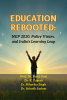
Education Rebooted: NEP 2020, Policy Vision, and India’s Learning Leap
Keywords:
National Education Policy (NEP) 2020, Education Reform in India, Learner-Centered Education, Wissira Press, Wissira Research Lab, Wissira Academic PublicationsSynopsis
Education has always been more than a system of schools, examinations, and degrees. It is a living social institution that shapes how individuals think, relate to one another, and imagine their futures. In India, education has historically carried the responsibility of preserving cultural continuity while enabling social mobility and national development. As the country enters a phase of rapid economic, technological, and demographic change, the need to rethink education has become both urgent and unavoidable.
The National Education Policy (NEP) 2020 represents a decisive moment in this journey. Rather than proposing incremental adjustments, it signals a structural and philosophical shift-one that redefines the purpose of learning, the role of teachers, the organization of institutions, and the relationship between education and society. This book, Education Rebooted: NEP, Policy Vision, and India’s Learning Leap, is written to examine this shift with clarity, balance, and depth.
The term “rebooted” is used deliberately. It reflects the recognition that many long-standing challenges-such as rote learning, rigid pathways, inequitable access, and skill mismatches-cannot be resolved through surface-level reform. What is required is a systemic reorientation that places the learner at the centre, values flexibility and inclusion, and aligns education with the realities of a complex and uncertain world. This book explores how NEP attempts to address these challenges while opening new possibilities for teaching, learning, and institutional design.
This volume is intended for a wide audience that includes students, teachers, teacher educators, policymakers, researchers, and readers interested in understanding contemporary education reform in India. The chapters are written in an accessible yet academically grounded manner, avoiding technical excess while maintaining conceptual rigor. Policy ideas are explained not only in terms of what they propose, but why they matter and how they can influence lived educational experiences.
Rather than treating NEP as a static document, this book approaches it as a guiding framework-one whose success depends on thoughtful implementation, contextual adaptation, and continuous reflection. Throughout the chapters, education is presented as a shared societal responsibility, shaped by collaboration between institutions, communities, and individuals.
Ultimately, Education Rebooted invites readers to view education not merely as preparation for employment, but as a foundation for ethical reasoning, democratic participation, social justice, and lifelong growth. India’s learning leap, as envisioned here, is not a single policy outcome but an ongoing national endeavour-one that demands commitment, imagination, and collective effort.
It is hoped that this book will contribute meaningfully to conversations around education reform and inspire informed engagement with the ideas shaping India’s educational future.
Chapters
-
Chapter-1 Reimagining Education in a Transforming India
-
Chapter-2 The Philosophy and Vision of the National Education Policy
-
Chapter-3 Early Childhood Care and Foundational Learning Reform
-
Chapter-4 Curriculum, Pedagogy, and Assessment Transformation
-
Chapter-5 Multidisciplinary, Flexibility, and Academic Mobility
-
Chapter-6 Teachers at the Core: Professional Development and Empowerment
-
Chapter-7 Digital Education, Technology, and EdTech Integration
-
Chapter-8 Equity, Inclusion, and Education for Social Justice
-
Chapter-9 India’s Learning Leap – Implementation, Challenges, and the Road Ahead
Downloads
References
Ministry of Education. (2020). National Education Policy 2020. Government of India.
https://www.education.gov.in/sites/upload_files/mhrd/files/NEP_Final_English_0.pdf
World Bank. (2018). World Development Report: Learning to Realize Education’s Promise.
https://www.worldbank.org/en/publication/wdr2018
UNESCO. (2015). Rethinking Education: Towards a Global Common Good?
https://unesdoc.unesco.org/ark:/48223/pf0000232555
Ministry of Education. (2020). National Education Policy 2020 (Vision & Guiding Principles sections).
https://www.education.gov.in/nep/about-nep
UNESCO. (2021). Reimagining Our Futures Together: A New Social Contract for Education.
https://www.unesco.org/en/futures-education
Delors, J. et al. (1996). Learning: The Treasure Within. **UNESCO.
https://unesdoc.unesco.org/ark:/48223/pf0000109590
NITI Aayog. (2021). National Multidimensional Poverty Index – India.
https://www.niti.gov.in/multidimensional-poverty-index
UNICEF. (2019). Early Childhood Development: The Key to a Full and Productive Life.
https://www.unicef.org/early-childhood-development
ASER Centre. (2022). Annual Status of Education Report (Rural).
https://asercentre.org/aser-reports/
NCERT. (2021). Curricular Frameworks aligned to NEP 2020.
Black, P., & Wiliam, D. (1998). Assessment and Classroom Learning. Assessment in Education, 5(1), 7–74.
https://doi.org/10.1080/0969595980050102
OECD. (2018). The Future of Education and Skills: Education 2030.
https://www.oecd.org/education/2030/
University Grants Commission. (2021). Guidelines on Academic Bank of Credits.
OECD. (2019). Trends Shaping Education.
https://www.oecd.org/education/trends-shaping-education/
Barnett, R. (2011). Being a University. Routledge.
https://www.routledge.com/Being-a-University/Barnett/p/book/9780415578547
Ministry of Education. (2021). National Professional Standards for Teachers (Draft).
Darling-Hammond, L. (2017). Teacher Education Around the World. European Journal of Teacher Education, 40(3).
https://doi.org/10.1080/02619768.2017.1315399
UNESCO. (2017). Teaching and Learning: Achieving Quality for All.
https://unesdoc.unesco.org/ark:/48223/pf0000247564
Ministry of Education. (2021). DIKSHA Platform Documentation.
World Bank. (2020). Remote Learning and COVID-19.
https://www.worldbank.org/en/topic/edutech
Selwyn, N. (2016). Education and Technology: Key Issues and Debates. Bloomsbury.
https://www.bloomsbury.com/education-and-technology-9781474246372/
UNESCO. (2020). Global Education Monitoring Report: Inclusion and Education.
https://www.unesco.org/gem-report/en/2020-inclusion
Sen, A. (1999). Development as Freedom. Oxford University Press.
https://global.oup.com/academic/product/development-as-freedom-9780198297581
NITI Aayog. (2022). India @75: Education Roadmap.
OECD. (2020). Education Policy Outlook.
Published
License

This work is licensed under a Creative Commons Attribution 4.0 International License.
Creative Commons Attribution 4.0 International (CC BY 4.0) — License Terms
The Creative Commons Attribution 4.0 International License (CC BY 4.0) is one of the most permissive open licenses. It allows others to use, share, and build upon a work for any purpose—including commercial use—provided that proper credit is given to the original creator.
1. Permissions Granted
Under CC BY 4.0, anyone may:
a) Share
Copy and redistribute the material in any medium or format (print, digital, audio, video, etc.).
b) Adapt
Remix, transform, translate, or build upon the material.
c) Commercial Use Allowed
The work may be used for commercial purposes, including resale, inclusion in paid products, or monetized distribution.
d) No Additional Permission Required
Users do not need to contact the author for permission, as long as they follow the license conditions.
2. Attribution Requirements (Core Condition)
Users must give appropriate credit to the original creator. Attribution should include:
- Name of the author/creator
- Title of the work (if available)
- Source (publisher, website, or platform)
- Link to the original work (if online)
- Link to the CC BY 4.0 license
- Indication of any changes made
Example Attribution:
“Title of Work” by Author Name is licensed under CC BY 4.0.
Adapted from the original available at [URL].
3. Indicating Changes
If the material is modified, translated, shortened, or otherwise altered, users must clearly state that changes were made.
Examples:
- “Translated from the original”
- “Adapted from…”
- “Modified version of…”
4. No Additional Restrictions
Users may not:
- Apply legal terms or technological measures (such as DRM) that restrict others from exercising the license rights
- Impose new licensing conditions that contradict CC BY 4.0
5. Rights Not Covered by the License
CC BY 4.0 does not automatically grant:
- Patent rights
- Trademark rights
- Privacy or publicity rights
- Moral rights where they cannot be waived by law
Users must ensure compliance with these separately.
6. Disclaimer of Warranties
The material is provided “as-is.”
The licensor (author/publisher) gives no guarantees regarding accuracy, suitability, or fitness for any purpose.
7. Termination and Reinstatement
- The license remains valid as long as the terms are followed.
- If a user violates the terms (e.g., fails to attribute), the rights terminate automatically.
- Rights may be reinstated if the violation is corrected within 30 days of discovery.
8. International Scope
CC BY 4.0 is designed to work worldwide and is not limited to any specific country’s copyright law.
Suggested Copyright Notice Using CC BY 4.0
© [Year] [Author Name].
This work is licensed under the Creative Commons Attribution 4.0 International License (CC BY 4.0).
To view a copy of this license, visit: https://creativecommons.org/licenses/by/4.0/
You are free to share and adapt this work for any purpose, even commercially, provided that appropriate credit is given.