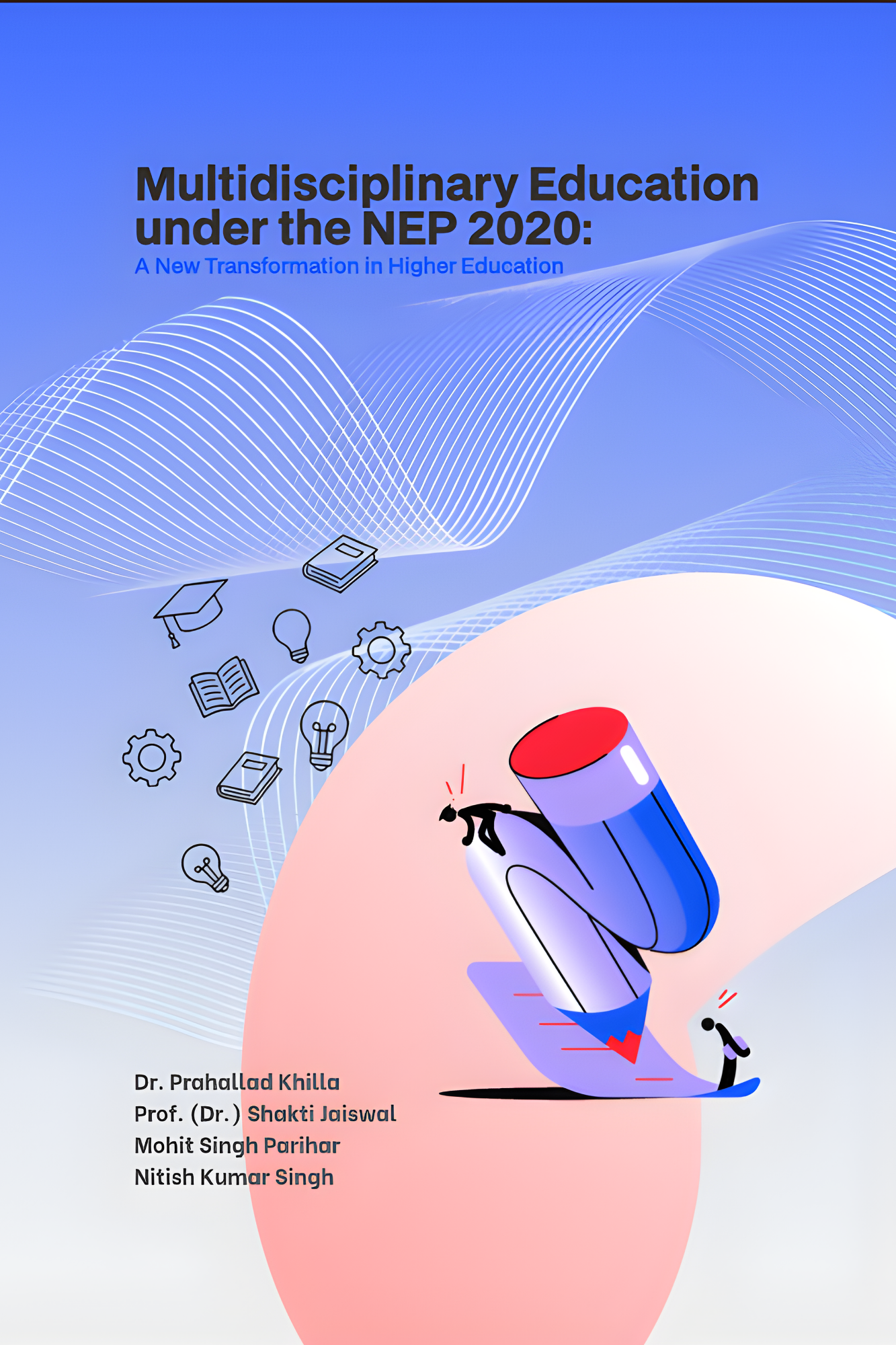
Multidisciplinary Education under the NEP 2020: A New Transformation in Higher Education
Keywords:
Multidisciplinary Education, Holistic Learning, Skill-Based Education, Wissira Press Academic Books, Books by Wissira, Wissira Press PublicationsSynopsis
Higher education across the world is undergoing a profound transformation, driven by rapid technological change, shifting economic demands, and the increasing complexity of global challenges. In India, this transformation has taken a decisive direction through the National Education Policy (NEP) 2020, which envisions a holistic, flexible, and multidisciplinary approach to learning. This book, Multidisciplinary Education under the NEP 2020: A New Transformation in Higher Education, seeks to explore the philosophical foundations, structural reforms, practical implications, and future possibilities associated with this landmark policy.
For decades, higher education in India largely followed compartmentalized disciplinary structures, where students were expected to specialize narrowly within predefined academic boundaries. While this system produced competent professionals, it often limited creativity, adaptability, and cross-domain understanding. In contrast, contemporary problems-ranging from climate change and public health to artificial intelligence and social equity-demand integrated perspectives that draw upon multiple fields of knowledge. NEP 2020 responds to this need by promoting multidisciplinary universities, flexible curricula, and learner-centred pedagogies designed to cultivate well-rounded individuals capable of critical thinking and innovation.
This book has been written with the intention of providing a comprehensive yet accessible examination of multidisciplinary education as envisioned by NEP 2020. It traces the historical evolution of higher education in India, explains the policy’s guiding principles, and analyses its emphasis on academic flexibility, integration of liberal arts with professional education, and the role of digital technologies. Particular attention is given to institutional reforms, governance changes, skill development initiatives, and the strengthening of research culture. By presenting both opportunities and challenges, the book aims to offer a balanced perspective on the practical realities of implementing such large-scale reforms.
The content is designed to serve a wide audience, including policymakers, educators, administrators, researchers, and students. Teachers and institutional leaders may find insights useful for curriculum design and organizational transformation, while students can gain a clearer understanding of how the new system expands their academic choices and career possibilities. Researchers and scholars may also benefit from the analytical discussions and references that connect Indian reforms with global educational trends.
Multidisciplinary education is not merely an administrative restructuring of universities; it represents a shift in the philosophy of learning itself. It emphasizes intellectual curiosity, ethical awareness, creativity, and the capacity to collaborate across diverse fields. By encouraging students to explore subjects beyond their primary specialization, the new framework aims to nurture individuals who can contribute meaningfully to society while adapting to an unpredictable future.
At the same time, the transition to such a system is complex and requires sustained commitment from all stakeholders. Issues such as infrastructure development, faculty preparedness, equitable access, and digital inclusion must be addressed to ensure that the envisioned transformation benefits all segments of society. This book therefore also highlights the practical constraints and suggests pathways for effective implementation.
Ultimately, the success of NEP 2020 will depend on how well institutions translate policy intentions into educational practice. The goal is not only to produce employable graduates but also to cultivate responsible citizens, innovative thinkers, and lifelong learners. If implemented thoughtfully, multidisciplinary education has the potential to strengthen India’s knowledge economy, enhance global competitiveness, and promote inclusive social progress.
It is hoped that this book will contribute to informed dialogue, critical reflection, and constructive action in the field of higher education. By bringing together historical insights, policy analysis, and forward-looking perspectives, it aims to serve as a useful resource for understanding one of the most significant educational reforms in contemporary India.
Chapters
-
Chapter-1 Evolution of Higher Education in India
-
Chapter-2 Vision and Framework of NEP 2020
-
Chapter-3 Concept of Multidisciplinary Education
-
Chapter-4 Curriculum Reforms and Academic Flexibility
-
Chapter-5 Integration of Liberal Arts, Sciences, and Professional Education
-
Chapter-6 Role of Technology and Digital Learning
-
Chapter-7 Institutional Transformation and Governance
-
Chapter-8 Skill Development, Employability, and Research Innovation
-
Chapter-9 Challenges, Opportunities, and Future Directions
Downloads
References
Altekar, A. S. (2009). Education in Ancient India. Delhi: Isha Books.
Keay, F. E. (1966). A History of Education in India and Pakistan. Oxford University Press.
Kumar, K. (2005). Political Agenda of Education: A Study of Colonialist and Nationalist Ideas. Sage Publications.
Government of India. (2020). National Education Policy 2020. Ministry of Education. https://www.education.gov.in
Kasturirangan Committee. (2019). Draft National Education Policy. Ministry of Human Resource Development.
OECD. (2019). Education Policy Outlook: India. Organisation for Economic Co-operation and Development.
Klein, J. T. (2010). Creating Interdisciplinary Campus Cultures. Jossey-Bass.
Newell, W. H. (2013). The state of the field: Interdisciplinary theory. Issues in Integrative Studies, 31, 22–43.
Repko, A. F., Szostak, R., & Buchberger, M. P. (2017). Introduction to Interdisciplinary Studies. Sage Publications.
University Grants Commission (UGC). (2021). Academic Bank of Credits: Guidelines. New Delhi.
UGC. (2015). Choice Based Credit System (CBCS) Guidelines. Government of India.
Altbach, P. G., Reisberg, L., & Rumbley, L. (2009). Trends in Global Higher Education. UNESCO.
Nussbaum, M. C. (2010). Not for Profit: Why Democracy Needs the Humanities. Princeton University Press.
Rothblatt, S. (1997). The Modern University and Its Discontents. Cambridge University Press.
Colby, A., Ehrlich, T., Sullivan, W., & Dolle, J. (2011). Rethinking Undergraduate Business Education. Jossey-Bass.
Bates, A. W. (2019). Teaching in a Digital Age. BCcampus.
Selwyn, N. (2016). Education and Technology: Key Issues and Debates. Bloomsbury Academic.
UNESCO. (2020). Education in a Post-COVID World. UNESCO Publishing.
Altbach, P. G., & Salmi, J. (2011). The Road to Academic Excellence. World Bank Publications.
Shattock, M. (2010). Managing Successful Universities. Open University Press.
Varghese, N. V. (2013). Governance reforms in higher education. UNESCO International Institute for Educational Planning.
World Economic Forum. (2020). The Future of Jobs Report.
National Skill Development Corporation (NSDC). (2019). Skill India Report. Government of India.
Yorke, M. (2006). Employability in higher education. Higher Education Academy.
Tilak, J. B. G. (2015). Higher education in India: Challenges and opportunities. Economic and Political Weekly.
Varghese, N. V. (2015). Challenges of massification of higher education. UNESCO IIEP.
World Bank. (2018). World Development Report: Learning to Realize Education’s Promise.
Downloads
Published
License

This work is licensed under a Creative Commons Attribution 4.0 International License.
Creative Commons Attribution 4.0 International (CC BY 4.0) — License Terms
The Creative Commons Attribution 4.0 International License (CC BY 4.0) is one of the most permissive open licenses. It allows others to use, share, and build upon a work for any purpose—including commercial use—provided that proper credit is given to the original creator.
1. Permissions Granted
Under CC BY 4.0, anyone may:
a) Share
Copy and redistribute the material in any medium or format (print, digital, audio, video, etc.).
b) Adapt
Remix, transform, translate, or build upon the material.
c) Commercial Use Allowed
The work may be used for commercial purposes, including resale, inclusion in paid products, or monetized distribution.
d) No Additional Permission Required
Users do not need to contact the author for permission, as long as they follow the license conditions.
2. Attribution Requirements (Core Condition)
Users must give appropriate credit to the original creator. Attribution should include:
- Name of the author/creator
- Title of the work (if available)
- Source (publisher, website, or platform)
- Link to the original work (if online)
- Link to the CC BY 4.0 license
- Indication of any changes made
Example Attribution:
“Title of Work” by Author Name is licensed under CC BY 4.0.
Adapted from the original available at [URL].
3. Indicating Changes
If the material is modified, translated, shortened, or otherwise altered, users must clearly state that changes were made.
Examples:
- “Translated from the original”
- “Adapted from…”
- “Modified version of…”
4. No Additional Restrictions
Users may not:
- Apply legal terms or technological measures (such as DRM) that restrict others from exercising the license rights
- Impose new licensing conditions that contradict CC BY 4.0
5. Rights Not Covered by the License
CC BY 4.0 does not automatically grant:
- Patent rights
- Trademark rights
- Privacy or publicity rights
- Moral rights where they cannot be waived by law
Users must ensure compliance with these separately.
6. Disclaimer of Warranties
The material is provided “as-is.”
The licensor (author/publisher) gives no guarantees regarding accuracy, suitability, or fitness for any purpose.
7. Termination and Reinstatement
- The license remains valid as long as the terms are followed.
- If a user violates the terms (e.g., fails to attribute), the rights terminate automatically.
- Rights may be reinstated if the violation is corrected within 30 days of discovery.
8. International Scope
CC BY 4.0 is designed to work worldwide and is not limited to any specific country’s copyright law.
Suggested Copyright Notice Using CC BY 4.0
© [Year] [Author Name].
This work is licensed under the Creative Commons Attribution 4.0 International License (CC BY 4.0).
To view a copy of this license, visit: https://creativecommons.org/licenses/by/4.0/
You are free to share and adapt this work for any purpose, even commercially, provided that appropriate credit is given.









