

Chapter-2 Memory and Learning: The Cognitive Architecture
Synopsis
Theories of Memory
Memory is a cornerstone of human cognition. Several theories attempt to explain how memory works, such as the multi-store model, which divides memory into sensory, short-term, and long-term stores. The working memory model further refines this by proposing that short-term memory is an active system with components for processing auditory and visual-spatial information.
Memory is an essential aspect of human cognition, serving as the foundation for learning, decision-making, and problem-solving. Multiple theories have been proposed to explain how memory functions, each contributing to a deeper understanding of its processes.
One influential theory is the multi-store model of memory, which was first introduced by Atkinson and Shiffrin in 1968. This model divides memory into three distinct stores: sensory memory, short-term memory, and long-term memory. Sensory memory captures fleeting impressions of the environment and holds them for a very brief period (milliseconds to seconds). Information that is paid attention to moves from sensory memory to short-term memory, which has limited capacity and retains information for a few seconds to minutes. If this information is rehearsed, it can be transferred into long-term memory, where it is stored more permanently.
An extension of the multi-store model is the working memory model, proposed by Baddeley and Hitch in 1974. This model refines the concept of short-term memory by suggesting that it is an active system with separate components for processing different types of information. These include the phonological loop, which processes auditory information; the visuospatial sketchpad, which handles visual and spatial data; and the central executive, which coordinates and integrates these components. Working memory emphasizes that memory is not just a passive repository but an active, dynamic system where information is actively manipulated.
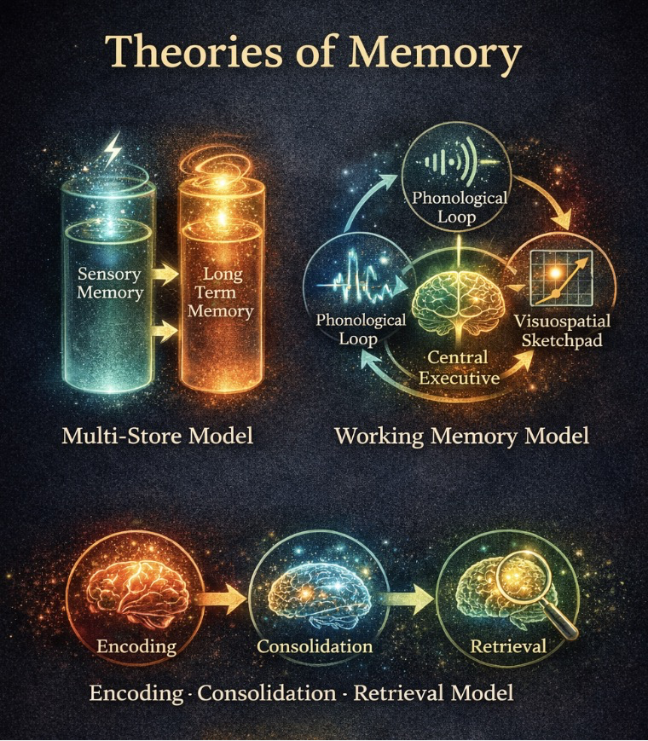
More recent theories of memory, such as the encoding, consolidation, and retrieval model, focus on the stages of memory processing. Encoding refers to the process of transforming sensory input into a form that can be stored. Consolidation involves the stabilization of memories over time, particularly through rehearsal and the formation of neural connections. Retrieval is the process of accessing stored information when needed. This model suggests that memory is not a perfect recording of past events but rather a reconstructive process, influenced by various factors like attention, prior knowledge, and the context in which the memory is retrieved.
These theories illustrate the complexity of memory and highlight the fact that memory is not a static storage system but an active and dynamic cognitive process. By integrating these theories, psychologists continue to gain insights into how memories are formed, retained, and retrieved, as well as the factors that influence memory accuracy and recall.

Published
January 7, 2026
Copyright (c) 2026 Wissira Press
How to Cite
Chapter-2 Memory and Learning: The Cognitive Architecture. (2026). In Cognitive Footprints: Tracing Human Nature Through Psychology. Wissira Press. https://books.wissira.us/index.php/WIL/catalog/book/54/chapter/414








