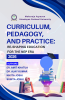
Curriculum, Pedagogy, and Practice: Re-shaping Education for the NEP Era
Keywords:
Curriculum reform, Pedagogical innovation, Educational transformation, Wissira Press, Books by Wissira, Wissira Research LabSynopsis
Education has always been the cornerstone of social progress and national development. In India, the National Education Policy (NEP) 2020 represents a landmark reform, seeking to transform the education system into one that is flexible, multidisciplinary, and learner-centric. This book, Curriculum, Pedagogy, and Practice: Re-shaping Education for the NEP Era, has been written with the aim of interpreting this transformation and providing a comprehensive understanding of the paradigms that will guide teaching and learning in the years to come.
The authors recognize that curriculum design, pedagogical innovation, and practical implementation are deeply interconnected. Without relevant curricula, pedagogy loses direction; without innovative pedagogy, even the best curricula remain ineffective; and without meaningful practice, reforms risk becoming only policy rhetoric. It is within this triad—curriculum, pedagogy, and practice—that NEP 2020’s promise of holistic, equitable, and future-ready education will be realized.
This volume seeks to bridge theory with practice by examining the vision of NEP 2020 alongside classroom realities. Each chapter provides readers with a structured exploration: from the philosophical underpinnings of the policy to its implications for curriculum redesign, pedagogical strategies, early childhood care, use of technology, inclusivity, assessments, vocational education, and higher education reform. Case studies, examples, and contextual insights have been included to highlight how these reforms can be translated into actionable strategies.
The book is intended for a wide audience—teachers, educationists, researchers, policymakers, and students of education—who are committed to understanding and contributing to India’s educational transformation. It is our belief that by embracing creativity, collaboration, and inclusivity, Indian education can align with global standards while staying true to its cultural roots.
As authors, we have been guided by a shared vision: to contribute meaningfully to the discourse on educational reform and to inspire practitioners to see NEP 2020 not as a challenge but as an opportunity to reshape education for the better. We hope that this work serves as a valuable resource in navigating the exciting journey of reimagining Indian education.
Chapters
-
Chapter 1: The Vision of NEP 2020 – A Paradigm Shift in Indian Education
-
Chapter 2: Re-imagining Curriculum for Holistic and Multidisciplinary Learning
-
Chapter 3: Pedagogical Innovations in the NEP Era
-
Chapter 4: Early Childhood Care and Education – The Foundation of Learning
-
Chapter 5: Harnessing Technology in Education – Digital Classrooms and Beyond
-
Chapter 6: Teachers at the Heart of Transformation
-
Chapter 7: Inclusive and Equitable Education for All
-
Chapter 8: Assessments and Examinations – Redefining Student Evaluation
-
Chapter 9: Vocational Education and Skill Development – Bridging the Employability Gap
Downloads
References
Ministry of Education (2020). National Education Policy 2020. Government of India.
Jhingran, D. (2021). “Understanding the Paradigm Shift of NEP 2020.” Journal of Education Policy Studies, 18(2), 45–58.
National Council of Educational Research and Training (NCERT). (2021). Draft National Curriculum Framework.
Bruner, J. (1996). The Culture of Education. Harvard University Press.
Dewey, J. (1938). Experience and Education. Macmillan.
Kumar, R., & Sharma, A. (2021). “Competency-Based Education in Indian Schools.” Contemporary Education Dialogue, 18(1), 1–15.
UNESCO (2019). Futures of Education: Learning to Become. Paris: UNESCO.
UNICEF (2019). The State of the World’s Children: Children, Food, and Nutrition.
Kaul, V. (2021). “ECCE in India: Policies and Practices.” Early Childhood Education Journal, 49(6), 1035–1047.
Rao, N., & Sun, J. (2019). Early Childhood Development and Education in South Asia. Springer.
Ministry of Education (2021). Digital Infrastructure for Knowledge Sharing (DIKSHA) Report.
Selwyn, N. (2016). Education and Technology: Key Issues and Debates. Bloomsbury.
Sharma, P. (2022). “Digital Pedagogy in Post-Pandemic India.” International Journal of Educational Technology, 14(2), 55–72.
Ministry of Education (2022). National Professional Standards for Teachers (NPST).
Fullan, M. (1993). The New Meaning of Educational Change. Teachers College Press.
Jain, S. (2021). “Teacher Professional Development in the NEP Framework.” Indian Educational Review, 58(1), 65–80.
UNESCO (2020). Global Education Monitoring Report: Inclusion and Education.
Nair, P. (2021). “Inclusive Classrooms in India Post-NEP.” Journal of Inclusive Education, 9(2), 112–126.
Government of India (2021). Samagra Shiksha Abhiyan Guidelines.
CBSE (2021). Competency-Based Question Bank. Central Board of Secondary Education.
Black, P., & Wiliam, D. (1998). “Assessment and Classroom Learning.” Assessment in Education: Principles, Policy & Practice, 5(1), 7–74.
National Council of Educational Research and Training (NCERT). (2022). Holistic Report Card Framework.
Ministry of Skill Development and Entrepreneurship (MSDE). (2021). Skill India Annual Report.
Ra, S., Shrestha, U., & Khatiwada, S. (2019). The Promise of Skills Training in India: Evidence from the NSDC. Asian Development Bank.
Mehrotra, S. (2020). “Vocational Education in NEP 2020: Opportunities and Challenges.” Economic & Political Weekly, 55(41).
Published
License

This work is licensed under a Creative Commons Attribution 4.0 International License.
Creative Commons Attribution 4.0 International (CC BY 4.0) — License Terms
The Creative Commons Attribution 4.0 International License (CC BY 4.0) is one of the most permissive open licenses. It allows others to use, share, and build upon a work for any purpose—including commercial use—provided that proper credit is given to the original creator.
1. Permissions Granted
Under CC BY 4.0, anyone may:
a) Share
Copy and redistribute the material in any medium or format (print, digital, audio, video, etc.).
b) Adapt
Remix, transform, translate, or build upon the material.
c) Commercial Use Allowed
The work may be used for commercial purposes, including resale, inclusion in paid products, or monetized distribution.
d) No Additional Permission Required
Users do not need to contact the author for permission, as long as they follow the license conditions.
2. Attribution Requirements (Core Condition)
Users must give appropriate credit to the original creator. Attribution should include:
- Name of the author/creator
- Title of the work (if available)
- Source (publisher, website, or platform)
- Link to the original work (if online)
- Link to the CC BY 4.0 license
- Indication of any changes made
Example Attribution:
“Title of Work” by Author Name is licensed under CC BY 4.0.
Adapted from the original available at [URL].
3. Indicating Changes
If the material is modified, translated, shortened, or otherwise altered, users must clearly state that changes were made.
Examples:
- “Translated from the original”
- “Adapted from…”
- “Modified version of…”
4. No Additional Restrictions
Users may not:
- Apply legal terms or technological measures (such as DRM) that restrict others from exercising the license rights
- Impose new licensing conditions that contradict CC BY 4.0
5. Rights Not Covered by the License
CC BY 4.0 does not automatically grant:
- Patent rights
- Trademark rights
- Privacy or publicity rights
- Moral rights where they cannot be waived by law
Users must ensure compliance with these separately.
6. Disclaimer of Warranties
The material is provided “as-is.”
The licensor (author/publisher) gives no guarantees regarding accuracy, suitability, or fitness for any purpose.
7. Termination and Reinstatement
- The license remains valid as long as the terms are followed.
- If a user violates the terms (e.g., fails to attribute), the rights terminate automatically.
- Rights may be reinstated if the violation is corrected within 30 days of discovery.
8. International Scope
CC BY 4.0 is designed to work worldwide and is not limited to any specific country’s copyright law.
Suggested Copyright Notice Using CC BY 4.0
© [Year] [Author Name].
This work is licensed under the Creative Commons Attribution 4.0 International License (CC BY 4.0).
To view a copy of this license, visit: https://creativecommons.org/licenses/by/4.0/
You are free to share and adapt this work for any purpose, even commercially, provided that appropriate credit is given.









